



EU moves to scrap grace period for nuclear plant rules
Oct 28, 2026, 05:20 pm


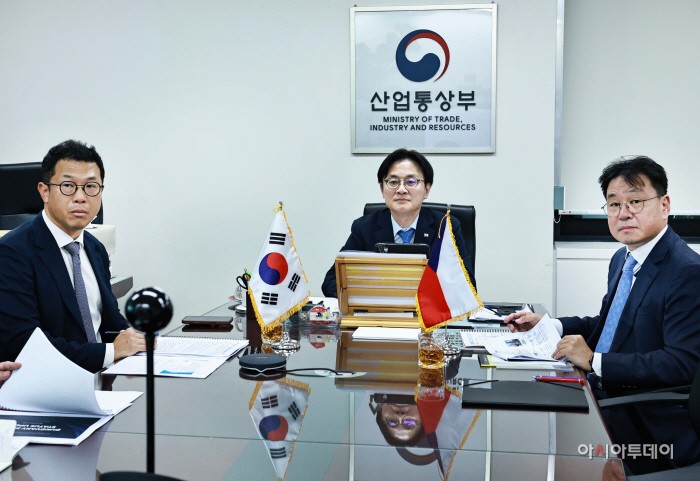 |
| Kim Jung-kwan, Korea's Minister of Trade, Industry and Energy, holds a video meeting with Czech Minister of Industry and Trade Karel Havlíček for the third Dukovany Steering Committee meeting at his office in the Government Complex Seoul on Oct. 20. / Courtesy of the Ministry of Trade, Industry and Energy |
The European Parliament has prepared an amendment that would bring forward the requirement to use key European-made components in new nuclear power plants by four years, increasing the burden on Korean companies seeking to export nuclear power technology to Europe. The Temelín nuclear power project in the Czech Republic and the Kozloduy project in Bulgaria still face final contract negotiations and government support procedures, meaning the new regulations could take effect before these steps are completed. The French industry is also pressing for earlier implementation.
According to European Parliament documents released on Oct. 28, an amendment to the Industrial Accelerator Act (IAA) proposed in September would require nuclear power plants to use key European-made components immediately after the law takes effect, increasing the number of mandatory components from two to three. The requirement would expand to four components after three years. The amendment eliminates the four-year grace period included in the European Commission's original proposal. Whether the requirements apply would depend on when public procurement notices are issued or applications for nuclear construction support are submitted.
European Parliament officials expect to reach an agreement with the Council of the European Union on key provisions of the bill by March next year. If the legislation subsequently takes effect in 2027, the component requirements originally scheduled to apply after 2031 would be brought forward by four years. The implementation date has therefore become important even for Korean companies already involved in projects, as they must still complete subsequent procurement and support procedures.
For Units 3 and 4 of the Temelín nuclear power plant in the Czech Republic, the government plans to decide in 2027 whether to proceed with construction, followed by a review of proposals from Czech energy company ČEZ before determining a final project plan in 2028. In its investment prospectus this year, ČEZ stated that the project had been temporarily suspended pending decisions on the need for new nuclear power plants and government financial support. As the government must still decide whether to resume the project and complete subsequent procurement and support procedures, the new regulations could take effect before those steps are completed.
Korea Hydro & Nuclear Power (KHNP) secured preferential negotiation rights for the construction of two additional units at Temelín through its Dukovany nuclear power plant contract. However, those rights are not legally binding and must be converted into a final contract depending on the Czech government's decision. As the option secured during the original contractor selection process does not guarantee future procurement or government support procedures, adoption of the amendment removing the grace period could also affect the conditions under which Korean-made equipment and components are supplied.
Bulgaria's Kozloduy nuclear power plant Units 7 and 8 had aimed to transition to a main construction contract in 2027, but the new government is comprehensively reviewing the existing project plan, including costs and construction schedules. An audit of the project company uncovered excessive spending and workforce expansion, leading to management changes and a review of existing contracts. The new management submitted a revised financial model and construction schedule to the government, but even a proposed 14-month extension of the technical design contract held by the Westinghouse-Hyundai Engineering & Construction consortium failed to secure approval from higher authorities.
The EU state aid approval process was also left unfinished by the previous government and is now subject to review by the new administration. As of Oct. 1, no application for approval of state aid or government guarantees had been submitted to the European Commission. Even if applications are submitted later, approval could take more than a year, potentially disrupting the target of signing the main construction contract in 2027. If the Industrial Accelerator Act takes effect that same year, the stricter European-made component requirements could also apply to subsequent procurement and construction support procedures.
The burden on Korean companies involved in European nuclear power projects is growing further amid pressure from the French industry for tighter regulations. In July, the French Union of Electricity (UFE) called for the use of four key European-made components to become mandatory immediately upon the law's entry into force, in time for the selection of contractors for new nuclear power projects around 2028. Its demands go further than the European Parliament's amendment, with the organization also insisting that ownership and intellectual property rights of component manufacturers remain with European companies.
Even if requirements for European-made components are strengthened, the extent to which Korean-made equipment and components will be recognized will be determined during the final legislative process. Korea's Ministry of Trade, Industry and Energy is continuing diplomatic consultations to secure equal treatment for Korean-made components, citing the Korea-EU Free Trade Agreement (FTA) and bilateral supply chain cooperation. Ministry officials met with key European Parliament members on Oct. 20 and 21 and called for sufficient transition periods and reasonable exemptions for strategic industries, including nuclear power, at the Korea-EU FTA Committee on Trade in Goods.
Last month, Minister Kim Jung-kwan met with Stéphane Séjourné, the European Commission's Executive Vice-President, to express concerns about the Industrial Accelerator Act's stricter requirements for locally produced components. Kim emphasized that the principle of equivalence should be applied consistently to FTA partners such as Korea.
"Korea and the EU are important partners that can jointly contribute to stabilizing global supply chains and strengthening industrial competitiveness based on their complementary strengths," Kim said. "I look forward to achieving tangible results through our cooperation."
Jeong Soon-young
Most Read
-
1
Putin proposes trilateral U.S.-China-Russia summit..

-
2
U.S. weighs dropping MOAB, world's most powerful n..

-
3
"Aren't those foreigners on welfare?": M..

-
4
Attention centers on APEC for possible Trump-Xi-Pu..

-
5
U.S., Israel plan to resume strikes on Iran after..

-
6
China tightens grip on boosting domestic demand an..

-
7
Amid health rumors, Chinese President Xi Jinping i..

PEOPLE







-
Address : In-Young Bldg., 34, Uisadang-daero 1-gil, Yeongdeungpo-gu, Seoul
Copyright by ASIATODAY CO., LTD. All rights resereved