



Foreign residents in Korea hit record 2.66 million
Oct 28, 2026, 04:22 pm


 |
The number of foreign residents in Korea surpassed 2.66 million, reaching an all-time high. They accounted for 5.1% of the country's total population, or roughly one in every 20 residents. International students led the increase, with their numbers rising by more than 40,000 over the past year, while areas with high concentrations of foreign residents expanded, particularly outside the Seoul metropolitan area.
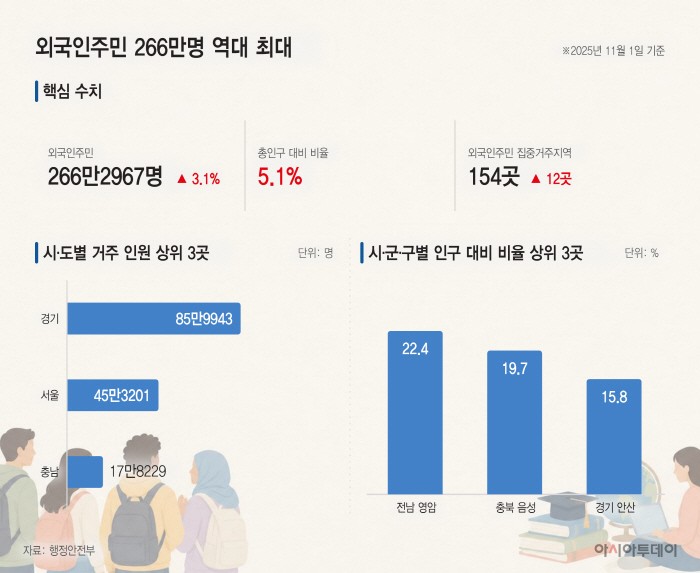
According to the "2025 Status of Foreign Residents in Local Governments" report released by the Ministry of the Interior and Safety on Oct. 28, the number of foreign residents stood at 2,662,967 as of Nov. 1 last year, up 79,341, or 3.1%, from a year earlier. They accounted for 5.1% of the country's total population of 51,817,499, based on the Population and Housing Census, setting records in both number and proportion.
The number of foreign residents has increased for four consecutive years since 2022, following declines in 2020 and 2021 due to the COVID-19 pandemic. Their share of the total population rose from 4.4% in 2022 to 4.8% in 2023, 5.0% in 2024 and 5.1% last year. However, the annual growth rate slowed from 5.0% in 2024 to 3.1% last year.
Foreign residents include foreign nationals who have lived in Korea for more than 90 days, naturalized Korean citizens and children of foreign residents who acquired Korean citizenship at birth. The statistics were compiled using underlying data from the Population and Housing Census conducted by the Ministry of Data and Statistics.
By category, international students recorded particularly strong growth. Their number rose by 41,092, or 17.6%, from a year earlier to 274,329, accounting for 51.8% of the total increase in foreign residents. The number of foreign workers increased by 11,409, or 2.3%, to 514,043, while marriage immigrants rose by 2,178, or 1.1%, to 194,017. In contrast, the number of overseas Koreans holding foreign citizenship fell by 4,381, or 1.1%, to 411,314.
Foreign residents without Korean citizenship numbered 2,109,057, accounting for 79.2% of the total. The number of naturalized Korean citizens reached 256,491, while children of foreign residents born in Korea numbered 297,419, up 4.4% and 0.7%, respectively, from a year earlier.
Aggregating regional statistics into metropolitan and nonmetropolitan areas, the number of foreign residents outside the Seoul metropolitan area reached 1,174,999 last year, an increase of 56,554 from a year earlier. This accounted for 71.3% of the nationwide increase of 79,341 foreign residents. During the same period, the number of foreign residents in the Seoul metropolitan area, comprising Seoul, Gyeonggi Province and Incheon, increased by 22,787.
The growth rate outside the Seoul metropolitan area stood at 5.1%, exceeding the metropolitan area's 1.6%. Although the number of foreign residents in the metropolitan area also increased to 1,487,968, its share of the nationwide total declined by 0.8 percentage points, from 56.7% in 2024 to 55.9% last year.
All 17 cities and provinces recorded increases in foreign residents. North Gyeongsang Province posted the highest growth rate at 8.0%, followed by Gangwon Province at 7.9% and South Jeolla Province at 7.8%. All three regions recorded growth rates of at least 7% for two consecutive years. North Jeolla Province (5.7%), North Chungcheong Province (5.4%) and South Chungcheong Province (5.3%) also exceeded the national average. In absolute numbers, Gyeonggi Province recorded the largest increase at 14,869, followed by North Gyeongsang Province at 10,282 and South Chungcheong Province at 8,984.
By total number of foreign residents, Gyeonggi Province ranked first with 859,943, followed by Seoul with 453,201, South Chungcheong Province with 178,229, Incheon with 174,824 and South Gyeongsang Province with 170,267. Among cities, counties and districts, Ansan in Gyeonggi Province had the largest number at 109,544, followed by Hwaseong with 83,657, Siheung with 79,706, Suwon with 74,161 and Bucheon with 63,381. As in the previous year, all five leading municipalities were located in Gyeonggi Province.
South Chungcheong Province had the highest proportion of foreign residents among the 17 cities and provinces, at 7.9%. Among cities, counties and districts, Yeongam in South Jeolla Province ranked first at 22.4%, meaning more than one in five residents was a foreign resident. It was followed by Eumseong in North Chungcheong Province at 19.7%, Ansan in Gyeonggi Province at 15.8%, Jincheon in North Chungcheong Province at 15.0% and Pocheon in Gyeonggi Province at 14.8%.
The number of areas designated as having high concentrations of foreign residents — defined as areas with at least 10,000 foreign residents or where foreign residents account for 5% or more of the total population — increased by 12 from a year earlier to 154. Of the newly designated areas, 10 were outside the Seoul metropolitan area and two were in Seoul. The number of such areas has steadily increased from 97 in 2022 to 127 in 2023 and 142 in 2024.
"The increase in foreign residents shows that our local communities are becoming more diverse and dynamic," said Jang Heon-beom, director-general for local administration at the Ministry of the Interior and Safety. "I hope these statistics will be used to closely examine regional characteristics and the needs of foreign residents, helping to develop policies that enable them to settle stably in local communities and grow together with other residents."
Kim Nam-hyung
Most Read
-
1
Putin proposes trilateral U.S.-China-Russia summit..

-
2
U.S. weighs dropping MOAB, world's most powerful n..

-
3
"Aren't those foreigners on welfare?": M..

-
4
Attention centers on APEC for possible Trump-Xi-Pu..

-
5
U.S., Israel plan to resume strikes on Iran after..

-
6
China tightens grip on boosting domestic demand an..

-
7
Amid health rumors, Chinese President Xi Jinping i..

PEOPLE






-
Address : In-Young Bldg., 34, Uisadang-daero 1-gil, Yeongdeungpo-gu, Seoul
Copyright by ASIATODAY CO., LTD. All rights resereved