



Venezuela eyes 2027 presidential election under U.S. roadmap
Oct 28, 2026, 03:17 pm


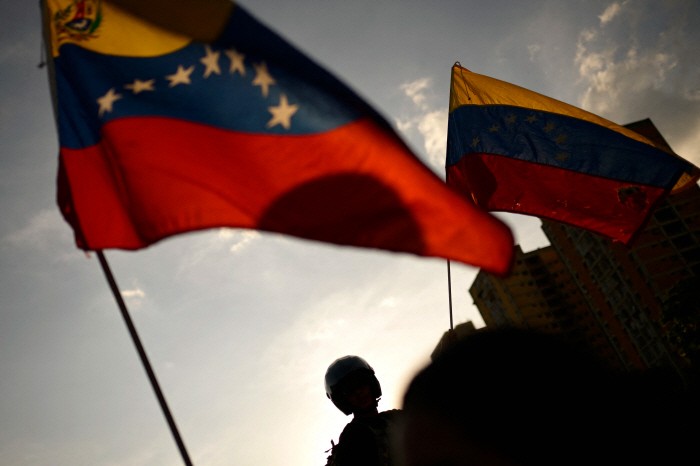 |
| A supporter of Venezuelan opposition leader and Nobel Peace Prize laureate María Corina Machado waves a Venezuelan flag following her arrival in Caracas on Oct. 25 (local time). / AFP-Yonhap |
Venezuela, led by acting President Delcy Rodríguez, is expected to hold a presidential election as early as the third quarter of next year.
According to a report by CNN en Español on Oct. 27 (local time), the Trump administration has presented a roadmap for holding a presidential election in Venezuela next year by overhauling the country's judicial and electoral institutions by the end of this year.
Venezuela has been governed by Rodríguez, who assumed the role of acting president after former President Nicolás Maduro was captured by U.S. forces early this year, transferred to the United States and brought to trial. Although Rodríguez has exceeded the constitutional limit of 180 days for a vice president to serve as acting president, the transitional government has remained in place following a Supreme Court interpretation classifying Maduro's absence as a "forced absence." However, discussions over the election timetable have gained momentum following the recent return of opposition leader María Corina Machado, who has stepped up calls for an early presidential election and the normalization of the country's political system.
Against this domestic political backdrop, the U.S. State Department has proposed an electoral roadmap based on dialogue between the Venezuelan government and opposition parties.
First, Venezuela plans to establish a judicial nominations committee, complete an overhaul of the Supreme Tribunal of Justice (TSJ), the country's highest court, by the end of the year, and nominate 32 justices. The aim is to restore judicial neutrality by reconstituting the TSJ, which has faced criticism for politically motivated rulings, including decisions that undermined the authority of the legislature.
The government also plans to restructure the National Electoral Council (CNE), which has exercised powers to reject political party registrations and disqualify candidates from running for office, into a purely technical and administrative body.
Once the judicial and electoral institutions have been reformed, acting President Rodríguez is expected to formally declare the presidency vacant. Under constitutional provisions requiring an election within six months of such a declaration, a presidential election could be held as early as the third quarter of next year. Machado has previously mentioned July 24, the birthday of Simón Bolívar, who led independence movements against Spanish colonial rule across Venezuela and other parts of South America in the 19th century, as a possible election date.
However, ensuring fundamental political rights, including freedom of political party activity, the right to campaign and freedom of the press, remains a key challenge if the reforms are to be effective.
Lee Jeong-eun
Most Read
-
1
Putin proposes trilateral U.S.-China-Russia summit..

-
2
U.S. weighs dropping MOAB, world's most powerful n..

-
3
"Aren't those foreigners on welfare?": M..

-
4
Attention centers on APEC for possible Trump-Xi-Pu..

-
5
U.S., Israel plan to resume strikes on Iran after..

-
6
China tightens grip on boosting domestic demand an..

-
7
Amid health rumors, Chinese President Xi Jinping i..

PEOPLE






-
Address : In-Young Bldg., 34, Uisadang-daero 1-gil, Yeongdeungpo-gu, Seoul
Copyright by ASIATODAY CO., LTD. All rights resereved