



Japan to prioritize deterrence in defense strategy
Oct 28, 2026, 01:18 pm


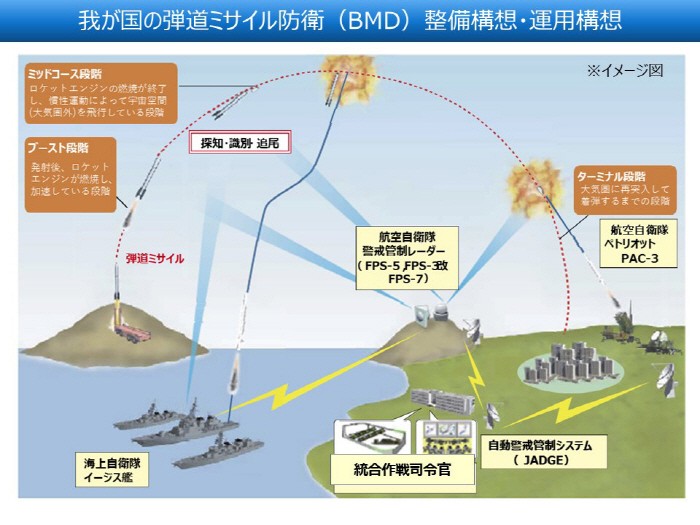 |
| A diagram illustrating the Japanese Ministry of Defense's ballistic missile defense (BMD) system. It shows how Aegis-equipped ships at sea, ground-based Patriot (PAC-3) systems, and surveillance and control radars work together to detect, track and intercept incoming ballistic missiles. / Screenshot from the Japanese Ministry of Defense website |
The Japanese government plans to make "denial capability," aimed at convincing potential adversaries that they cannot achieve their military objectives even if they attack Japan, a central pillar of its defense buildup. The strategy seeks to deter attacks by using long-range missiles and drones to repel invasions and maintaining the capacity to produce ammunition and weapons even during a prolonged war.
The Yomiuri Shimbun reported on Oct. 28, citing multiple government officials, that Japan had begun incorporating the concept of denial capability as a core principle for strengthening its defense capabilities into three key security documents scheduled for revision by the end of the year. The three documents are the National Security Strategy, which sets the basic direction of foreign and security policy; the National Defense Strategy, which outlines military strategy; and the Defense Buildup Program, which details equipment procurement and investment plans.
Denial capability refers to the ability to prevent an adversary's attack from succeeding. The idea is to prevent war by convincing a potential aggressor that it would be difficult to achieve its objectives even after committing troops and military equipment. To this end, Japan plans to expand the development and deployment of long-range missiles and drones capable of striking invading vessels from a distance. It will also focus on making it difficult for potential adversaries to conduct military operations in waters surrounding Japan. In addition, Japan intends to strengthen its capacity to continuously produce ammunition and missiles. Even if an initial attack is repelled, a shortage of supplies could make it difficult to sustain a defense. Japan therefore aims to develop the capacity to fight a prolonged war.
Cooperation with allies and friendly countries will also be used as a means of deterrence. The strategy seeks to influence potential adversaries' decisions by making clear that attacking Japan would mean confronting multiple countries. It is also intended to align Japan's strategy more closely with that of the United States. According to the Yomiuri Shimbun, the United States emphasized strengthening "deterrence by denial" alongside allies and partners, with China in mind, in its National Defense Strategy released in January. Japan is also expected to deepen cooperation between the U.S. military and the Japan Self-Defense Forces in the Indo-Pacific.
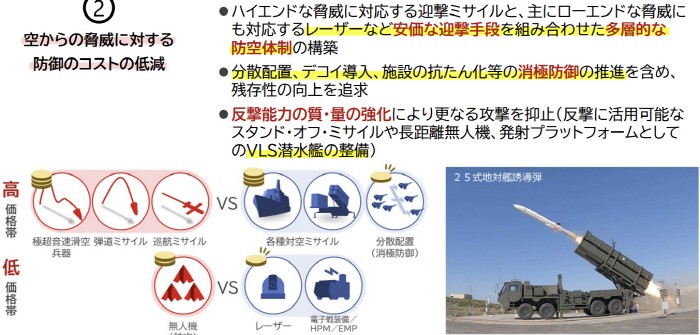 |
| A proposal to strengthen air defense systems and counterstrike capabilities outlined in Japanese Ministry of Defense materials on the country's three key security documents. The plan calls for combining interceptor missiles and lasers to reduce defense costs while enhancing counterstrike capabilities with long-range missiles and drones. At right is the launch of a Type 25 surface-to-ship missile. / Screenshot from the Japanese Ministry of Defense website |
The Japanese government aims to establish a system capable of increasing and sustaining military equipment production in the event of war. Under the proposed approach, ammunition, missiles and destroyers would be produced for export during peacetime, with supplies redirected toward domestic needs in an emergency. Civilian products such as drones could also be repurposed for defense use when necessary. The goal is to maintain production facilities and a skilled workforce by securing demand even during peacetime.
The government is also considering establishing a new corporation to support these efforts. The Ministry of Defense and the Ministry of Economy, Trade and Industry would be involved in strengthening the production base and supporting technological innovation and export-related operations. This approach regards not only the acquisition of military equipment but also the industrial capacity to continuously produce it as part of the country's defense capabilities.
Funding, however, remains a challenge. The Asahi Shimbun reported that Prime Minister Sanae Takaichi's administration plans to significantly increase defense spending as part of the year-end revision of the three security documents. Japan has long kept defense spending at around 1% of gross domestic product (GDP). However, in the 2022 revision of the three documents, it set a target of raising total defense-related expenditures to approximately 2% of GDP. The newspaper reported that the United States is pressing Japan to raise that figure further to around 3.5%.
The Japanese government maintains that denial capability is consistent with the principle of "exclusively defense-oriented policy," under which Japan limits its military response to what is necessary after coming under attack. In a speech on Oct. 23, Defense Minister Koizumi said Japan must establish the capabilities needed to counter threats against the country without launching attacks first.
However, concerns have also been raised about Japan's shift away from its traditionally cautious approach to arms exports toward a policy of expanding its defense industry and increasing weapons exports. Key issues in the year-end revision of the three security documents are expected to include the scale of military capabilities needed to repel an invasion and prepare for prolonged warfare, as well as ways to secure the production capacity and funding required to support them.
Choi Young-jae
Most Read
-
1
Putin proposes trilateral U.S.-China-Russia summit..

-
2
U.S. weighs dropping MOAB, world's most powerful n..

-
3
"Aren't those foreigners on welfare?": M..

-
4
Attention centers on APEC for possible Trump-Xi-Pu..

-
5
U.S., Israel plan to resume strikes on Iran after..

-
6
China tightens grip on boosting domestic demand an..

-
7
Amid health rumors, Chinese President Xi Jinping i..

PEOPLE






-
Address : In-Young Bldg., 34, Uisadang-daero 1-gil, Yeongdeungpo-gu, Seoul
Copyright by ASIATODAY CO., LTD. All rights resereved