



Hyundai and Kia show resilience in China as rivals retreat
Oct 27, 2026, 10:06 am


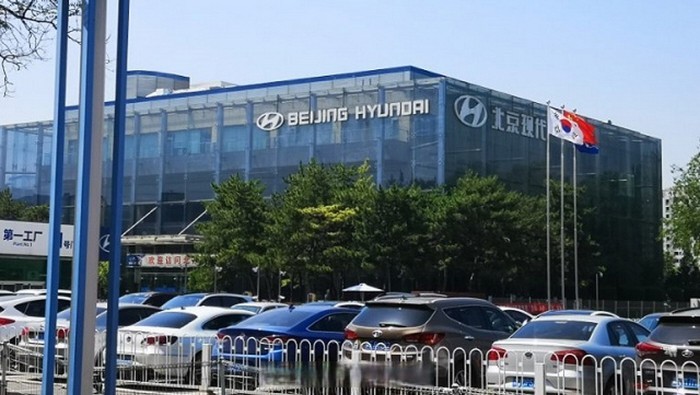 |
| A view of Beijing Hyundai Motor's facilities in Shunyi District, Beijing. / Hong Soon-do, Beijing correspondent |
Hyundai Motor and Kia are seen as performing relatively well in China's automobile market, which is struggling with intense competition and oversupply. Compared with Japanese and European automakers that are scaling back operations or facing the possibility of withdrawing from the market, the two South Korean companies are also considered to be preserving a foundation for a future rebound by expanding exports.
According to Chinese media outlets, including Yicai (第一財經), on Oct. 26, Hyundai Motor and Kia's sales in the Chinese market last September were estimated at approximately 4,000 and 5,000 vehicles, respectively, for a combined total of around 9,000. These were disappointing results, representing year-on-year declines of 47% and 31%, respectively. Their combined monthly sales fell below 10,000 vehicles for the first time this year. This represents a sharp decline compared with their combined sales of 1.8 million vehicles in 2016. The two companies' combined market share in China currently stands at less than 1%. However, the picture changes when the Chinese automobile market as a whole is taken into account.
As the market rapidly shifts toward electric vehicles, production capacity exceeding demand by approximately 30% has intensified competition for survival among automakers to a level reminiscent of China's Warring States period. Considering that even domestic Chinese electric vehicle manufacturers have been going bankrupt one after another, it is difficult to regard Hyundai Motor and Kia's struggles as an exceptional phenomenon.
In particular, compared with global Japanese and European automakers operating in China, Hyundai Motor and Kia can be seen as performing relatively well. Infiniti, the premium brand of Japan's Nissan, is estimated to have sold just 601 vehicles between January and July this year. Nissan recently closed its plant in Wuhan, Hubei Province, and is reportedly considering a complete withdrawal from the Chinese market.
Expanding exports are also providing support. Beijing Hyundai, Hyundai Motor's local subsidiary in China, is estimated to have exported 120,000 vehicles between January and September this year, up 70% from the same period last year. Chinese media outlets predict that, if this trend continues, the company could achieve annual exports of 200,000 vehicles in 2027, three years earlier than the originally projected target of 2030. Yueda Kia, which has a production base in Yancheng, Jiangsu Province, is showing similar momentum. Exporting more than 10,000 vehicles every month, the company is expected to reach the milestone of 1 million vehicles in cumulative exports.
Beijing-based economic commentator Gu Jinjun (顧金俊) praised the resilience of the two companies, saying, "There is no need to worry about Beijing Hyundai and Yueda Kia. They are highly resilient companies that can survive even without teeth by relying on their gums."
Hong Soon-do
Most Read
-
1
Ukraine halts strikes on Russian oil refineries un..

-
2
China's fifth plenum to conclude amid expectations..

-
3
Southeast Asian auto parts makers hit hard by Chin..

-
4
Hegseth rejects calls for impeachment over Iran wa..

-
5
U.S. links Myanmar peace efforts to rare earth acc..

-
6
Democrats flip U.S. Congress in historic midterm s..

-
7
USFK commander cites interoperability gaps, urges..

PEOPLE







-
Address : In-Young Bldg., 34, Uisadang-daero 1-gil, Yeongdeungpo-gu, Seoul
Copyright by ASIATODAY CO., LTD. All rights resereved