



S. Korea's university funding gap widens to 13-fold
Oct 27, 2026, 09:22 am


 |
As the government pushes ahead with its "10 Seoul National Universities" initiative, the widening gap in financial support between major regional national universities and private universities outside the capital region has become a contentious issue. With annual support packages worth approximately 210 billion won being planned for three major national universities — Pusan National University, Chonnam National University and Chungnam National University — concerns are growing that regional private universities could face further disadvantages.
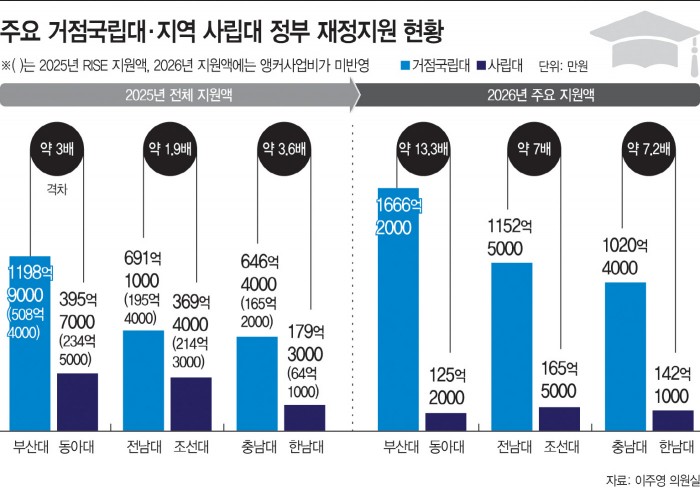
An analysis of the Ministry of Education's data on major university funding programs from 2024 to 2026, submitted to the National Assembly, showed on Oct. 26 that funding for major projects differed by as much as 13.3 times between regional national universities and private universities this year.
Pusan National University received 166.62 billion won in funding this year, 13.3 times the 12.52 billion won allocated to Dong-A University. Last year, Pusan National University received 119.89 billion won, compared with Dong-A University's 39.57 billion won, a gap of approximately threefold. Notably, funding for Dong-A University under the Regional Innovation System and Education (RISE), now known as the Anchor Project, amounted to 23.45 billion won last year, accounting for 59.3% of its total funding under major government financial support programs.
A similar gap was observed in Gwangju and South Jeolla Province, where Chonnam National University received 115.25 billion won this year, approximately seven times the 16.55 billion won allocated to Chosun University. Last year, however, Chosun University received more RISE funding, at 21.43 billion won, than Chonnam National University, which received 19.54 billion won. In Daejeon and South Chungcheong Province, Chungnam National University received 102.04 billion won this year, compared with 14.21 billion won for Hannam University, a difference of approximately 7.2 times.
However, this year's data does not include funding under the Anchor Project, limiting the extent to which the figures can be directly compared. Nevertheless, the Anchor Project is linked to the shared university initiative under the government's "10 Seoul National Universities" policy and its five regional hubs and three special autonomous regions framework. Therefore, even though the funding amounts were not reflected in the data submitted by the Ministry of Education, the project could affect the future structure of financial support for regional national and private universities.
RISE was introduced by the previous administration to foster universities connected to regional industries. Last year, 127 general private universities received a combined 614.97 billion won under the program, accounting for approximately 35% of their total funding from major government support programs. The University of Ulsan received the largest amount at 37.04 billion won, followed by Hallym University with 26.59 billion won and Wonkwang University with 26.13 billion won. These relatively well-established regional private universities secured more than 70% of their major government funding through RISE.
However, the Lee Jae Myung administration has shifted its policy toward concentrating investment in major regional national universities under the "10 Seoul National Universities" initiative. While the policy could strengthen regional research capabilities, concerns have emerged that it may reduce research and funding opportunities for major regional private universities.
"Regional private universities struggling to survive made desperate efforts to innovate and qualify for the previous administration's Glocal University and RISE programs," the president of a regional private university said. "Now that the direction of government support has changed, we feel deeply discouraged."
Rep. Lee Ju-young of the Reform Party said, "Even if we accept the policy priority of directing limited national resources toward public universities, regional private universities, another pillar of higher education outside the capital region, are being denied even the opportunity to restructure themselves independently."
"We urgently need policy coherence so that national and private universities can coexist while fulfilling their respective roles," Lee added.
In response, the Ministry of Education is considering a so-called "Autonomous Innovation University" initiative as part of efforts to reform private universities. The ministry also plans to establish a tentatively named Higher Education Innovation Committee to discuss university policies and related matters.
"Selective investment and concentration of resources are necessary to support national and private universities facing crises caused by declining numbers of school-age students and other challenges," an official said. "We are considering ways to restructure and support universities according to their areas of specialization, including research, regional and industry-academia-research cooperation, and lifelong education, so we do not expect an extreme funding gap to emerge."
Park Ji-sook
#University #Funding #Public school #Education #Seoul National University
Copyright by Asiatoday
Most Read
-
1
Ukraine halts strikes on Russian oil refineries un..

-
2
China's fifth plenum to conclude amid expectations..

-
3
Southeast Asian auto parts makers hit hard by Chin..

-
4
U.S. links Myanmar peace efforts to rare earth acc..

-
5
Hegseth rejects calls for impeachment over Iran wa..

-
6
Democrats flip U.S. Congress in historic midterm s..

-
7
USFK commander cites interoperability gaps, urges..

PEOPLE







-
Address : In-Young Bldg., 34, Uisadang-daero 1-gil, Yeongdeungpo-gu, Seoul
Copyright by ASIATODAY CO., LTD. All rights resereved