



[Market Power] Hanwha reemerges as potential Lotte Card buyer
Oct 23, 2026, 09:36 am


 |
 |
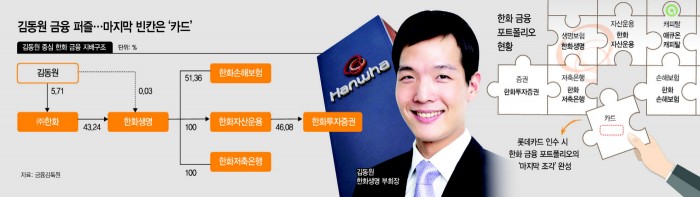
Hanwha Group is being mentioned as a potential buyer as Lotte Card's sale process resumes. This comes as Hanwha has expanded its financial businesses under the leadership of Kim Dong-won, vice chairman of Hanwha Life, including the acquisition of Acuon Capital, while Lotte Card's expected sale price has recently fallen to around 1.5 trillion won from a previously discussed level of approximately 3 trillion won. Another reason Hanwha is being mentioned as a potential buyer is that its financial affiliates, which operate in insurance, securities, asset management, savings banking and, more recently, the capital financing business, still lack a credit card business.
However, Vice Chairman Kim faces challenges if he is to further expand the group's financial businesses. While the possibility of Hanwha's financial division becoming independent in the medium to long term has been raised, Kim directly owns only a 0.03% stake in Hanwha Life. Strengthening his control over the financial affiliates and translating business expansion into tangible improvements in corporate value remain challenges ahead.
According to investment banking (IB) industry sources on Oct. 22, Hanwha Life has recently been mentioned as one of the potential buyers as efforts to sell Lotte Card resume. MBK Partners, Lotte Card's largest shareholder, has selected UBS as the sale adviser and is pursuing a third attempt to sell the company. Lotte Card's asking price, once discussed at around 3 trillion won, has reportedly fallen to approximately 1.5 trillion won.
Hanwha participated in the preliminary bidding process when Lotte Group sought to sell Lotte Card in 2019 but did not proceed to the final bidding round. At the time, Hanwha explained its decision not to participate by saying, "The decision was made after comprehensively reviewing various circumstances."
Hanwha's continued expansion of its financial businesses helps explain why the group has reemerged as a potential buyer seven years later. Hanwha's financial affiliates are structured around Hanwha Life, with businesses spanning non-life insurance, securities, asset management and savings banking. Hanwha Corp. holds a 43.24% stake in Hanwha Life, which owns subsidiaries including Hanwha General Insurance, Hanwha Asset Management and Hanwha Savings Bank. Hanwha Investment & Securities is a sub-subsidiary of Hanwha Life, with Hanwha Asset Management holding a 46.08% stake in the securities firm.
The group has also recently expanded into the capital financing business. Last month, Hanwha Life signed an agreement to acquire a 50.54% stake in Acuon Capital for 440 billion won. Once the transaction is completed following regulatory approval, Hanwha's financial portfolio will include the capital financing business alongside insurance, securities, asset management and savings banking.
Within this structure, the credit card business is one of the few remaining sectors missing from Hanwha's financial portfolio. Analysts suggest that acquiring a credit card company would allow Hanwha to link payment and consumer spending data with existing financial products, including insurance and securities. The group could also generate synergies by combining payment services and customer benefits with its retail and leisure businesses. Lotte Card's lower valuation compared with the past is also considered a factor that could make the acquisition more attractive to Hanwha.
However, business conditions in the credit card industry remain challenging. Growth across the industry has slowed, profitability remains under pressure, and Lotte Card faces regulatory sanctions stemming from a data breach. In July, the Financial Services Commission imposed a 1.5-month business suspension and a fine of 5 billion won on Lotte Card.
The results of the financial business expansion led by Vice Chairman Kim have varied across affiliates. Hanwha Life's net profit in the first half of this year reached 904.5 billion won, nearly double the 461.5 billion won recorded a year earlier. Hanwha General Insurance also saw its net profit rise from 197.4 billion won to 227.6 billion won. However, Hanwha Investment & Securities posted relatively weak results despite favorable conditions in the securities industry. Its first-half net profit fell by approximately 30% to 46.2 billion won from 66.5 billion won a year earlier.
In particular, despite improving earnings, Hanwha Life, the group's key financial affiliate, has maintained a price-to-book ratio (PBR) of around 0.2 times for several years. According to the Korea Exchange, its year-end PBR stood at 0.17 times in 2020, 0.18 times in 2022 and 0.14 times in 2024, and remained at just 0.21 times at the end of last year. As of Oct. 21, the figure was also around 0.23 times. Hanwha General Insurance has likewise maintained a PBR of approximately 0.2 to 0.3 times in recent years. PBR is an indicator showing how a company's share price is valued relative to its net asset value.
From a corporate governance perspective, Kim's small direct stake in Hanwha Life is another variable. Although the market has raised the possibility of Hanwha's financial division being separated from the group in the medium to long term, Kim directly owns only 0.03% of Hanwha Life.
Meanwhile, Kim has recently been selling some of his stakes in non-financial affiliates. At the end of last year, he sold approximately 5% of Hanwha Energy to a financial investor (FI), reducing his stake from 25% to around 20%. On Oct. 22, he also decided to tender his 3.381 million shares in a tender offer being conducted by Kim Dong-sun, president and head of future strategy at Hanwha Machinery & Service Holdings (Hanwha M&S). If all the shares are sold at the tender offer price of 8,000 won per share, Kim Dong-won will secure approximately 27 billion won.
Industry observers are paying close attention to how Kim will use the funds raised through the sale of his stakes in non-financial affiliates. Given the possibility of a separation of Hanwha's financial division in the medium to long term, some speculate that the funds could be used to strengthen his control over the financial affiliates, including by increasing his stake in Hanwha Life.
Hanwha Life, however, has distanced itself from speculation that it is actively pursuing an acquisition of Lotte Card. "We are currently focused on completing the acquisition process for Acuon Capital," a Hanwha Life official said. "There are no indications that we are interested in acquiring Lotte Card."
Park Ju-yeon
#Hanwha #Lotte Card #Finance #Portfolio
Copyright by Asiatoday
Most Read
-
1
AMD's Lisa Su floated as potential Nvidia successo..

-
2
U.S. links Myanmar peace efforts to rare earth acc..

-
3
Alice Huang, affair partner of Jensen Huang, repor..

-
4
Iran resumes attacks after two months, targeting U..

-
5
Hegseth rejects calls for impeachment over Iran wa..

-
6
Xi secures fourth term as China reshuffles next-ge..

-
7
Democrats flip U.S. Congress in historic midterm s..

PEOPLE







-
Address : In-Young Bldg., 34, Uisadang-daero 1-gil, Yeongdeungpo-gu, Seoul
Copyright by ASIATODAY CO., LTD. All rights resereved