



Kakao Mobility unveils AI parking technology
Oct 23, 2026, 09:31 am


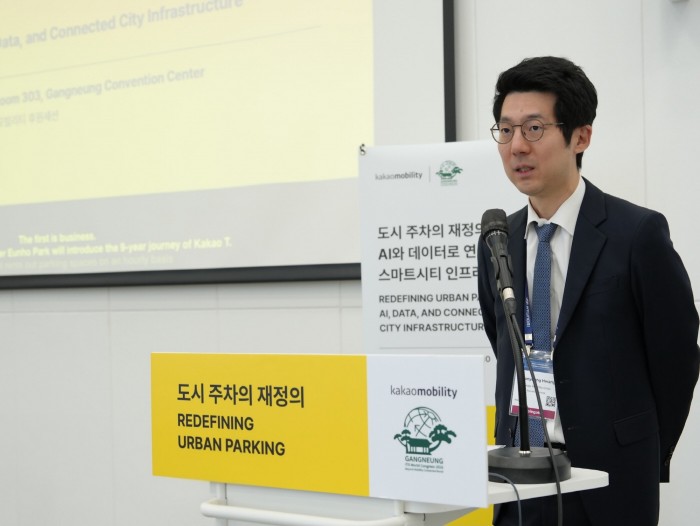 |
| Hwang Yoon-young, head of Kakao Mobility's Compliance Management Division, delivers opening remarks at the company's independently sponsored parking session during the 2026 Gangneung ITS World Congress at Gangneung Olympic Park on Oct. 22. / Courtesy of Kakao Mobility |
Kakao Mobility has unveiled technologies and a vision for using artificial intelligence (AI) and big data to transform parking lots from simple vehicle storage spaces into key transportation infrastructure for smart cities.
According to Kakao Mobility on Oct. 23, the company participated as an official sponsor of the 2026 Gangneung ITS World Congress and held an independent session the previous day under the theme "Redefining Urban Parking: Smart City Infrastructure Connected by AI and Data."
Since launching Kakao T Parking in 2017, Kakao Mobility has expanded its business of managing parking lots nationwide through a single platform by connecting its platform, operations and equipment. The company has introduced automated payments that allow vehicles to exit parking lots without stopping, as well as cloud-based monitoring and control. It has also recently expanded into overseas business by signing a proof-of-concept (PoC) contract for the Diriyah smart city project in Saudi Arabia.
The company also unveiled AI-based parking technologies. These technologies use cameras to recognize license plates and parking spaces, along with three-dimensional indoor and outdoor spatial maps and digital twin technology, to enable real-time monitoring, control and operation of parking lots.
Kakao Mobility also presented data demonstrating the effects of its parking technologies on actual traffic flow. An analysis of approximately 1.62 million parking-related records by the company's Future Platform Economy Research Institute found that the intervals between vehicles exiting parking lots decreased by up to approximately 20% when services such as Kakao T Parking Pass and automated payments were applied.
The company explained that reducing bottlenecks at parking lot exits could also help ease congestion on surrounding roads, allowing parking systems to expand their role as infrastructure for managing urban traffic in the future.
Kakao Mobility also participated in technical and academic sessions during the congress to share its research findings. The company attended a joint South Korea-Netherlands conference on smart mobility and met with senior officials from the Czech Ministry of Transport to discuss opportunities for global cooperation.
The company also provided transportation support for international visitors. It established a dedicated virtual pickup point for the congress venue at Gangneung Olympic Park on its mobility platform for foreigners, k.ride, and set up a taxi pickup zone at the site. International visitors accounted for approximately 70% of all paid registrants.
Kakao Mobility also received a plaque of appreciation from the congress organizing committee in recognition of its participation in the independent session, academic activities and on-site transportation support.
"The 2026 Gangneung ITS World Congress was an opportunity to share our AI and data technologies and research achievements with transportation officials from around the world," said Hwang Yoon-young, head of Kakao Mobility's Compliance Management Division.
"We will continue to advance our parking technologies, which will serve as essential infrastructure supporting urban transportation and as a future mobility hub in the era of autonomous driving, and expand them into global markets," Hwang said.
Son Kang-hoon
Most Read
-
1
AMD's Lisa Su floated as potential Nvidia successo..

-
2
U.S. links Myanmar peace efforts to rare earth acc..

-
3
Alice Huang, affair partner of Jensen Huang, repor..

-
4
Iran resumes attacks after two months, targeting U..

-
5
Hegseth rejects calls for impeachment over Iran wa..

-
6
Xi secures fourth term as China reshuffles next-ge..

-
7
Democrats flip U.S. Congress in historic midterm s..

PEOPLE






-
Address : In-Young Bldg., 34, Uisadang-daero 1-gil, Yeongdeungpo-gu, Seoul
Copyright by ASIATODAY CO., LTD. All rights resereved