



IMF raises S. Korea’s 2026 growth forecast to 3.3%, up 0.7 percentage points on chip boom
Oct 13, 2026, 02:08 pm


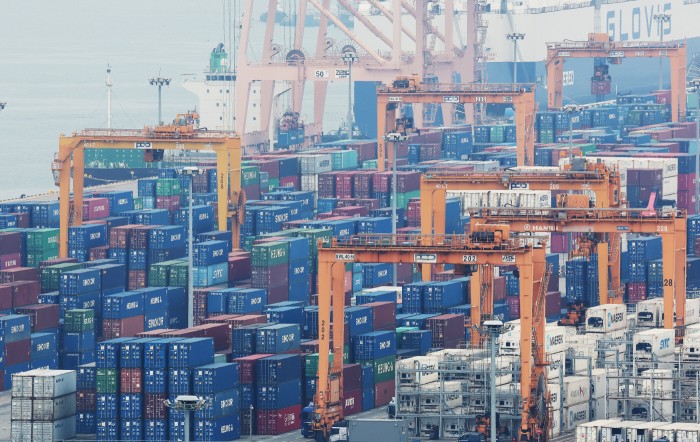 |
| Containers stacked at Pyeongtaek Port in Gyeonggi Province. / Yonhap |
The International Monetary Fund (IMF) has raised its forecast for South Korea's economic growth this year by 0.7 percentage points, citing robust external demand led by semiconductors that outweighs the negative fallout of the Middle East war.
In its October World Economic Outlook released on the 13th, the IMF projected South Korea's economy to expand by 3.3% this year, up 0.7 percentage points from its July estimate of 2.6%. The growth projection for next year was also revised upward by 0.3 percentage points, from 2.5% to 2.8%. South Korea's upward revision for this year outpaced both the global average (0.1 percentage points) and the advanced economy average (0.4 percentage points).
The IMF's growth projection is higher than forecasts from the South Korean government (3.0%), the Bank of Korea (3.3%), the Korea Development Institute (KDI, 3.2%), and the Asian Development Bank (ADB, 3.2%). Conversely, it fell below projections from the Organization for Economic Cooperation and Development (OECD, 3.7%) and Moody's (3.5%).
The IMF attributed the upward revision for South Korea to strong external demand centered on semiconductors, which overpowered the adverse effects of the war in the Middle East. Highlighting South Korea alongside Taiwan as key trading nations in artificial intelligence (AI) hardware, the fund noted that their momentum could generate spillover benefits for raw material exporters and manufacturing hubs.
Additionally, the IMF lifted its 2026 global economic growth forecast by 0.1 percentage points from July to 3.1%, while holding its outlook for next year steady at 3.4%. The fund assessed that the global economy is maintaining better-than-expected momentum despite the prolonged Middle East conflict and trade frictions, buoyed by expanding investment in AI. However, it noted that growth trajectories will diverge depending on individual nations' exposure to the Middle East conflict and their level of integration into the AI technology value chain.
The South Korean government assessed that booming exports of AI hardware and semiconductors drove the upgraded outlook. Nonetheless, officials stated plans to concentrate on stabilizing public livelihoods and rebounding potential growth through three flagship social policy areas—housing, jobs, and microfinance—as structural challenges persist, including cost-of-living burdens stemming from extended Middle East tensions and elevated inflation and interest rates, alongside polarization and a decelerating potential growth rate.
Lee Ji-hoon
Most Read
-
1
Kia Sportage outperforms Mazda CX-5 in German auto..

-
2
Houthis launch successive attacks on Saudi airport..

-
3
Saudi Arabia, Iran hold first diplomatic talks to..

-
4
U.S. deploys carrier, 10,000 more troops to Middle..

-
5
Saudi airport in Riyadh struck again, leaving at l..

-
6
Putin's ally visits China on the 8th ahead of APEC..

-
7
Five ASEAN countries welcome Myanmar coup leader

PEOPLE






HEADLINE NEWS

-
Address : In-Young Bldg., 34, Uisadang-daero 1-gil, Yeongdeungpo-gu, Seoul
Copyright by ASIATODAY CO., LTD. All rights resereved