



S. Korea goes all out to secure Westinghouse stake and board seats
Oct 13, 2026, 09:50 am


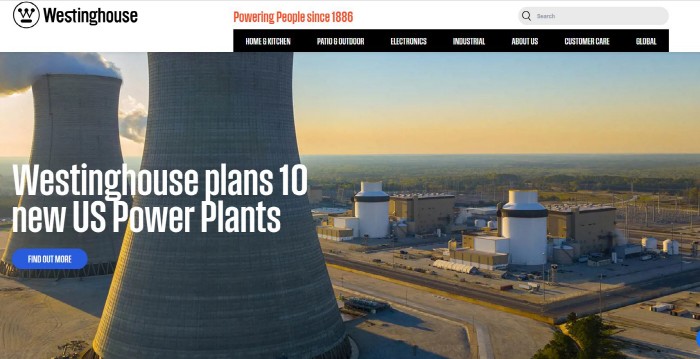 |
| Westinghouse's website. / Westinghouse |
South Korea's push to enter the U.S. nuclear power market and negotiations over acquiring an equity stake in Westinghouse have run up against an unexpected variable: friction between the United States and Canada. Amid Washington's move to tighten its grip over Westinghouse—currently controlled by Canadian capital—South Korea's equity participation is emerging as a potential alternative. However, with the acquiring entity still undecided and South Korea's representation on the board of directors uncertain, analysts suggest that the tangible benefits of the investment will hinge entirely on the final negotiation terms.
According to the Ministry of Trade, Industry and Energy (MOTIE) and the nuclear power industry on the 12th, South Korea and the U.S. are pursuing a cooperative initiative worth up to 120 billion dollars to construct eight large-scale nuclear reactors in the United States. Under the blueprint, two units would be South Korea's APR1400 model, while the remaining six would be Westinghouse's AP1000. South Korea's acquisition of a 5% to 10% equity stake in Westinghouse is also folded into the cooperation plan.
Westinghouse is currently owned by Canadian asset manager Brookfield, which holds a 51% stake, and Canadian uranium firm Cameco, with 49%. Despite serving as a cornerstone of the American nuclear industry, its equity structure is entirely controlled by Canadian investors.
As Washington and Ottawa have recently clashed over tariff disputes, interpretations have emerged suggesting that this ownership structure has influenced the nuclear negotiations between Seoul and Washington. Media reports indicate MOTIE considers that, from the U.S. standpoint, having all shares of a key nuclear player held by Canadian entities posed a strategic dilemma, and that recent strains in U.S.-Canada relations played a role in the talks.
Washington's moves to cement oversight over Westinghouse are also drawing scrutiny. According to written responses submitted by MOTIE to the National Assembly, the U.S. government is seeking to secure a "golden share" granting veto power over major managerial decisions during Westinghouse's initial public offering (IPO). Specific details regarding the scope of the veto and the final rights architecture remain undisclosed.
For South Korea, securing substantive management participation carries greater weight than the exact percentage of shares held. Westinghouse's board of directors is known to operate as a six-member body, with three members nominated by Brookfield and three by Cameco. South Korea reportedly sought a board seat alongside equity acquisition during negotiations, but whether it will ultimately secure board appointment rights remains unclear.
The specific entity tasked with acquiring the stake has also not been settled. A MOTIE official stated, "Regarding the Westinghouse stake acquisition, it has not yet been decided whether KEPCO or KHNP will proceed with the purchase," adding that "no decision has been made on whether private companies or state-owned enterprises will acquire the stake."
This implies that, beyond the size of the stake, the participating corporate entities and financing structures require further determination. Depending on whether public or private enterprises hold the shares, both investment burdens and avenues for management participation could shift substantially.
Appearing before the parliamentary audit of the National Assembly's Trade, Industry, Energy, SMEs and Startups Committee that day, Korea Electric Power Corporation (KEPCO) CEO Kim Dong-cheol also struck a measured tone. While expressing expectations that securing a stake in Westinghouse would facilitate entry into the U.S. and third-country nuclear markets, Kim stated that whether to acquire the stake and the scale of the investment would be decided within a rational scope.
The terms of South Korea's stake purchase reportedly include a 10% discount off Westinghouse's IPO offering price. In contrast, Cameco announced on the 30th of last month that it does not expect South Korea's potential equity investment to affect its existing shareholding.
A MOTIE official remarked, "At this stage, negotiations are ongoing with the ultimate goal of maximizing the Westinghouse stake and securing board representation," adding, "We will make our utmost effort to secure the equity ratio and board participation from the standpoint of national interest."
Han Dae-eui
Most Read
-
1
Kia Sportage outperforms Mazda CX-5 in German auto..

-
2
Houthis launch successive attacks on Saudi airport..

-
3
Saudi Arabia, Iran hold first diplomatic talks to..

-
4
U.S. deploys carrier, 10,000 more troops to Middle..

-
5
Saudi airport in Riyadh struck again, leaving at l..

-
6
Putin's ally visits China on the 8th ahead of APEC..

-
7
Five ASEAN countries welcome Myanmar coup leader

PEOPLE






HEADLINE NEWS

-
Address : In-Young Bldg., 34, Uisadang-daero 1-gil, Yeongdeungpo-gu, Seoul
Copyright by ASIATODAY CO., LTD. All rights resereved