



iPhones priced at up to 5 million won open for preorder this week
Oct 13, 2026, 09:47 am


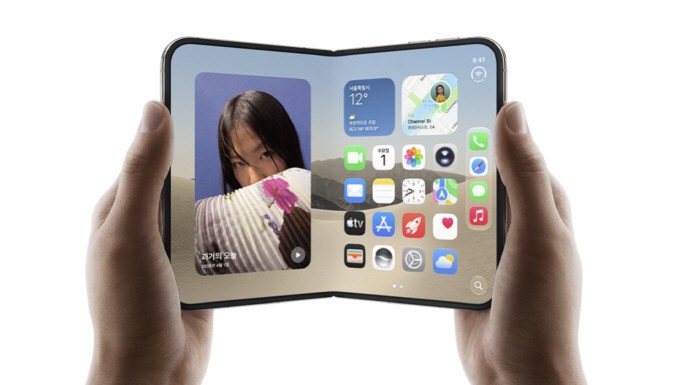 |
| Apple's foldable smartphone "iPhone Duo." / T Direct Shop |
South Korea's three major mobile carriers are set to launch domestic pre-orders this week for Apple's first foldable smartphone, the "iPhone Duo." With retail prices climbing past 5 million won for the top-tier model, carrier subsidy levels have quickly become a focal point. While each telecom provider has rolled out marketing campaigns highlighting discount packages worth over 1 million won to attract subscribers, actual carrier subsidies are expected to be stingy. This reflects a combination of the three carriers shouldering subsidy costs alone and an extremely limited initial supply.
According to industry sources on the 12th, the three telecom carriers will begin pre-orders for the iPhone Duo at 9:00 p.m. on the 16th. The official launch date follows a week later on the 23rd. The carriers are currently running pre-order notification events on their official online stores. The iPhone Duo marks Apple's first foldable smartphone, launching in four storage configurations: 256GB, 512GB, 1TB, and 2TB. Domestic retail prices are set at 3.3 million won, 3,597,000 won, 4,191,000 won, and 5,093,000 won, respectively.
While the public carrier subsidies offered by the three providers will be disclosed on the official launch date, industry observers project that even on high-end mobile plans priced in the 100,000-won range, subsidies may hover at around 200,000 to 250,000 won. This marks a noticeable gap compared to the previously released "iPhone 18" series, where common carrier subsidies reached up to 450,000 won. Although the three carriers are aggressively promoting perceived discounts exceeding 1 million won in pre-order marketing, most of these savings actually consist of trade-in compensations for used phones, co-branded credit card discounts, and first-come, first-served coupons. SK Telecom, for example, is advertising perceived discounts of 1.6 million to 1.7 million won on its T Direct Shop; however, this package is comprised of up to 1.17 million won in trade-in credit, a 200,000-won T Direct Shop special compensation (limited to the first 1,000 customers), a lucky roulette draw for 200,000 to 300,000 won (via a separate raffle), and a 30,000-won KakaoTalk channel coupon.
Behind the carriers' reluctance to loosen their purse strings lies the small initial supply of the iPhone Duo. Market research firm Counterpoint Research forecasts global shipments of the iPhone Duo to reach 6 million units this year. Typically, the three carriers prioritize large subsidies for models with strong consumer preference and high sales volumes. For instance, the iPhone 18 Pro saw common subsidies reach up to 450,000 won due to high demand and sales figures, whereas the iPhone 18 Pro Max capped out at 260,000 won. According to KT and LG Uplus, the Pro model accounted for 70% and 79.7% of pre-orders for the iPhone 18 series, respectively. A telecom industry official explained, "Ultra-premium, scarce products like the iPhone Duo sell out rapidly driven by early-adopter demand even without heavy carrier subsidies," adding that "with the volume allocated to South Korea being extremely limited, operators have little reason to expend their financial firepower."
Another structural constraint cited is that the manufacturer, Apple, does not share the financial burden of subsidies. While subsidies for Samsung's "Galaxy" lineup are jointly funded by Samsung Electronics and the three carriers, Apple maintains a policy of providing little to no financial contribution. Consequently, the burden of funding the iPhone Duo's carrier subsidies falls entirely on the three mobile carriers. Some industry watchers suggest opting for the "optional contract discount"—which offers a 25% monthly rate discount—instead of public subsidies, or purchasing an unlocked handset paired with a budget MVNO mobile plan. A retail channel official stated, "Faced with bearing the full cost of subsidies amid scarce inventory, carriers shifted their marketing toward aggregated discount benefits rather than direct price cuts," advising consumers to "carefully calculate the actual net purchase price based on installment fees and contract terms rather than relying on headline maximum discount figures."
Yeon Chan-mo
Most Read
-
1
Kia Sportage outperforms Mazda CX-5 in German auto..

-
2
Houthis launch successive attacks on Saudi airport..

-
3
Saudi Arabia, Iran hold first diplomatic talks to..

-
4
U.S. deploys carrier, 10,000 more troops to Middle..

-
5
Saudi airport in Riyadh struck again, leaving at l..

-
6
Putin's ally visits China on the 8th ahead of APEC..

-
7
Five ASEAN countries welcome Myanmar coup leader

PEOPLE






HEADLINE NEWS

-
Address : In-Young Bldg., 34, Uisadang-daero 1-gil, Yeongdeungpo-gu, Seoul
Copyright by ASIATODAY CO., LTD. All rights resereved