



Choi Yun-beom’s U.S. investment bet targets critical minerals supply chain
Oct 13, 2026, 09:43 am


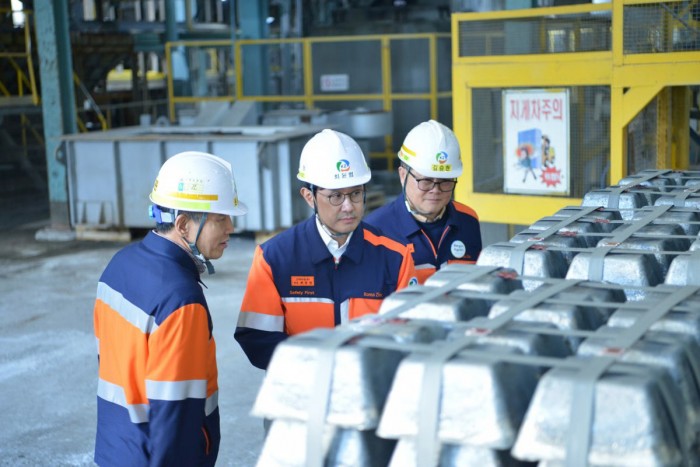 |
| Korea Zinc Chairman Choi Yun-beom visits the antimony plant at the Onsan Smelter and inspects manufactured products. / Korea Zinc |
An 11-trillion-won U.S. smelter investment spearheaded by Korea Zinc Chairman Choi Yun-beom is gaining prominence amid Washington’s broader push to restructure critical mineral supply chains.
The momentum comes as Korea Zinc’s strategy to establish local production hubs aligns directly with U.S. industrial policy, driven by an urgent need for critical mineral self-reliance in response to Chinese export restrictions. With U.S. President Donald Trump publicly citing the venture as a landmark investment milestone, attention is focusing on Chairman Choi’s global expansion strategy.
According to industry sources on the 13th, President Trump highlighted Korea Zinc’s investment plans during a Republican midterm campaign rally held on the 10th (local time) in Clarksville, Tennessee. He remarked that "Korea Zinc is investing over 6 billion dollars in Tennessee and creating 740 jobs," adding that "it will be the first new mineral smelter built in the United States since 1979."
Trump's direct mention of Korea Zinc’s investment project is seen as reflecting how closely the initiative matches Washington’s policy goals of securing critical mineral independence and revitalizing the domestic manufacturing base. The U.S. currently relies heavily on overseas sources for significant portions of the critical minerals required by high-tech and defense industries.
In particular, foreign supply dependency for elements such as indium, antimony, bismuth, and gallium exceeds 70%. Consequently, building production facilities capable of smelting and refining minerals locally—rather than merely securing raw ore—has emerged as a foundational supply chain security priority.
This shift directly aligns with Chairman Choi Yun-beom’s motivation behind pursuing the U.S. investment. China has progressively tightened export controls on critical minerals, including the rollout of export licensing requirements for gallium and germanium in August 2023. As materials essential for semiconductors, artificial intelligence (AI), and defense systems became focal points of geopolitical competition, Choi pursued a strategy capitalizing on Korea Zinc’s nonferrous smelting technologies to unlock fresh growth opportunities in the U.S. market. The vision goes beyond a standard overseas production footprint, aiming to broaden the company's scope by actively participating in Washington's supply chain realignment.
At the heart of this strategy is "Project Crucible." In December of last year, Korea Zinc partnered with the U.S. government and stakeholders to invest approximately 7.4 billion dollars (roughly 11 trillion won) to build an integrated nonferrous metals smelter in Tennessee. Upon completion, the facility will span roughly 660,000 square meters. The plant is slated to produce traditional metals including zinc, lead, copper, and silver, alongside critical elements such as antimony, indium, bismuth, tellurium, palladium, and gallium.
The production roster includes 11 critical minerals designated by the U.S. government. By leveraging smelting capabilities that process a wide array of metals in a single location, the company aims to secure a strategic foothold within the domestic U.S. critical mineral supply chain.
Interest from the U.S. government, international organizations, and think tanks continues to grow. At a critical minerals supply chain roundtable hosted at the U.S. Department of State in Washington, D.C. on August 7 (local time), U.S. Secretary of Commerce Howard Lutnick reportedly introduced Project Crucible. The International Energy Agency (IEA) and the Center for Strategic and International Studies (CSIS) have also underscored the project’s strategic value in published reports. Notably, CSIS assessed Project Crucible as a prime example of South Korea and the United States jointly building a critical mineral ecosystem, highlighting South Korea's potential to establish itself as a "co-architect" of the supply chain.
For Chairman Choi, Project Crucible represents a pivotal venture to elevate Korea Zinc’s global business structure. Transferring domestic smelting competitiveness directly to a U.S. production base broadens the company's role across critical mineral supply networks. Direct participation in U.S. supply chain independence policies sets this venture apart from conventional foreign market expansions. Nevertheless, managing the financing requirements of such large-scale capital expenditure, keeping construction and operational timelines on track, and securing actual productivity and profitability remain key hurdles determining the project's ultimate success.
In a shareholder letter last month, Korea Zinc Chairman Choi Yun-beom emphasized, "Korea Zinc is entering a new phase centered on Project Crucible," adding, "This project will position the company at the core of the global critical mineral supply chain and serve as the foundation for sustainable mid- to long-term growth." President Trump's public acknowledgment demonstrates how closely Korea Zinc's U.S. investment aligns with American industrial policy. The central test now is whether this political momentum can translate into actual production and profitability, securing an enduring presence within the global critical mineral supply chain.
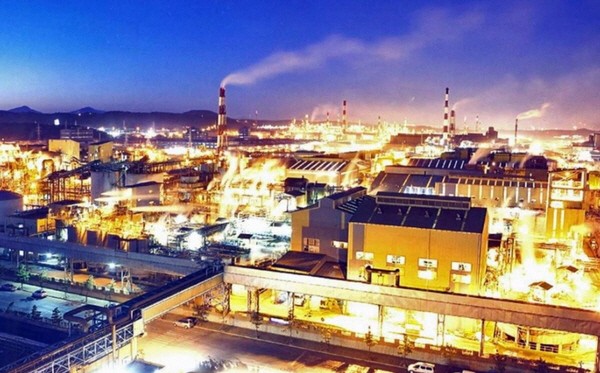 |
| Korea Zinc Co.'s Onsan Smelter. / Korea Zinc |
Lee Seo-yeon
Most Read
-
1
Kia Sportage outperforms Mazda CX-5 in German auto..

-
2
Houthis launch successive attacks on Saudi airport..

-
3
Saudi Arabia, Iran hold first diplomatic talks to..

-
4
U.S. deploys carrier, 10,000 more troops to Middle..

-
5
Saudi airport in Riyadh struck again, leaving at l..

-
6
Putin's ally visits China on the 8th ahead of APEC..

-
7
Five ASEAN countries welcome Myanmar coup leader

PEOPLE






HEADLINE NEWS

-
Address : In-Young Bldg., 34, Uisadang-daero 1-gil, Yeongdeungpo-gu, Seoul
Copyright by ASIATODAY CO., LTD. All rights resereved