



Lee faces growing challenge aligning positions on U.S. investment and security
Oct 13, 2026, 09:11 am


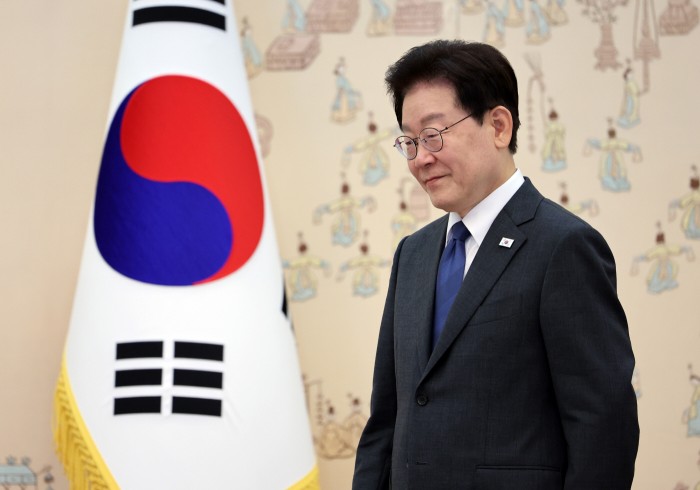 |
| President Lee Jae-myung leaves the venue after concluding the credential presentation ceremony for foreign ambassadors to South Korea held at Cheong Wa Dae on the 12th. / Yonhap |
President Lee Jae-myung faces a critical test as he seeks to untangle a cascade of pending bilateral issues with the United States, spanning investment, national security, and intelligence cooperation. While the first project under South Korea's strategic investment initiative in the U.S. is underway, differing stances on follow-up ventures persist, progress in security consultations remains sluggish, and friction over intelligence-sharing has added to the strain. To resolve these intertwined challenges, Cheong Wa Dae is reportedly giving broad consideration to expanding high-level communication and the potential reshuffling of select foreign policy and national security officials.
According to government sources on the 12th, South Korea and the U.S. are pursuing the Encinal combined-cycle gas turbine power plant project in Texas as the flagship initiative under South Korea's 200 billion dollar strategic investment package in the U.S. The two sides have also outlined a broad framework for cooperation on the construction of large-scale nuclear power plants in the United States.
However, a noticeable gap remains over the Alaska liquefied natural gas (LNG) project. While Seoul maintains that commercial feasibility and domestic statutory requirements must be satisfied before reaching an investment decision, U.S. President Donald Trump has continued to frame South Korea's participation as a foregone conclusion. Divergent views on project terms and timelines for follow-up investments could emerge as key friction points between the two nations.
Unresolved matters requiring follow-up discussions are also mounting in the security arena. During their summit last month, President Lee and President Trump addressed topics such as fuel for nuclear-powered submarines, uranium enrichment, and spent fuel reprocessing, but these talks have yet to produce tangible outcomes. Moreover, controversy over signs of strain in intelligence cooperation has deepened following revelations that the U.S. partially curbed the sharing of intelligence on North Korea and that South Korea's National Intelligence Service was excluded from a trilateral working-level meeting between South Korea, the U.S., and Japan on countering North Korean cyber threats.
Scrutiny has centered in particular on Unification Minister Chung Dong-young's public remarks regarding a North Korean uranium enrichment facility in Kusong, cited as the catalyst for the restriction on intelligence sharing. In a press briefing that day, Minister Chung pushed back, arguing that "this time, the United States is mistaken," noting, "I publicly mentioned the Kusong nuclear facility back in July of last year, even before taking office as minister." Rejecting opposition calls for his dismissal, he countered, "What ought to be dismissed is a skewed view of the alliance."
Discussions are underway within the government and Cheong Wa Dae on the need to overhaul communication channels with Washington. Along with expanding direct high-level exchanges—including potential U.S. visits by Cheong Wa Dae officials—the administration is reportedly reviewing the possibility of replacing select members of the foreign policy and national security team, including Minister Chung. As President Lee works to reconcile differences across individual issues while dispelling doubts over mutual trust, the political burden on his leadership appears to be mounting.
Park Young-hoon
Most Read
-
1
Kia Sportage outperforms Mazda CX-5 in German auto..

-
2
Houthis launch successive attacks on Saudi airport..

-
3
Saudi Arabia, Iran hold first diplomatic talks to..

-
4
U.S. deploys carrier, 10,000 more troops to Middle..

-
5
Saudi airport in Riyadh struck again, leaving at l..

-
6
Japan tracks Ukraine fiber-optic drones, bolsters..

-
7
Putin's ally visits China on the 8th ahead of APEC..

PEOPLE





HEADLINE NEWS

-
Address : In-Young Bldg., 34, Uisadang-daero 1-gil, Yeongdeungpo-gu, Seoul
Copyright by ASIATODAY CO., LTD. All rights resereved