



American expert says ‘Takaichinomics’ unlikely to spur growth despite fiscal stimulus
Oct 06, 2026, 01:13 pm


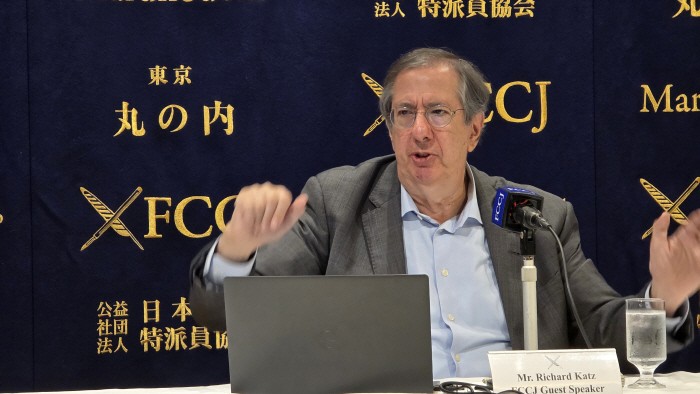 |
| Richard Katz, publisher of Japan Economy Watch, raised strong doubts about the Takaichi administration's investment-led growth strategy during a press conference at the Foreign Correspondents' Club of Japan (FCCJ) in Tokyo on the 6th. He argued that setting investment targets without improving corporate incentives to invest and household purchasing power makes it difficult to achieve the anticipated growth. / Tokyo Correspondent Choi Young-jae |
An assessment has emerged from an American expert on the Japanese economy indicating that Japanese Prime Minister Sanae Takaichi's "Takaichinomics," which seeks to revive the economy through increased fiscal spending and investment, will struggle to succeed without a recovery in wages and consumption. The analysis suggests that while Japan has room to sustain fiscal expansion, spending more money alone cannot alter its low-growth economic structure.
Richard Katz, publisher of Japan Economy Watch, raised strong doubts regarding the Takaichi administration's investment-led growth strategy during a press conference at the Foreign Correspondents' Club of Japan (FCCJ) in Tokyo on the 6th. He argued that setting investment targets without improving corporate incentives to invest and household purchasing power makes it difficult to achieve the intended growth.
The core issue pointed out by Katz is stagnation in wages and consumption. He assessed that gains from productivity growth do not sufficiently translate into real wages, leaving households without enough purchasing power for goods and services. Even if businesses expand output, demand to purchase those products fails to keep pace. As a result, a structure has persisted where the government must step up spending to prop up deficient demand. He maintained that relying solely on expectations that wages will naturally rise as corporate investment increases cannot break this vicious cycle.
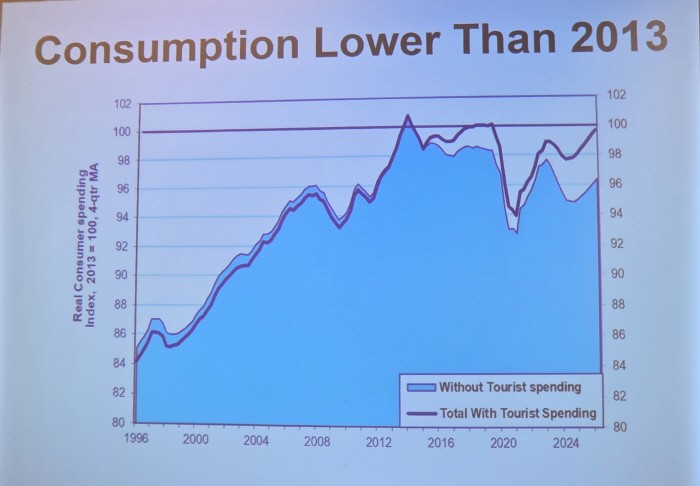 |
| The trend of Japan's real consumer spending (2013 = 100) presented by Richard Katz at a press conference at the Foreign Correspondents' Club of Japan (FCCJ) in Tokyo on the 6th. Consumer spending, excluding tourist expenditures, remains below the 2013 level. Katz pointed out that reviving the Japanese economy through expanded investment alone is difficult without a recovery in wages and consumption. / Tokyo Correspondent Choi Young-jae |
He also cited the government's heavy reliance on private enterprise participation in its investment initiatives as a problem. He noted that proposing large-scale investment plans by the government is entirely different from companies evaluating business viability and actually deploying capital.
Katz emphasized that "what generates growth are enterprises capable of turning investment and technology into economic value." This means that rather than fixating on expanding investment figures, conditions must be fostered so invested capital can enhance productivity and profitability. He argued that the economic structure must also shift to allow labor and capital trapped in low-productivity sectors to move toward competitive companies.
However, he did not link his criticism of the growth strategy to projections of an immediate fiscal crisis. Katz assessed that the Takaichi administration's expansionary fiscal policy itself remains sustainable, remarking that "even bad policies can persist for quite a long time." He explained that even if yields on newly issued government bonds rise, those rates do not immediately apply to the entire stock of bonds issued at lower yields in the past. Therefore, the government's overall interest burden should not be judged solely by the yields of newly issued debt. He stated that his primary concern is a gradual erosion of growth potential rather than a sudden financial crisis.
He was relatively positive about the Bank of Japan raising interest rates in tandem with fiscal expansion. Katz diagnosed that Japan is simultaneously experiencing rising import prices and sluggish domestic demand, placing the central bank in a difficult position. He explained this as a dilemma where interest rates should be lowered to address economic weakness, but raised to curb inflation.
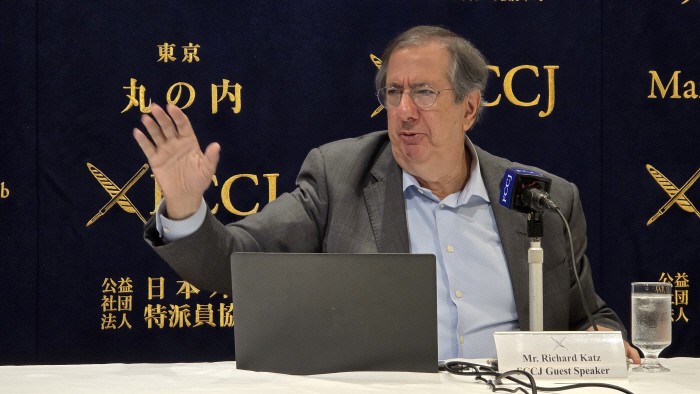 |
| Richard Katz, publisher of Japan Economy Watch, found potential for Japan's economic recovery in young entrepreneurs, female talent, and startups. / Tokyo Correspondent Choi Young-jae |
He assessed that the Bank of Japan's approach of adjusting interest rates incrementally while gauging market and real-economy responses is broadly reasonable. However, he expressed critical views regarding its economic forecasting and market communication methods.
He identified the potential for Japan's economic recovery in young entrepreneurs, female talent, and startups. As policy alternatives, he proposed improving financing channels for startups, allowing the carryforward of tax credits, and expanding startup participation in public procurement. He emphasized that solutions exist for Japan, and the political choices made to implement them are what matter most.
Richard Katz is an expert who has analyzed the Japanese economy for more than 40 years. He published the Japan-focused economic publication The Oriental Economist Report for two decades and served as a senior fellow at the Carnegie Council for Ethics in International Affairs. In 2023, he published a book with Oxford University Press analyzing the future of Japan's economy through competition between entrepreneurs and corporate giants.
Choi Young-jae
Most Read
-
1
Alteogen secures European patent for Keytruda SC,..

-
2
Trump shares map on social media labeling Strait o..

-
3
Celltrion seeks rheumatoid arthritis indication ex..

-
4
Kia Sportage outperforms Mazda CX-5 in German auto..

-
5
Chinese e-commerce giants AliExpress, Temu and She..

-
6
U.S. deploys carrier, 10,000 more troops to Middle..

-
7
Trump rejects Iran's offer to open Strait of Hormu..

PEOPLE







-
Address : In-Young Bldg., 34, Uisadang-daero 1-gil, Yeongdeungpo-gu, Seoul
Copyright by ASIATODAY CO., LTD. All rights resereved