



Vance says Alaska LNG details need further talks with Seoul
Oct 06, 2026, 10:42 am


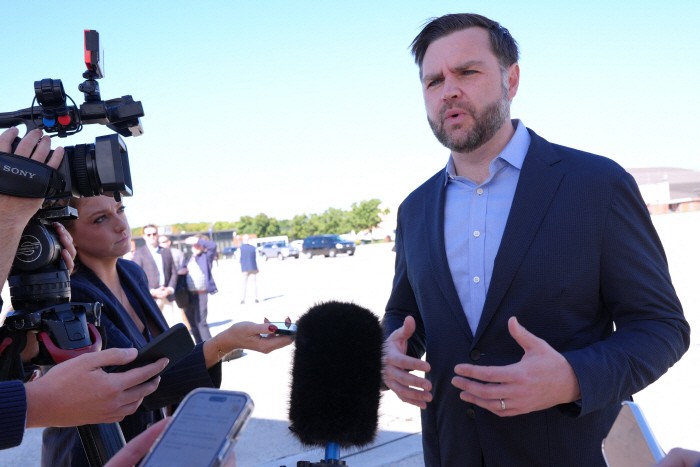 |
| U.S. Vice President J.D. Vance answers reporters' questions before boarding Air Force Two at Joint Base Andrews in Maryland on the 5th (local time). Vice President Vance departed to attend a campaign rally in Fairbanks, Alaska, ahead of the midterm elections. / AFP, Yonhap |
Article summary:
1. U.S. Vice President Vance acknowledged South Korea's unconfirmed investment stance, expressing belief that the Alaska liquefied natural gas project will materialize while noting that details remain to be negotiated with South Korea.
2. President Trump announced that 54 billion dollars would be allocated to Alaska LNG out of South Korea's 200 billion dollars in U.S. investments, but the South Korean government stated that whether to invest and the exact scale remain undecided.
3. The joint U.S.-South Korea fact sheet released by the U.S. Department of Commerce omitted specific investment figures, stating only that project work would commence subject to commercial conditions.
4. Developer Glenfarne estimated total project costs at 44.5 billion to 54.5 billion dollars, noting that an additional 3 million tons in commitments beyond the existing 13 million tons is needed to support a final investment decision.
U.S. Vice President J.D. Vance stated on the 5th (local time) that while he expects the Alaska liquefied natural gas (LNG) development project to materialize, details still remain to be negotiated with South Korea. Unlike U.S. President Donald Trump, who announced South Korea's 54 billion dollars (72.495 trillion won) investment as an established fact, Vice President Vance acknowledged the need for further consultations, noting that the South Korean side has pointed out remaining details.
 |
| U.S. Vice President J.D. Vance (second from right) and Second Lady Usha Vance (left) walk to board Air Force Two at Joint Base Andrews in Maryland on the 5th (local time). / AFP, Yonhap |
Vance says details remain to be negotiated with South Korea on Alaska LNG project while expressing optimism about realization
Before boarding his plane for a visit to Alaska at Joint Base Andrews in Maryland near Washington, D.C., on that day, Vice President Vance answered reporters asking whether the Alaska project would proceed despite South Korea's denial of a finalized investment, stating, "I think this is something that is going to happen," adding, "Obviously, there are still some details to work through, and South Korea has mentioned that as well."
Vice President Vance expressed confidence in moving the project forward itself. He said, "There is demand for this sort of thing, and the demand for U.S. natural gas is really strong, so I think we are going to be able to get this done." Vice President Vance also mentioned that not only the U.S. but also South Korea, Japan, and Southeast Asian countries hope for the success of this project.
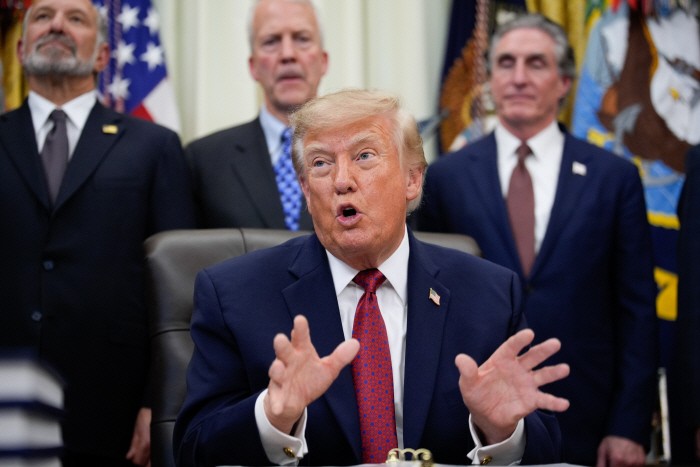 |
| U.S. President Donald Trump (center) announces South Korea's 200 billion dollar investment plan in the U.S. under the US-Korea Trade and Investment Initiative in the Oval Office at the White House in Washington, D.C., U.S., on September 30 (local time). This included the 54 billion dollar Alaska liquefied natural gas (LNG) pipeline construction project. / EPA, Yonhap |
Trump announces 200 billion dollar investment from South Korea and proposes 54 billion dollars for Alaska LNG
Vice President Vance's remarks that day are interpreted as differing in tone from President Trump's approach of presenting the investment scale as a finalized matter. In the Oval Office at the White House on the 30th of last month, President Trump stated, "Thanks to the agreement my administration secured with the Republic of Korea, they will invest up to 200 billion dollars (268.5 trillion won)," citing eight large nuclear reactors, a natural gas pipeline, and a 6-gigawatt (GW) power generation facility in Texas as key investment areas.
Among these, 54 billion dollars was allocated for the Alaska LNG pipeline. President Trump said, "This alone will be one of the largest energy projects in American history and a massive victory for the people of Alaska."
The announcement represents the first major cluster of projects drawn from the 350 billion dollar (469.875 trillion won) investment package proposed by South Korea as part of last year's trade agreement. The package consists of 150 billion dollars (201.375 trillion won) for shipbuilding and 200 billion dollars for strategic investments, alongside a separate pledge by South Korea to purchase 100 billion dollars (134.25 trillion won) worth of U.S. energy. In exchange for these investment commitments, South Korea secured an agreement lowering U.S. tariffs on most items from 25% to 15%.
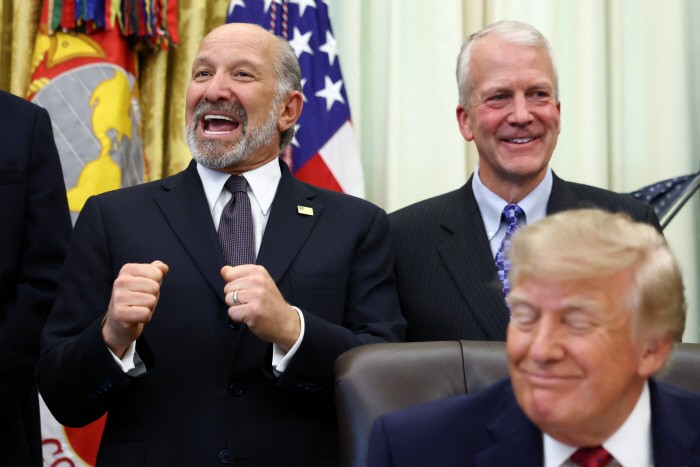 |
| U.S. Commerce Secretary Howard Lutnick (left) speaks regarding the Alaska energy infrastructure project in the Oval Office at the White House in Washington, D.C., U.S., on September 30 (local time). U.S. President Donald Trump and Republican Senator Dan Sullivan of Alaska listen. / Reuters, Yonhap |
South Korea states investment decision and scale remain undecided while US-Korea fact sheet also omits dollar amount
The South Korean government denied having agreed to the investment, explaining that it had merely left the project as an item for future consultation with the United States. The Ministry of Trade, Industry and Energy stated that it will review the commercial feasibility and compliance with legal procedures of the Alaska LNG project, adding that "no decision has been made regarding whether to invest or the scale of the investment."
The Wall Street Journal (WSJ) reported that Trade, Industry and Energy Minister Kim Jung-kwan stated at a briefing, "Presenting figures or using definitive expressions goes far beyond what was agreed." Minister Kim expressed regret to U.S. Commerce Secretary Howard Lutnick, stating that the White House announcement exceeded the scope of the agreement, and noted that Secretary Lutnick showed understanding of the South Korean concerns.
The WSJ pointed out that the joint U.S.-South Korea fact sheet released by the U.S. Department of Commerce did not specify an investment amount, stating only that both countries would "begin work" on the Alaska LNG project subject to certain commercial conditions. South Korea's Ministry of Trade, Industry and Energy also explained that the two nations had agreed to "commence a review" of the project.
The South Korean government confirmed plans to invest 22.3 billion dollars (29.9378 trillion won) in a gas power plant project in Texas and 120 billion dollars (161.1 trillion won) in the construction of eight nuclear reactors.
In a post on X (formerly Twitter), President Lee Jae-myung stated that both the LNG project and nuclear power plant initiatives can only proceed once their commercial viability is verified. In response, President Trump dialed up the pressure on the 2nd, stating, "Did they say they didn't agree? Tell them if they don't agree soon, I'll double it."
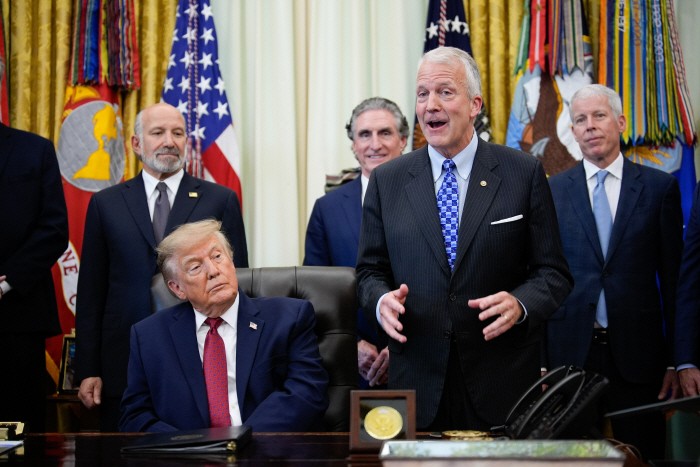 |
| U.S. Republican Senator Dan Sullivan of Alaska (right) speaks regarding the Alaska energy infrastructure project in the Oval Office at the White House in Washington, D.C., U.S., on September 30 (local time). / EPA, Yonhap |
Alaska LNG cost per capacity stands at 2.2 billion to 2.7 billion dollars, more than double recent US LNG projects
Questions surrounding the economic viability of the project also continue to emerge. Developer Glenfarne Group estimated the total project cost of Alaska LNG at 44.5 billion to 54.5 billion dollars (59.7413 trillion to 73.1663 trillion won). This translates to 2.2 billion to 2.7 billion dollars (2.9535 trillion to 3.6248 trillion won) per million tonnes per annum (mtpa) of production capacity, marking the highest level among U.S. LNG export projects proposed to date. Reuters reported that U.S. LNG projects approved following Russia's invasion of Ukraine have generally been constructed for roughly 1 billion dollars (1.3425 trillion won) or less per mtpa.
The White House explained that Alaska LNG is structured around constructing an 807-mile (about 1,300 km) pipeline from the North Slope to Nikiski in the south, transporting 3.9 billion cubic feet of natural gas per day and producing up to 20 million tons of LNG annually. Unlike Gulf Coast export terminals that utilize shale gas supply networks across Texas, Louisiana, and Appalachia, the Alaska initiative requires separate construction of a long-distance pipeline and North Slope gas treatment facilities. The pipeline construction cost alone has been estimated at 13.2 billion to 16.9 billion dollars (17.7210 trillion to 22.6883 trillion won).
Alaska LNG requires additional 3 million tons annually in commitments to reach final investment decision
Alongside the cost burden, securing the necessary off-take volume for a final investment decision (FID) remains a variable. Glenfarne has secured approximately 13 million tons per year in commitments, but an additional 3 million tons per year is required to underpin the FID and make existing commitments binding. Glenfarne stated, "We will work with the U.S. and South Korean governments to finalize the investment structure and complete the remaining procedures needed to reach FID."
Japan's top two LNG importers, JERA and Tokyo Gas, signed preliminary agreements to purchase a combined 2 million tons annually if the project is built. Since the project first emerged in 2014, successive plans to attract ExxonMobil, BP, and Chinese investors have fallen through, and South Korea and Japan both rejected U.S. investment proposals several years ago.
Vice President Vance's remarks that day came just before departing for a campaign support trip to Alaska. Vice President Vance visited Alaska to support Republican Senator Dan Sullivan, who is seeking re-election in the November midterm elections. Senator Sullivan is locked in a tight race under pursuit from the Democratic candidate, Representative Mary Peltola. Attending the White House announcement event on the 30th of last month, Senator Sullivan said, "This is massive for Alaska."
Jason Feer, head of business intelligence at Poten & Partners, told Reuters, "The question is whether Asian buyers are willing to pay a premium in exchange for supply security," adding, "So far, we have not seen evidence of that." Alex Munton, director of global gas and LNG research at Rapidan Energy Group, assessed that the project "may not meet commercial criteria for investment."
Ha Man-ju
Most Read
-
1
Alteogen secures European patent for Keytruda SC,..

-
2
Trump shares map on social media labeling Strait o..

-
3
Celltrion seeks rheumatoid arthritis indication ex..

-
4
Kia Sportage outperforms Mazda CX-5 in German auto..

-
5
Chinese e-commerce giants AliExpress, Temu and She..

-
6
U.S. deploys carrier, 10,000 more troops to Middle..

-
7
Trump rejects Iran's offer to open Strait of Hormu..

PEOPLE







-
Address : In-Young Bldg., 34, Uisadang-daero 1-gil, Yeongdeungpo-gu, Seoul
Copyright by ASIATODAY CO., LTD. All rights resereved