



S. Korean military says final DMZ probe found N. Korean mine was planted
Oct 06, 2026, 09:18 am


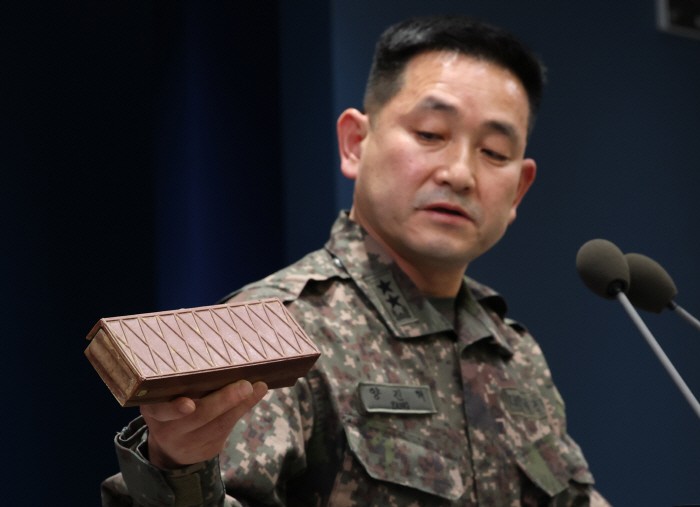 |
| Major General Yang Jin-hyuk, director of operations at the Joint Chiefs of Staff, holds up a previously recovered resin anti-personnel mine during a briefing announcing the final findings of the joint on-site investigation task force regarding the Demilitarized Zone (DMZ) landmine explosion, held at the Ministry of National Defense in Yongsan-gu, Seoul, on the 5th. / Yonhap |
The Joint Chiefs of Staff and the United Nations Command announced the final findings of the investigation into the Demilitarized Zone (DMZ) landmine explosion incident on the 5th. The incident was caused by the detonation of a North Korean resin anti-personnel mine, which was conclusively determined to have been artificially planted at least 12 months ago rather than being a displaced mine.
That day, the joint on-site investigation task force announced these final findings regarding the DMZ blast site at the Ministry of National Defense in Yongsan-gu, Seoul. The task force conducted a joint on-site investigation with the UNC from the 26th to the 29th of last month. Synthesizing the forensic evaluation results from the National Forensic Service received on the 2nd, the task force delivered its final investigation findings on the explosion site.
North Korean mine 'artificially' planted 12 months ago; military confirms "Armistice violation"
Based on scientific evidence and joint investigation findings with the UNC, the task force definitively determined that South Korean soldiers conducting normal DMZ operations south of the Military Demarcation Line (MDL) sustained severe injuries from a resin anti-personnel mine installed south of the MDL by North Korea under the pretext of its "border fortification" work. The UNC assessed that the mine had been positioned intentionally and placed at least 12 months prior.
Furthermore, considering the spacing between the discovered mine and the blast crater as well as the row-to-row intervals, investigators determined the location was not an area with a "displaced mine," but rather a "typical planted North Korean minefield." Because the resin anti-personnel mine discovered during the final investigation and the sites of the primary and secondary detonations were verified to be approximately 10 meters south of the MDL, the action was deemed a violation of the Armistice Agreement.
In addition, multiple forensic appraisals conducted by the National Forensic Service confirmed that TNT residues, brown foreign substances, and thermosetting resin components recovered from the soldiers' uniforms and gear matched those from a North Korean resin anti-personnel mine previously retrieved from the Imjin River.
During the briefing, Major General Yang Jin-hyuk, director of operations at the Joint Chiefs of Staff, directly displayed to reporters the North Korean resin anti-personnel mine recovered from the Imjin River. The mine is made of brown square-shaped plastic material with a checkered grid pattern on its surface. Major General Yang stated that its appearance is identical to the mine identified during the final on-site investigation on the 29th of last month.
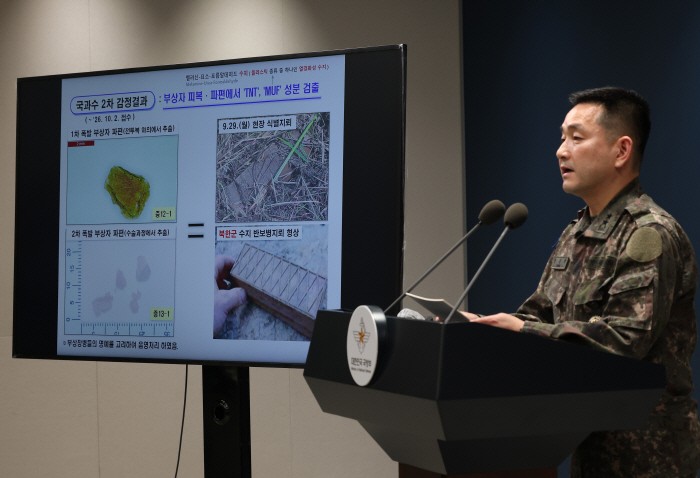 |
| Major General Yang Jin-hyuk, director of operations at the Joint Chiefs of Staff, explains the final findings of the joint on-site investigation task force regarding the Demilitarized Zone (DMZ) landmine explosion at the Ministry of National Defense in Yongsan-gu, Seoul, on the 5th. / Yonhap |
Military clears minefield directly and rejects criticism of passive response
Around 12:51 p.m. that day, the task force cleared the North Korean minefield in close consultation with the United Nations Command as an effective response to the casualties suffered by South Korean soldiers. Lieutenant General Kwon Dae-won, vice chairman of the Joint Chiefs of Staff, stated, "The purpose of this operation is to eliminate the minefield installed by North Korea south of the MDL in violation of the Armistice Agreement. If North Korea does not voluntarily remove them, our military will continue operations to clear mines laid south of the MDL."
In response to criticism over deploying South Korean military budgets and equipment for such dangerous operations, a Defense Ministry official explained, "While the action could increase risks to our soldiers, it builds experience in executing further measures and is one of the necessary counteractions."
Addressing criticism that limiting the action to demining operations constitutes a passive response, the official remarked, "This is the first time physical demining operations have been conducted, and we cannot agree that it is passive. While some might see it as lacking immediate, substantive impact, the international community will take notice, and we will pursue efforts through dialogue and pressure alike."
Regarding the resumption of anti-Pyongyang loudspeaker broadcasts, the official noted, "While loudspeakers have been effective in the past, it is also true that they caused inconvenience to local residents. We are studying realistic and varied measures, including whether they would still prove effective in the modern era and taking into account what North Korea actually fears."
The task force also explained the current status of the Military Demarcation Line. Following the signing of the Armistice Agreement in 1953, 1,292 marker signs were installed across the terrain along the pencil-drawn line on the military map. Due to aging, many markers have been lost, and only around 200 can be identified today.
Besides this line, the South Korean military uses the MDL depicted on military maps established by the U.S. National Ground Intelligence Center in 2004. Meanwhile, through its 2016 MDL Project, the United Nations Command uses a line connecting coordinates created across roughly 23,000 points at 10-meter intervals. If North Korea applies its own separate MDL, at least four mutually inconsistent demarcation lines are coexisting and competing inside the DMZ.
Brigadier General Kim Sung-yoon, head of intelligence analysis at the Joint Chiefs of Staff, stated, "We assess that the North Korean military is carrying out border fortification work based on the lines connecting the markers or on their own applied MDL. Our military continues consultations with the UNC to align the MDL baselines."
A Defense Ministry official explained, "MDL discrepancies continue to generate issues between North and South. We proposed alignment to the North in November last year, but received no response. No additional proposals have been made, and we view North Korea as having made no efforts toward alignment to date. Aligning the MDL requires active discussions through military talks. There have been efforts on our part to align the standards internally first so dialogue would even be possible."
According to the Joint Chiefs of Staff, North Korea initiated its border fortification work in 2024 following its unilateral scrapping of the inter-Korean military agreement in 2023 and its definition of inter-Korean ties as two hostile states. Since March of last year, it has expanded this work across the entire length of the MDL. This year, up to 7,000 personnel per day have been mobilized to construct minefields and barbed-wire fences. Across the 250-kilometer MDL, barren-ground clearing is in its final stages, while barbed wire, minefields, and tactical roads are approximately 40 to 60 percent complete. The work is projected to conclude within the next two years.
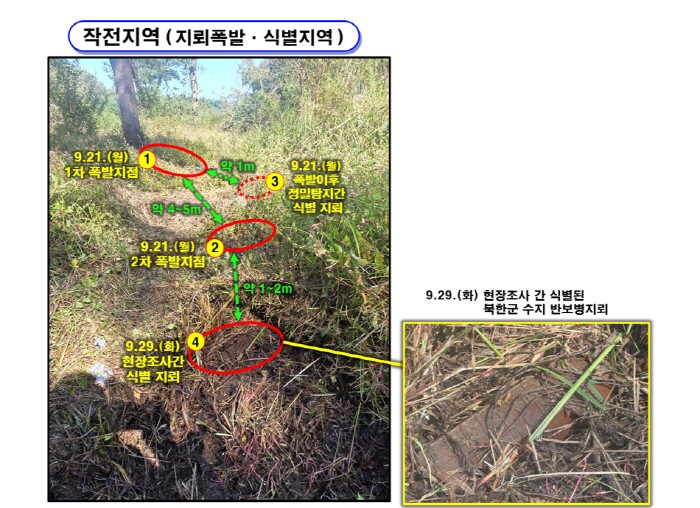 |
| A photograph released on the 5th during the briefing by the Joint Chiefs of Staff joint on-site investigation task force announcing the final findings regarding the landmine explosion during operations by the 25th Division in the DMZ. / Joint Chiefs of Staff |
MDL incursions identified over 50 times this year alone with an average breach of roughly 20 meters across the entire MDL
Since North Korea began work near the Military Demarcation Line, North Korean military incursions across the MDL have been identified 9 times in 2024, 17 times in 2025, and about 50 times in 2026. This year in particular, MDL incursions have been concentrated in specific sectors following the first incident in the eastern region in mid-August. North Korean guard post troops have been using cleared wasteland sections as patrol routes, patrolling daily through points 10 meters south of the MDL, resulting in around 40 recurring incursions at a single location.
Brigadier General Kim stated, "Regarding this, we are carrying out normal operational procedures. During this process, when warning shots are fired, North Korean troops check their location holding maps or observe our side, suggesting they perceive that they have not crossed the MDL. Across the entire 250-kilometer MDL, the depth of the breached sectors varies by region, but the average incursion southward is about 20 meters. Whenever incursions occur, we execute operations decisively in accordance with established principles and standards."
Vice Chairman Kwon emphasized, "Our military strongly urges North Korea to offer a sincere apology even now to our soldiers wounded in this landmine blast, and to immediately remove the mines installed in violation of the Armistice Agreement."
Regarding this landmine explosion incident, the Ministry of National Defense maintains that it will take necessary measures. A Defense Ministry official stated, "Taking necessary measures remains the stance of the Ministry of National Defense. Specific explanations are restricted because operational security must be maintained to prevent North Korea from preparing and responding."
Lee Han-sol
Most Read
-
1
Alteogen secures European patent for Keytruda SC,..

-
2
Trump shares map on social media labeling Strait o..

-
3
Celltrion seeks rheumatoid arthritis indication ex..

-
4
Kia Sportage outperforms Mazda CX-5 in German auto..

-
5
Chinese e-commerce giants AliExpress, Temu and She..

-
6
U.S. deploys carrier, 10,000 more troops to Middle..

-
7
Trump rejects Iran's offer to open Strait of Hormu..

PEOPLE







-
Address : In-Young Bldg., 34, Uisadang-daero 1-gil, Yeongdeungpo-gu, Seoul
Copyright by ASIATODAY CO., LTD. All rights resereved