



Trump, Putin, Zelenskyy may hold peace talks at G20 summit
Nov 23, 2026, 09:10 am


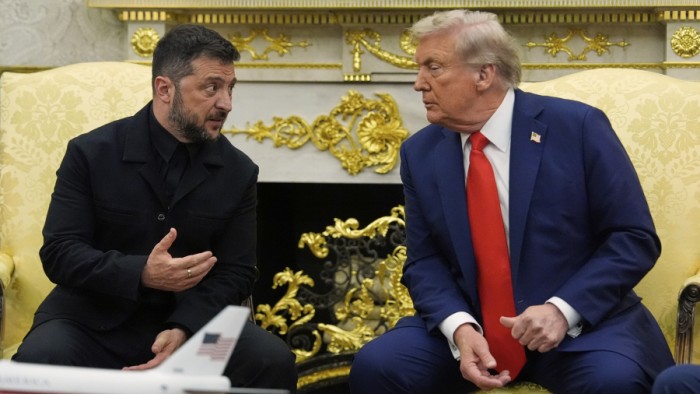 |
| U.S. President Donald Trump (right) and Ukrainian President Volodymyr Zelenskyy discuss the Russia-Ukraine war during a meeting at the White House on August 18 last year (local time). / AP-Yonhap |
The leaders of the United States, Russia and Ukraine may meet before Christmas for negotiations to end the war. Ukrainian President Volodymyr Zelenskyy has agreed to a recent proposal by U.S. President Donald Trump to hold trilateral talks. The three leaders could meet as early as next month on the sidelines of the Group of 20 (G20) summit in the United States.
However, Russian President Vladimir Putin's attendance has yet to be confirmed, leaving it uncertain whether the talks will lead to an actual peace agreement. This is because Russia and Ukraine remain divided over key issues, including territory and NATO-style security guarantees.
According to The Washington Post (WP), Reuters and other news outlets on November 21 (local time), Zelenskyy said the United States had proposed holding trilateral peace talks. Expressing hope that the talks would take place soon, Zelenskyy stressed, “The sooner we see results, the better.” However, Zelenskyy has yet to receive an official invitation.
Germany urged the United States to formally invite Zelenskyy, arguing that Ukraine's future should not be decided without its participation. Putin, on the other hand, has already received an invitation from the United States. Russia has not attended a G20 summit since 2019. The Kremlin has yet to clarify whether Putin will attend this time.
Trump presses for peace talks before shift in congressional control
Analysts suggest that Trump's push to accelerate peace negotiations is linked to domestic political developments in the United States. Britain's Financial Times (FT) reported that Trump wants to end the war before the Democratic Party secures a majority in the U.S. Congress in early January next year.
The reasoning is that Trump's negotiating leverage could weaken if Democrats increase support for Ukraine and tighten sanctions against Russia. According to Reuters, Trump recently told a meeting of countries supporting Ukraine in Berlin by telephone that “European countries are spending a great deal of money on the war in Ukraine” and that “they could spend this money at home once the war ends.”
Zelenskyy did not interpret the remarks as a threat, but he remains more skeptical than the U.S. side about whether Russia is ready to make compromises.
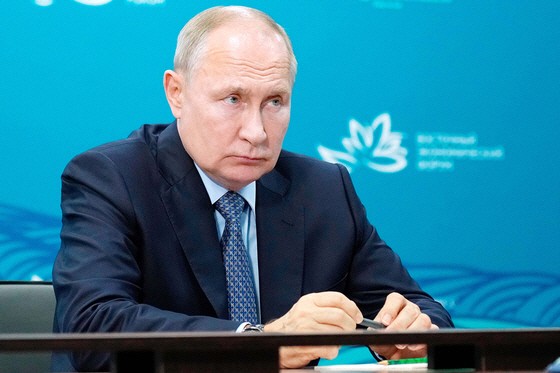 |
| Russian President Vladimir Putin. / AP-Yonhap |
NATO-style security guarantees and territorial disputes remain major obstacles
A central issue in the negotiations is Ukraine's postwar security. In this regard, the United States has presented Ukraine and Russia with a proposal for NATO-style security guarantees. According to the Associated Press (AP), Trump's envoy Jared Kushner recently presented the proposal during a meeting with European leaders.
The proposal involves a commitment similar to NATO's Article 5 collective defense principle, under which an attack on one member is considered an attack on all members.
Russia has refused to make any concessions on territory. In particular, Russia is prioritizing its demand for the transfer of the entire Donbas region, leaving discussions at a standstill.
Ukraine has made clear its opposition to this demand. It maintains that effective security guarantees capable of preventing another Russian invasion must come first. Russia and Ukraine also remain divided over the specific form such guarantees should take.
Earlier this month, the two sides sought to improve the atmosphere by reaching agreements on humanitarian issues, including a large-scale prisoner exchange, through U.S. mediation. However, military clashes have continued as the parties have failed to achieve a breakthrough on core issues such as territory and security. Tensions have risen following Russian airstrikes on Ukrainian facilities and Ukrainian forces' bombardment of the Crimean Bridge.
Against this backdrop, Zelenskyy expressed concern that Russia could deliberately delay the talks despite U.S. mediation efforts. Unless the two sides narrow their differences on these two issues, reaching a substantive agreement is likely to remain difficult even if a trilateral meeting takes place at the G20 summit.
Cheon Hyun-bin
Most Read
-
1
AMD's Lisa Su floated as potential Nvidia successo..

-
2
China President Xi's Keynote Speech at the APEC C..

-
3
Iran resumes attacks after two months, targeting U..

-
4
Alice Huang, affair partner of Jensen Huang, repor..

-
5
Inside Kylin Villa, the symbol of China's reform h..

-
6
Xi secures fourth term as China reshuffles next-ge..

-
7
Trump, Xi, Putin call for security cooperation at..

PEOPLE







-
Address : In-Young Bldg., 34, Uisadang-daero 1-gil, Yeongdeungpo-gu, Seoul
Copyright by ASIATODAY CO., LTD. All rights resereved