



UN agrees to two years of talks on 'killer robot' regulations
Nov 23, 2026, 09:16 am


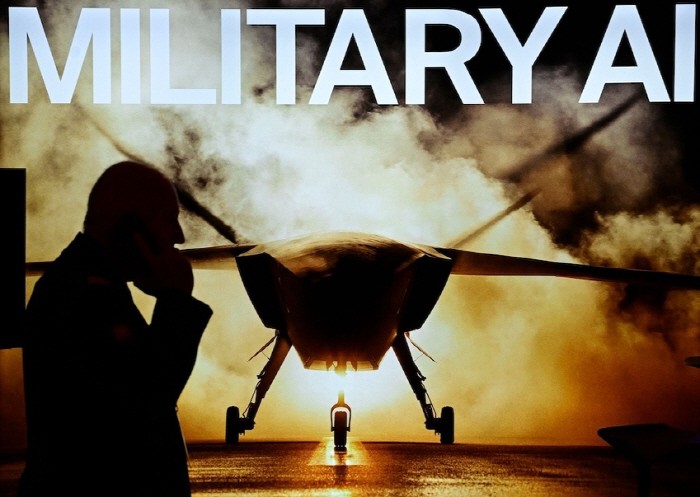 |
| A passerby walks past a poster promoting military AI outside a security conference in Berlin, Germany. / Yonhap News |
As the use of autonomous lethal weapons capable of identifying and attacking targets using artificial intelligence (AI) expands on the battlefield, the United Nations has moved to establish international rules to regulate so-called “killer robots.” However, reaching a substantive agreement is expected to be a difficult process, as major military powers, including the United States and Russia, remain reluctant to embrace legally binding regulations.
On November 21 (local time), the 128 states parties to the United Nations Convention on Certain Conventional Weapons (CCW) agreed to hold discussions over the next two years to develop international rules on lethal autonomous weapons systems (LAWS), following a five-day review conference in Geneva, Switzerland.
LAWS are weapons systems capable of detecting, selecting and attacking targets without direct human intervention. As advances in AI technology have led to their deployment on actual battlefields, controversy has grown over the extent of human control and responsibility for their use.
Julien Thöni, president of the CCW Review Conference, explained that future discussions would seek to establish more specific criteria for distinguishing between weapons that should be prohibited under international humanitarian law and those whose use should be restricted under certain conditions.
However, conflicting national interests present considerable obstacles to establishing such rules. While many countries are calling for a legally binding international treaty, the United States and Russia remain cautious about imposing restrictions on the development and use of autonomous weapons.
Civil society groups have criticized the decision for failing to keep pace with the proliferation of autonomous weapons. Stop Killer Robots (SKR), an international coalition of civil society organizations, pointed out that no concrete procedures or timetable had been presented for concluding a legally binding treaty.
“Autonomous weapons technology, including AI in the targeting cycle, is already being deployed on the battlefield,” said Nicole van Rooijen, executive director of SKR, warning that further delays in establishing regulations could increase the risks to civilians and humanity.
Nam Hyun-soo
Most Read
-
1
AMD's Lisa Su floated as potential Nvidia successo..

-
2
China President Xi's Keynote Speech at the APEC C..

-
3
Iran resumes attacks after two months, targeting U..

-
4
Alice Huang, affair partner of Jensen Huang, repor..

-
5
Inside Kylin Villa, the symbol of China's reform h..

-
6
Xi secures fourth term as China reshuffles next-ge..

-
7
Trump, Xi, Putin call for security cooperation at..

PEOPLE







-
Address : In-Young Bldg., 34, Uisadang-daero 1-gil, Yeongdeungpo-gu, Seoul
Copyright by ASIATODAY CO., LTD. All rights resereved