



[Exclusive] Hyundai scraps IONIQ 3 Australia launch amid Chinese low-cost EV push
Oct 06, 2026, 09:49 am


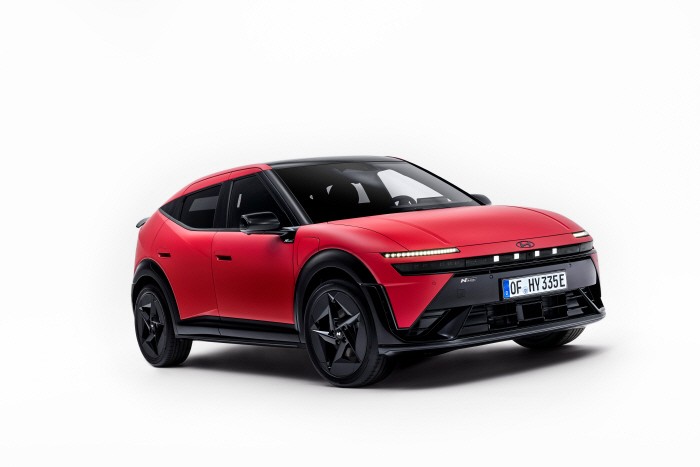 |
| The IONIQ 3 unveiled at the 2026 Milan Design Week held in Milan, Italy, in April. / Hyundai Motor |
Hyundai Motor has scrapped its plan to launch the compact electric vehicle IONIQ 3 in Australia, originally scheduled for early next year. The decision stems from the assessment that competing on price against low-cost Chinese electric vehicles rapidly eating into the local market is difficult. This suggests that aggressive pricing by Chinese automakers is beginning to influence Hyundai's global rollout strategy for new models.
According to automotive industry sources and foreign media reports on the 5th, Hyundai Motor Australia recently canceled its rollout plan for the IONIQ 3, which was slated for early 2027. Previously, Hyundai teased the launch of the IONIQ 3 on its local website and gathered prospective buyers, but it has now taken down the related page.
The IONIQ 3 is a compact electric hatchback developed by Hyundai targeting the European market. Built on the dedicated EV platform E-GMP, it is manufactured at the Izmit plant in Türkiye.
The primary reason behind the cancellation is price competitiveness. In Australia, Chinese automakers such as BYD and MG have been driving price competition by releasing a succession of budget electric vehicles. The local starting price for the IONIQ 3 was initially expected to be in the high-30-million-won range. Compared to rival models like the BYD Dolphin and MG 4, which sit below 30 million won, this creates a price gap of several million won or more.
The IONIQ 3 produced in Türkiye can leverage geographical advantages to keep logistics costs down within the European market, but exporting it as far as Australia presents a different reality. The addition of long-distance shipping and import costs makes it difficult to match prices against manufacturers exporting directly from China to Australia. Lowering prices erodes profitability, while securing adequate margins widens the price gap with Chinese electric vehicles, placing the automaker in a dilemma.
This decision is significant in that the low-cost offensive by Chinese automakers is moving beyond sales competition to reshaping how global carmakers allocate new models. Rather than expanding EV lineups and target countries indiscriminately, selecting models that can ensure market-specific profitability considering production and logistics costs has become crucial.
Hyundai is also reinforcing strategies that factor in profitability by market and model segment in line with shifting EV demand. Raising the proportion of local production in key markets like North America and Europe while diversifying powertrains to include hybrids and extended-range electric vehicles (EREVs) is part of its strategy to adapt to evolving market conditions.
Price competition is set to intensify further as Chinese automakers, led by BYD, expand their reach into Southeast Asia, Europe, and Australia. As cost competitiveness built on China's massive supply chain and production scale spills over into overseas markets, the burden on legacy automakers inevitably mounts. Consequently, Hyundai is expected to manage production hubs and target markets for new models far more selectively, focusing on regions where price competition against Chinese rivals is most severe.
An official from Hyundai Motor Australia stated, "In addition to high import costs, we have to compete in a segment that is extremely price-sensitive," adding, "Given the fierce competitive environment, we judged that the numbers simply do not make sense."
Nam Hyun-soo
Most Read
-
1
Alteogen secures European patent for Keytruda SC,..

-
2
Trump shares map on social media labeling Strait o..

-
3
Celltrion seeks rheumatoid arthritis indication ex..

-
4
Kia Sportage outperforms Mazda CX-5 in German auto..

-
5
Chinese e-commerce giants AliExpress, Temu and She..

-
6
U.S. deploys carrier, 10,000 more troops to Middle..

-
7
Trump rejects Iran's offer to open Strait of Hormu..

PEOPLE







-
Address : In-Young Bldg., 34, Uisadang-daero 1-gil, Yeongdeungpo-gu, Seoul
Copyright by ASIATODAY CO., LTD. All rights resereved