



Hyundai Glovis, U.S. LGL to build SMR-powered car carrier ecosystem
Oct 06, 2026, 09:43 am


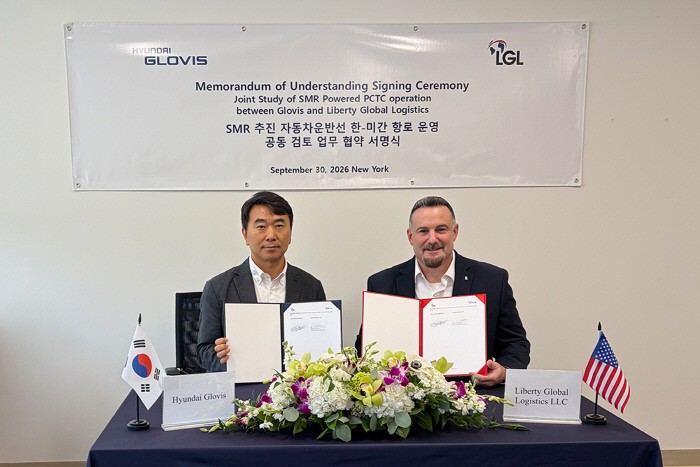 |
| From left, Kim Tae-woo, head of the Logistics Business Division at Hyundai Glovis, and David R. Minetti, president of LGL, pose for a commemorative photo during a partnership signing ceremony held at LGL headquarters in New York, U.S., on the 30th of last month. / Hyundai Glovis |
Hyundai Glovis announced on the 6th that it signed a memorandum of understanding with U.S. logistics and shipping company Liberty Global Logistics to jointly review operating routes between South Korea and the U.S. for small modular reactor-powered pure car and truck carriers.
LGL is a shipping and international multimodal transport specialist that handles automobiles, heavy equipment, breakbulk cargo, and project cargo, while also serving as a major contractor for the U.S. Department of Defense and armed forces to transport U.S. government freight.
Officials from both companies pledged collaboration to analyze the commercial feasibility of SMR-powered vessels.
Utilizing SMRs as a vessel power source is projected to generate virtually zero carbon emissions while enabling long-term navigation without refueling.
Analyses also indicate cargo-loading efficiency can be improved since fuel tanks and exhaust gas structures required on conventional ships are eliminated. Accordingly, the South Korean government is promoting the development and wider utilization of innovative SMRs based on the Special Act on SMRs, while also advancing SMR ship development combining nuclear power with shipbuilding and marine engineering as part of K-Moonshot.
Under this agreement, the two companies will jointly study the commercial operation potential of SMR-powered vessels centered on South Korea and the U.S. Hyundai Glovis will assess the characteristics of South Korean ports, regulatory environments, and navigation requirements, while LGL will review relevant domestic regulations and operational environments within the U.S.
The two sides also plan to conduct joint research on vessel development and construction feasibility, vessel flag states and classification societies, and commercialization strategies.
A Hyundai Glovis official stated, "Having previously established the technical feasibility of SMR-powered pure car and truck carriers, we plan to verify various conditions for actual commercial operation through this collaboration."
The official added, "Following our preemptive adoption of the world's largest liquefied natural gas dual-fuel powered PCTCs, we are expanding our review scope to next-generation zero-carbon vessel technologies to prepare for the future maritime shipping market."
Kim A-yoon
Most Read
-
1
Alteogen secures European patent for Keytruda SC,..

-
2
Trump shares map on social media labeling Strait o..

-
3
Celltrion seeks rheumatoid arthritis indication ex..

-
4
Kia Sportage outperforms Mazda CX-5 in German auto..

-
5
Chinese e-commerce giants AliExpress, Temu and She..

-
6
U.S. deploys carrier, 10,000 more troops to Middle..

-
7
Trump rejects Iran's offer to open Strait of Hormu..

PEOPLE







-
Address : In-Young Bldg., 34, Uisadang-daero 1-gil, Yeongdeungpo-gu, Seoul
Copyright by ASIATODAY CO., LTD. All rights resereved