



U.S. 30-year Treasury yield hits 5.613% intraday, highest since 2002 as bond selloff spreads
Sep 30, 2026, 10:40 am


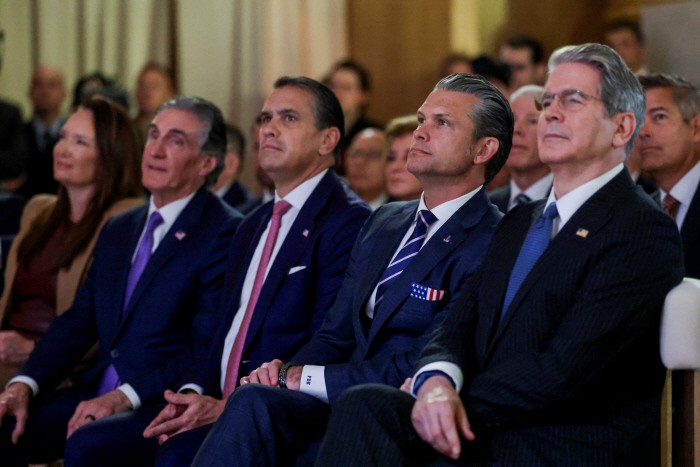 |
U.S. Agriculture Secretary Brooke Rollins (from left), Interior Secretary Doug Burgum, Attorney General Todd Blanche, Defense Secretary Pete Hegseth, and Treasury Secretary Scott Bessent attend a National Design Studio event for the launch of the AI-powered new government website "America.gov" held at the Mellon Auditorium in Washington, D.C., on the 29th (local time). / Reuters, Yonhap
The yield on the 30-year U.S. Treasury bond rose for a sixth straight trading session on the 29th (local time), topping 5.6% intraday to touch its highest level since 2002.
U.S. broadcaster CNBC tallied the intraday peak at 5.613%, while the U.S. daily Wall Street Journal (WSJ) reported that the 30-year yield logged its highest closing level since 2002. Long-term Treasury yields maintained their upward march amid sustained elevated oil prices and the pressure of heavy corporate bond issuance, despite an intraday pullback in global crude prices.
30-year yields hit 5.613% intraday, rising for 6 straight days, WSJ closing figures show discrepancy between 5.594% and 5.572%
The 30-year Treasury yield rose to 5.613% intraday, marking its highest level since 2002. CNBC reported that as of 2:50 p.m. on the 29th (local time; 3:50 a.m. on the 30th KST), the yield stood at 5.600%, up 3.8 basis points (1 bp = 0.01 percentage point) from the previous session.
The WSJ reported that the 30-year note finished at 5.594%, recording its highest closing level since 2002. Bloomberg News reported that with long-term yields surpassing 5.61%, the approximately $32 trillion U.S. Treasury market deepened a monthslong downturn.
|
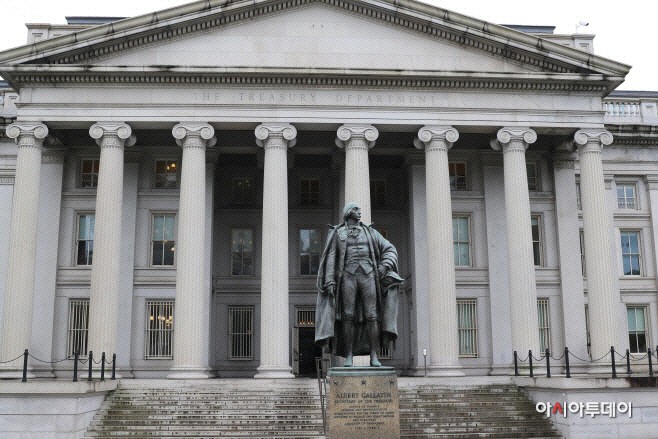 |
| The U.S. Department of the Treasury building in Washington, D.C. / Washington Correspondent Ha Man-ju |
U.S. 30-year yield hits 5.613% intraday, rising for 6 straight days to reach highest level since 2002
The 10-year Treasury yield also touched a 19-year intraday peak once again.
CNBC tallied the 10-year yield at 5.264% as of 2:50 p.m., up 2.2 basis points from the previous session. Bloomberg reported that it traded near 5.25%, hovering around its highest levels since 2007.
According to the WSJ, the 10-year yield edged down 0.3 basis point from 5.244% on the 28th to 5.241% on the 29th. After hovering around 4.3% in April, the 10-year yield surged sharply into the 5.2% range entering September.The 2-year yield also varied depending on the point of calculation.
CNBC reported that the 2-year yield was little changed at 4.922% as of 2:50 p.m., while Bloomberg reported that it fell by as much as 5 basis points following remarks from New York Fed President John Williams, trading around 4.89%.
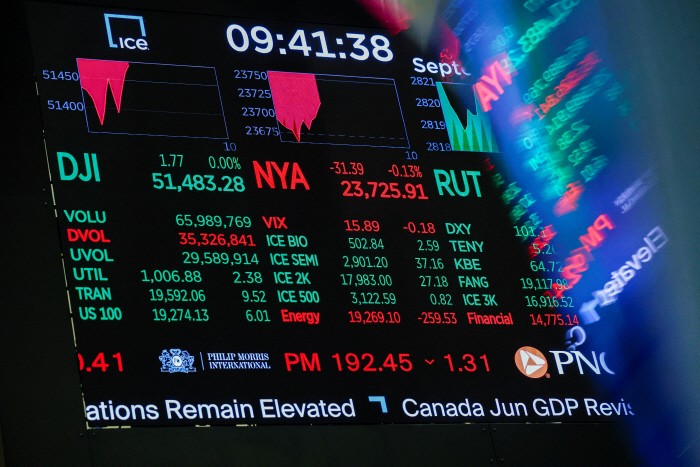 |
| Major indices are displayed on monitors at the New York Stock Exchange (NYSE) on the 29th (local time). / Reuters, Yonhap |
U.S. 10-year yield hits 5.264% intraday, 2-year yield slips to 4.89% following New York Fed remarks
President Williams remarked that to curb inflation, "one further upward adjustment" to the policy target range might be warranted later this year.
Markets had already been pricing in at least a 25-basis-point additional rate hike by year-end. Bloomberg reported that market pricing factors in a potential rate increase as early as the October meeting, with the possibility of about three additional hikes through mid-2027. Dan Carter, senior portfolio manager at Fort Washington Investment Advisors, noted that Williams' comments formed a notable contrast with other Fed officials who had stressed an urgent need for further rate increases.
Carter predicted that bets on an October rate increase would largely hold until the release of the September employment report on Friday. Following a rate increase in September, the Federal Reserve's current benchmark target range stands at 3.75% to 4.00%. The rates derivatives market is pricing in a terminal policy rate of 4.85% by September 2027, according to an analysis by TD Securities.
Long-term yields climb despite 2.6% drop in Brent crude, pressured by $32 billion corporate bond supply
On the day, international crude prices relinquished some of their recent sharp gains. Brent crude futures fell 2.6% to settle at $102.59 per barrel. Although the recovery of Middle Eastern oil supply heightened prospects of easing the energy supply crunch, long-term Treasury yields continued to march higher.
Bloomberg reported that elevated oil prices tied to the Middle East conflict are weighing on the global economy, driving investors to wager on additional rate increases by the Federal Reserve and other central banks. Higher Treasury yields pushed the greenback up as well, lifting the U.S. dollar by roughly 1.5% against major currencies in September. On Wall Street, the Dow Jones Industrial Average fell about 0.3% on the day.
Corporate bond supply also weighed heavily on long-duration paper. Paramount Skydance embarked on an offering of about $32 billion in investment-grade corporate bonds, part of a $52 billion syndicated debt package designed to fund its acquisition of Warner Bros. Discovery.
Monty Gandhi, interest rate strategist at SMBC, called it the fifth-largest investment-grade deal in history, noting that part of the rise in long-term yields was likely linked to this issuance.
Market points to lack of big buyers and unwind of yen carry trade, counterarguments cite excessive bond sell-off
Market assessments of the Treasury sell-off remained mixed. Michael Cloherty, head of U.S. rates strategy at CIBC Capital Markets, pointed out that while long-term bonds look historically cheap, major value buyers have not stepped in for over a month. Citigroup strategists analyzed that the Treasury market is experiencing a light buyer's strike.
Yardeni Research viewed the unwinding of the yen carry trade—where investors borrow cheaply in yen to fund higher-yielding assets—as fueling the sell-off. Wall Street veteran Jim Bianco turned bullish on U.S. Treasuries for the first time in six years, while veteran bond investor Chris Iggo projected a rebound after four sluggish years. Mark Dowding, chief investment officer at RBC BlueBay Asset Management, also evaluated that the global bond market sell-off had gone too far.
Based on Bloomberg indexes, U.S. Treasuries have shed 2.6% this year, following a 6.3% gain last year. Bloomberg noted that the recent downturn represents the steepest slump since Donald Trump's administration announced tariffs in April 2025.
U.S. Treasuries log -0.86% in September and -0.71% in October, jobs report and October hike bets loom as swing factors
According to Bloomberg, over the past decade, median monthly returns on U.S. Treasuries stood at -0.86% in September and -0.71% in October, marking the weakest stretch of the year. Performance rebounded to 0.69% in November. Bloomberg observed that September this year is on track to mark the worst September performance since 2023.
Bloomberg analyzed that the U.S.-Iran conflict, fiscal deficits, and a hawkish Fed are raising the risk of extending losses into October. Prashant Newnaha, senior rates strategist at TD Securities, likened the September rates market to a train wreck, warning that unless Middle East tensions are resolved, risk reduction in the bond market could spill over into equities.
Masahiko Loo, senior fixed-income strategist at State Street Global Advisors, explained that a seasonal test typically confronts U.S. Treasuries in October as debt supply builds and investors return from the summer lull. He warned that heading into Thanksgiving (November 26), the resumption of Treasury issuance, massive corporate debt sales, and capital expenditure demand for artificial intelligence are colliding, creating heightened competition for capital and amplified volatility in the Treasury market.
TD Securities projects 2-year notes at +4% and 30-year bonds at -8% if yields rise another 1 percentage point
The WSJ analyzed that amid surging long-term yields, the relative appeal of 2-year Treasuries has grown. The 2-year yield sits above 4.9%, narrowing the spread against the 10-year yield, which stands above 5.2%. By comparison, the Crane 100 Money Fund Index yields around 3.7%.
TD Securities calculated that even if 2-year yields climb by another 1 percentage point over the next year, total returns including coupon payments would come in at around 4%. Under the same conditions, 10-year notes would return approximately -2%, while 30-year bonds would post a loss of around -8%. Conversely, the WSJ noted that if interest rates fall sharply, long-term bonds would yield significantly larger upside gains.
Ha Man-ju
Most Read
-
1
Trump shares map on social media labeling Strait o..

-
2
Celltrion seeks rheumatoid arthritis indication ex..

-
3
Trump demands rates fall below 1% as Fed hikes for..

-
4
Chinese e-commerce giants AliExpress, Temu and She..

-
5
Trump warns countries not helping U.S. must pay re..

-
6
China expels No. 2 military official Zhang Youxia..

-
7
Houthi rebels release video claiming downing of Sa..

PEOPLE






HEADLINE NEWS
- UNC says N. Korea violated armistice agreement in DMZ landmine explosion
- U.S. 30-year Treasury yield hits 5.613% intraday, highest since 2002 as bon..
- Netanyahu faces political crisis ahead of election over allegations he igno..
- Chinese Foreign Minister Wang Yi demands retraction of Takaichi's remarks o..

-
Address : In-Young Bldg., 34, Uisadang-daero 1-gil, Yeongdeungpo-gu, Seoul
Copyright by ASIATODAY CO., LTD. All rights resereved