



Chinese Foreign Minister Wang Yi demands retraction of Takaichi's remarks on Taiwan contingency
Sep 30, 2026, 10:20 am


Wang Yi, member of the Political Bureau of the CPC Central Committee and Chinese Foreign Minister (who also serves as Director of the Office of the Central Financial and Foreign Affairs Commission), demanded during a meeting with former Japanese Foreign Minister Takeshi Iwaya that Japanese Prime Minister Sanae Takaichi retract remarks hinting at potential intervention in the event of a Taiwan contingency.
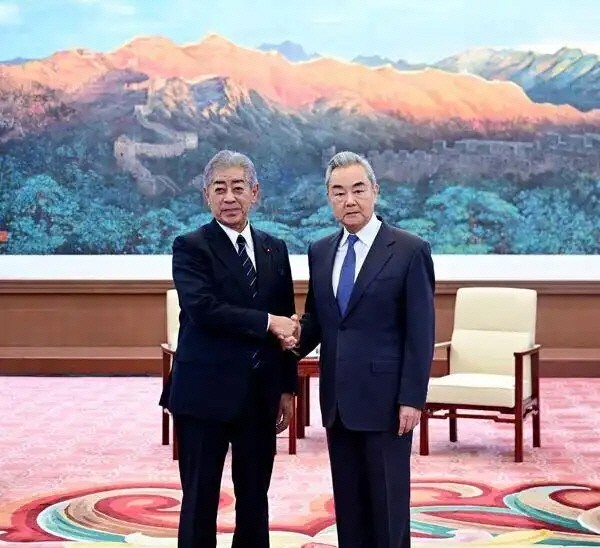 |
| Wang Yi, member of the Political Bureau of the CPC Central Committee and Chinese Foreign Minister, demanded a retraction of Japanese Prime Minister Sanae Takaichi's remarks hinting at potential intervention in the event of a Taiwan contingency during a meeting with former Japanese Foreign Minister Takeshi Iwaya. Wang Yi (right) shakes hands with former Japanese Foreign Minister Iwaya in Beijing on the 28th. / Xinhua |
According to Beijing diplomatic sources familiar with China-Japan relations on the 29th, Director and Minister Wang held talks in Beijing the previous day with former Japanese Foreign Minister Takeshi Iwaya, who was visiting China in his capacity as president of the Japan International Trade Promotion Association (JITA, hereinafter the Association). As expected, Wang immediately brought up historical issues as if he had been waiting, indirectly criticizing the Takaichi administration.
In particular, with Prime Minister Takaichi's remarks on a Taiwan contingency made in parliament last November in mind, Wang directly demanded that "Japan's urgent task is to promptly rectify its leader's mistaken words and deeds regarding the Taiwan question."
Last November, Prime Minister Takaichi argued in the Diet that potential Chinese use of force against the U.S. in the event of an attack on Taiwan "could constitute an existential threat situation" for Japan. This remark touched upon the possibility of armed intervention, as recognition of an existential threat situation allows the Self-Defense Forces to exercise the right of collective self-defense on a limited basis to support U.S. forces.
Naturally, China pushed back strongly. Bilateral relations were bound to deteriorate immediately. Since then, ties between the two countries have frozen to the point where they have largely ignored each other. Even now, there are virtually no signs of improvement.
Beijing diplomatic sources analyzed Wang's remarks against this backdrop, stating, "They appear aimed at rattling the Takaichi administration." At the same time, it should be noted that the remarks were not made with the intention of driving bilateral ties into total rupture. This interpretation finds support in a report by Japan's Asahi Shimbun, which observed that "(Director and Minister Wang) continued to criticize Prime Minister Takaichi while showing a stance of maintaining dialogue with Japan's political and business circles that value relations with China."
Given the various circumstances, it is fair to say that the likelihood of bilateral relations improving beyond their current state is quite low. In a worst-case scenario, this status quo will likely persist even after President and General Secretary Xi Jinping and Prime Minister Takaichi hold a summit at the Asia-Pacific Economic Cooperation (APEC) forum, scheduled for mid-November in Shenzhen, Guangdong Province. It seems safe to assert that Prime Minister Takaichi's remarks on a Taiwan contingency touched upon China's ultimate red line—one that should never be crossed.
Hong Soon-do
Most Read
-
1
Trump shares map on social media labeling Strait o..

-
2
Celltrion seeks rheumatoid arthritis indication ex..

-
3
Trump demands rates fall below 1% as Fed hikes for..

-
4
Chinese e-commerce giants AliExpress, Temu and She..

-
5
Trump warns countries not helping U.S. must pay re..

-
6
China expels No. 2 military official Zhang Youxia..

-
7
Houthi rebels release video claiming downing of Sa..

PEOPLE






HEADLINE NEWS
- UNC says N. Korea violated armistice agreement in DMZ landmine explosion
- U.S. 30-year Treasury yield hits 5.613% intraday, highest since 2002 as bon..
- Netanyahu faces political crisis ahead of election over allegations he igno..
- Chinese Foreign Minister Wang Yi demands retraction of Takaichi's remarks o..

-
Address : In-Young Bldg., 34, Uisadang-daero 1-gil, Yeongdeungpo-gu, Seoul
Copyright by ASIATODAY CO., LTD. All rights resereved