



China scrambles to revive sluggish domestic demand ahead of National Day holiday
Sep 28, 2026, 04:58 pm


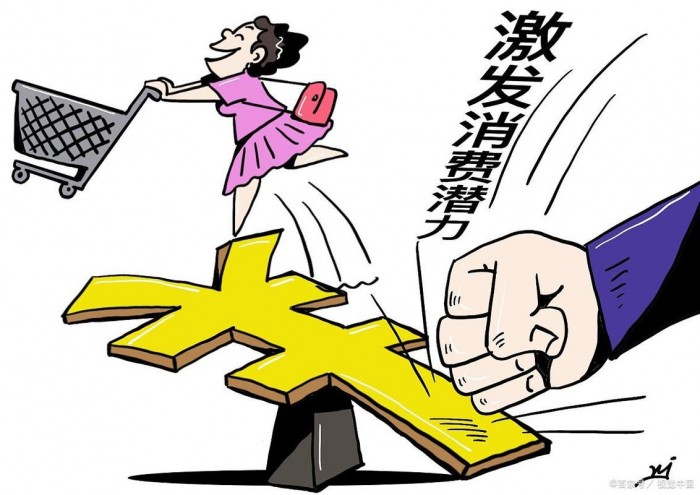 |
| An editorial cartoon from a media outlet depicting China's all-out efforts to stimulate domestic demand ahead of the National Day holiday, though positive results appear unlikely. / The Beijing News |
China is exploring every possible measure to maximally stimulate domestic demand—which can fairly be described as facing a substantial crisis—during the weeklong National Day holiday (October 1–7), one of the country's biggest festive seasons. It would hardly be an exaggeration to say that virtually the entire national capacity is being poured into this effort.
Synthesizing recent reports from media outlets including The Beijing News, the current state of the Chinese economy leads inevitably to the conclusion of considerable severity, contrary to official claims that conditions remain reasonably sound. It is fair to say that the reality shows economic activity deteriorating with each passing quarter. Given that growth in the second quarter stood at just 4.3%, dropping by a significant 0.7 percentage points from the 5.0% recorded in the first quarter, such an assessment is by no means an overstatement.
High expectations for the third quarter are also unlikely, given that business conditions have remained notably sluggish over the past three months. Analysts observe that both consumption and investment—critical drivers for bolstering domestic demand—have continued to show weakness following the second quarter. Economic authorities have little choice but to hope that the upcoming weeklong National Day holiday will serve as a turning point. There was clear rationale behind authorities heavily promoting the slogan "qing san xiu shi san" (take three days of leave to enjoy thirteen days off) well ahead of the recent Mid-Autumn Festival, encouraging workers across the country to take off the three bridging days between the two holidays.
The initiatives do not end there. Authorities plan to aggressively implement diverse programs to boost domestic demand. A prominent example is the issuance of consumer vouchers and direct subsidies under the banner of the National Day Culture and Tourism Consumption Month campaign. It is estimated that more than 310 million yuan (62.93 billion won) will be distributed nationwide. This injection is expected to offer notable support in stimulating domestic demand across culture, tourism, food and beverage, and retail sectors.
Also worth highlighting is the continued rollout of the trade-in subsidy policy ("yijiuhuanxin"—trading old goods for new), a term that has now become deeply familiar to Chinese consumers. This virtually ensures that almost all consumers purchasing new automobiles, home appliances, and digital gadgets nationwide during the National Day period will be eligible for subsidies. In Shanghai's Pudong district, for instance, a consumer purchasing a new car can receive a subsidy of up to 5,000 yuan.
Programs permitting high-speed rail and performing arts tickets to double as discount vouchers, along with a multitude of cultural and tourism festivals slated across the nation, need hardly be mentioned. These measures reflect the immense determination of Chinese authorities to revive the economy through an all-out push across domestic stimulus programs.
Judging by the current atmosphere, however, the outlook appears far from bright. Various economic indicators clearly point to deeply frozen consumer sentiment, and this year's National Day is widely expected to fall short of staging a massive economic rebound, much like last year. Foreign media are already characterizing China's uphill scramble to revive domestic demand as almost desperate, and that sentiment appears to be well-founded.
Hong Soon-do
Most Read
-
1
Trump demands rates fall below 1% as Fed hikes for..

-
2
Celltrion seeks rheumatoid arthritis indication ex..

-
3
Chinese e-commerce giants AliExpress, Temu and She..

-
4
Trump warns countries not helping U.S. must pay re..

-
5
China expels No. 2 military official Zhang Youxia..

-
6
Houthi rebels release video claiming downing of Sa..

-
7
Trump rejects Iran's offer to open Strait of Hormu..

PEOPLE







-
Address : In-Young Bldg., 34, Uisadang-daero 1-gil, Yeongdeungpo-gu, Seoul
Copyright by ASIATODAY CO., LTD. All rights resereved