



Taiwan and rare earths remain high hurdles despite U.S.-China tariff pact
Sep 28, 2026, 10:33 am


 |
| / Yonhap News |
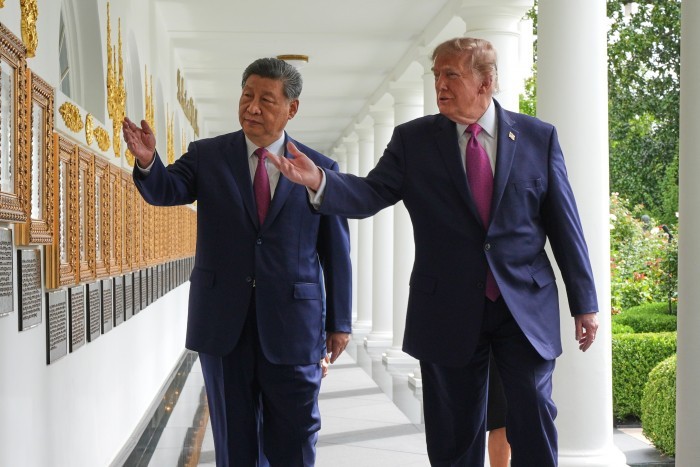
During their three-day summit last week, U.S. President Donald Trump and Chinese President Xi Jinping agreed to establish a dialogue on the risks and benefits of super intelligence (SI) and set up a communication channel in the event of related accidents, while also agreeing on recommendations for preferential tariff treatment on 30 billion dollars (40.77 trillion won) worth of non-sensitive goods each.
However, Xi's demand to oppose Taiwan independence was omitted from both nations' post-summit announcements, and discrepancies emerged between the statements of the two sides regarding rare earths, purchases of U.S. coal, and the designation of SI, underscoring differing stances on core issues.
In a fact sheet titled "President Donald J. Trump Advances Fair and Reciprocal Relations with China on Historic State Visit" released on the 25th local time, the U.S. White House stated that the U.S.-China Joint Commission on Commerce and Trade (JCCT) and the Joint Investment Committee, which both nations agreed to establish at the Beijing summit in May, were fully launched this week.
Through the trade commission, the two sides agreed on recommendations to grant more favorable tariff treatment to 30 billion dollars of non-sensitive items in each direction. U.S. exports covered under the recommendation include agricultural products, fish and seafood, logs and wood products, cosmetics, and medical devices, while Chinese exports include consumer goods such as small home appliances, toys, holiday decorations, and child safety seats. The trade commission also launched a working group to address market access barriers in the agricultural sector, and China is scheduled to import at least 10 million metric tons of U.S. coal each year in 2027 and 2028, the White House explained.
Nonetheless, the scale of this agreement remains limited compared to overall bilateral trade. Bloomberg News evaluated that 30 billion dollars accounts for only a fraction of the U.S.-China trade in goods and services, which totaled nearly 500 billion dollars (679.5 trillion won) last year. Bloomberg also pointed out that the extension of the tariff truce announced by U.S. Treasury Secretary Scott Bessent ahead of the summit lasts just two months until January 10 next year, falling short of the previously discussed six-month duration.
High tariff walls between the U.S. and China also remain firmly in place. Citing data from British investment bank Barclays, Bloomberg reported that Chinese goods face an effective average U.S. tariff of around 23%, more than three times higher than the roughly 7% levied on other major trading partners. Although both countries agreed to apply preferential tariff treatment to select goods, the steep tariff barriers across overall U.S.-China trade remain intact.
Ha Man-Ju
Hong Soon-do
Most Read
-
1
Trump demands rates fall below 1% as Fed hikes for..

-
2
Celltrion seeks rheumatoid arthritis indication ex..

-
3
Chinese e-commerce giants AliExpress, Temu and She..

-
4
Trump warns countries not helping U.S. must pay re..

-
5
China expels No. 2 military official Zhang Youxia..

-
6
Houthi rebels release video claiming downing of Sa..

-
7
U.S. allows Iranian delegation to attend UN Genera..

PEOPLE







-
Address : In-Young Bldg., 34, Uisadang-daero 1-gil, Yeongdeungpo-gu, Seoul
Copyright by ASIATODAY CO., LTD. All rights resereved