



Samsung Electronics nears 100 trillion won in operating profit while DRAM expansion faces wafer supply risks
Sep 28, 2026, 10:13 am


 |
Riding the boom in artificial intelligence (AI) semiconductors, Samsung Electronics is projected to post an operating profit in the 100 trillion won range for the first time in history in the third quarter. While the company's DRAM production capacity is also expected to expand by double digits next year, variables in the ramp-up process are mounting, including the reallocation of capacity toward HBM and the procurement of silicon wafers. In particular, although some analyses suggest that supply shortages have made certain commodity DRAMs even more profitable than HBM, Samsung Electronics is anticipated to continue increasing its share of HBM to secure leadership in the AI memory market.
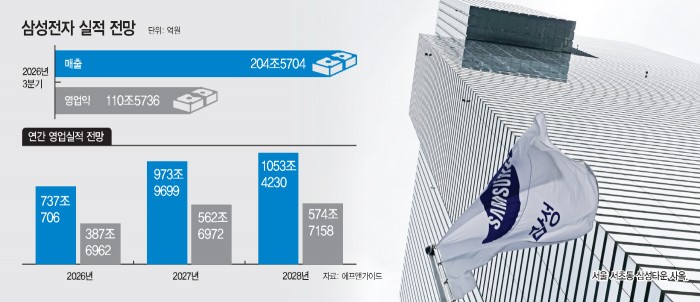
According to financial data tracker FnGuide on the 27th, the third-quarter consensus for Samsung Electronics' revenue and operating profit was tallied at 204.5704 trillion won and 110.5736 trillion won, respectively. If forecasts hold, quarterly operating profit will surpass 100 trillion won for the first time on record. The company's annual operating profit forecast for this year also reaches 387.6962 trillion won.
Leading this earnings growth is the Device Solutions (DS) division, which oversees semiconductors. With prices of commodity DRAM such as DDR5 and LPDDR5X holding at high levels and sales of HBM4 expanding, memory profitability has surged considerably. Backed by solid earnings power, Samsung Electronics is expected to move forward with expanding its DRAM production capacity. According to KB Securities, Samsung Electronics' monthly DRAM production capacity on a wafer-input basis is projected to grow 14% year over year this year and 16% next year.
However, the expansion in total production capacity does not translate directly into an increased supply of commodity DRAM, as more capacity is being allocated to HBM production to address AI market demand. HBM's share of total DRAM capacity is projected to rise from 27% in 2025 to 33% this year and 40% next year. Conversely, the share of commodity DRAM is expected to decline from 73% to 65% and then to 59% over the same period.
Consequently, the commodity DRAM supply shortage is likely to persist for the time being. Samsung Electronics' DRAM inventory as of September is estimated to have fallen to historical lows of under 10 days of supply. Lead times for high-capacity server DDR5 have also stretched from the typical six-week level to as long as 52 weeks.
The semiconductor output expansion is also impacting the market for silicon wafers, the foundational raw material. According to market research firm TrendForce, simultaneous production expansions in both logic and memory for AI have tightened 12-inch wafer supplies. The industry anticipates that prices for new long-term agreements (LTAs) starting in 2027 could jump 15% to 25% for 12-inch epitaxial wafers and by more than 40% for polished wafers.
For Samsung Electronics, because the required volume of wafers increases in tandem with DRAM capacity expansion, procurement scale and pricing could emerge as key variables in its production strategy. The DS division's raw material purchase expenses in the first half of this year reached 9.9963 trillion won, an increase of 22.2% from the same period last year. If wafer prices climb alongside higher output volumes, the financial burden of purchasing raw materials could rise accordingly.
Nevertheless, the prevailing market view holds that rising wafer prices will have only a limited impact on overall memory profitability. Strong product price increases driven by DRAM supply shortages continue, and profitability improvements remain substantial enough that the third-quarter DRAM operating margin is projected to top 80%. Wafer supply is thus viewed less as an immediate constraint on capacity expansion and more as a variable whose volume and procurement costs must be managed throughout future scale-ups.
A bigger dilemma lies in allocating limited production capacity across product lines. With commodity DRAM prices soaring, certain server-grade DDR5 modules have begun generating higher profit margins than HBM. TrendForce analyzed that since the first quarter of this year, revenue and profitability per wafer for DDR5 64GB RDIMMs have surpassed those of HBM.
Even so, Samsung Electronics is expected to maintain its course of expanding its HBM proportion. Rather than focusing solely on immediate profitability, securing supply relationships with global AI customers like Nvidia and translating those ties into contracts for next-generation products is critical to bolstering its dominance in the AI memory market.
Indeed, Samsung Electronics' HBM4 sales are accelerating rapidly. Third-quarter HBM4 revenue is expected to jump more than threefold from the previous quarter, with HBM4 projected to account for over 60% of total HBM revenue in the second half of the year. The proportion of HBM4 family products is expected to continue growing through next year as well.
Lee Ji-sun
Most Read
-
1
Trump demands rates fall below 1% as Fed hikes for..

-
2
Celltrion seeks rheumatoid arthritis indication ex..

-
3
Chinese e-commerce giants AliExpress, Temu and She..

-
4
Trump warns countries not helping U.S. must pay re..

-
5
China expels No. 2 military official Zhang Youxia..

-
6
Houthi rebels release video claiming downing of Sa..

-
7
Trump rejects Iran's offer to open Strait of Hormu..

PEOPLE







-
Address : In-Young Bldg., 34, Uisadang-daero 1-gil, Yeongdeungpo-gu, Seoul
Copyright by ASIATODAY CO., LTD. All rights resereved