



On-site investigation launched six days after DMZ explosion incident
Sep 28, 2026, 09:03 am


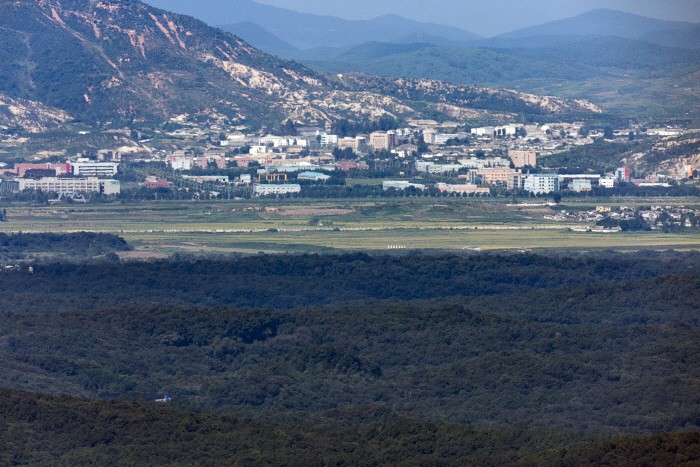 |
| As North Korea slammed the South Korea-U.S.-Japan multi-domain joint exercise Freedom Edge and other drills, the western front Demilitarized Zone (DMZ) and the Kaesong Industrial Complex area appear quiet and desolate when viewed from the border area in Paju, Gyeonggi Province, on the 8th. / Yonhap |
The South Korean military and the United Nations Command (UNC) conducted an on-site investigation on the 27th into an explosion that occurred in the Demilitarized Zone (DMZ), six days after the incident.
According to the Joint Chiefs of Staff (JCS) on that day, the military carried out an on-site probe alongside the UNC into the suspected landmine explosion in the DMZ, reaching the vicinity of the presumed blast site.
The deployed on-site investigation team comprised around 40 personnel, including South Korean operational troops, the UNC Military Armistice Commission (including its secretary), and investigative agencies. Some of the officers who had been on mission during the incident on the 21st also took part in the day's investigation.
Leading the way with mine detectors alongside UNC personnel, the military conducted precision mine sweeps along mobility routes inside the DMZ and cleared additional access routes from around 9:00 a.m. until sunset.
A JCS official stated, "Because the investigation area is an unidentified minefield within the DMZ presenting high risks, and the fatigue among participating personnel was severe, the operation was concluded with safety as the top priority, to be resumed at a later date. The military and the UNC plan to thoroughly determine the cause of the incident through further on-site investigations and will explain confirmed facts to the public objectively and transparently."
The previous day, the JCS and the UNC deployed troops into the DMZ to secure mobility routes and assess operational conditions as preparatory steps for the on-site probe. This was done to evaluate route safety and review overall operational conditions, including surveillance and communication status. The advance team consisted of about 20 personnel, with some soldiers who had been involved in the operation at the time of the blast voluntarily taking part.
On the day of the explosion, military authorities initially collected physical evidence from the bodies of the reconnaissance battalion commander and a staff sergeant who were severely injured, requesting analysis from the National Forensic Service. Attention is focused on whether more concrete details will be gathered and made public through this on-site investigation. Given the severity of the injuries, some observe that it was likely an antipersonnel toe-popper mine, meaning blast fragments may not have scattered far.
The primary focus centers on identifying the owner of the explosive. Because the blast occurred not along routes South Korean troops routinely patrol, but rather at a spot where a new reconnaissance path was being cleared, the possibility has been raised that it might be a North Korean device rather than South Korea's. Even if identified as North Korean, the military's response level is expected to hinge on whether the placement was intentional. If identified as a South Korean munition, lapses in maintenance and management will likely emerge as a major controversy.
The decision to initiate preparations and launch the on-site investigation before the holiday break concluded appears to reflect sensitivity to public criticism. Independent lawmaker Han Dong-hoon and lawmakers from the People Power Party leveled daily criticisms, arguing that the government had failed to provide any credible explanation regarding the DMZ blast. Concerns over potential site contamination were particularly acute, as heavy rain had been forecast for the area over the holiday period.
Meanwhile, a series of criminal complaints regarding the blast have been filed with the police targeting President Lee Jae-myung and top military commanders. The civic group People's Livelihood Countermeasures Committee announced that it filed a complaint with the Seoul Metropolitan Police Agency against nine individuals—including President Lee, National Security Adviser Wi Sung-lac, former Defense Minister Ahn Gyu-back, and current Defense Minister Kang Shin-chul—on charges including abuse of authority, dereliction of duty, and aiding the enemy.
Former People Power Party Seoul City Council member Lee Jong-bae also lodged a complaint with the Seoul Metropolitan Police Agency against Minister Kang on charges including dereliction of duty, abuse of authority, and destruction of evidence, citing allegations that the minister rejected a UNC proposal for an on-site investigation.
Lee Han-sol
Most Read
-
1
Trump demands rates fall below 1% as Fed hikes for..

-
2
Celltrion seeks rheumatoid arthritis indication ex..

-
3
Chinese e-commerce giants AliExpress, Temu and She..

-
4
Trump warns countries not helping U.S. must pay re..

-
5
China expels No. 2 military official Zhang Youxia..

-
6
Houthi rebels release video claiming downing of Sa..

-
7
U.S. allows Iranian delegation to attend UN Genera..

PEOPLE







-
Address : In-Young Bldg., 34, Uisadang-daero 1-gil, Yeongdeungpo-gu, Seoul
Copyright by ASIATODAY CO., LTD. All rights resereved