



Lee unveils ‘phased denuclearization’ plan for North Korea: freeze, reduction, dismantlement
Sep 23, 2026, 09:14 am


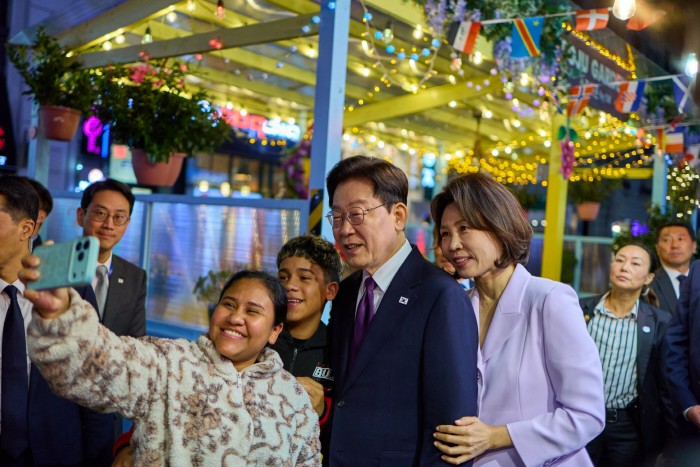 |
| President Lee Jae-myung and First Lady pose for a commemorative photo with local children during a visit to Koreatown in New York on the 21st local time while visiting the U.S. to attend the United Nations General Assembly. / Yonhap |
Visiting New York to attend the United Nations General Assembly, President Lee Jae-myung laid out a phased denuclearization roadmap that proposes swapping sanctions relief for a freeze on North Korea's further development of nuclear weapons and intercontinental ballistic missiles (ICBMs). While keeping complete denuclearization as the ultimate goal, the plan takes a realistic approach aimed at first halting the expansion of North Korea's nuclear and missile capabilities. The move is seen as an initiative to break the prolonged deadlock in nuclear negotiations with Pyongyang.
In an interview with The New York Times published on the 21st local time, President Lee stated, "There is considerable value in trading sanctions relief for a halt to North Korea's additional development of nuclear weapons and ICBMs," adding, "Insisting on complete denuclearization as the immediate goal makes it difficult to achieve practical progress."
In a separate interview with the Associated Press, President Lee used the analogy that a speeding car must first be brought to a stop before changing its direction, highlighting a phased formula of "freeze, reduction, and dismantlement." With North Korea's nuclear and missile capabilities advancing continuously, the rationale is that stopping further development must come first, followed by reductions and ultimate dismantlement. The framework keeps denuclearization as the final objective while preventing Pyongyang's nuclear capabilities from expanding any further. Under this formula, if North Korea halts further development of nuclear weapons and ICBMs, corresponding measures such as sanctions relief would be provided, paving the way for phased negotiations on weapons reduction and eventual dismantlement. President Lee's estimate that North Korea has the capacity to produce 10 to 20 additional nuclear warheads annually reflects this assessment. The longer the negotiations remain stalled, the larger Pyongyang's arsenal grows, raising the threshold for future denuclearization talks. In fact, North Korea has continued ballistic missile tests and trials of new weapons systems in recent days.
Nevertheless, significant hurdles remain. Concerns could arise that if North Korea retains its existing arsenal after receiving sanctions relief as a reciprocal measure, such a "freeze" could essentially lock in long-term nuclear possession. Factoring in contentious debates over the timing and scope of sanctions relief, actual negotiations are likely to face substantial friction.
U.S. President Donald Trump's willingness to engage in dialogue with North Korea is also seen as a factor behind President Lee's phased proposal. The Trump administration has recently scaled back South Korea-U.S. joint military exercises to foster conditions for talks with Pyongyang, and President Lee has likewise emphasized the need for unconditional dialogue. President Lee has maintained that South Korea will serve as a facilitator if North Korea-U.S. talks resume. Having previously likened President Trump to a "peacemaker" and himself to a "pacemaker," President Lee is viewed as seeking to position this phased denuclearization roadmap as the starting point for future talks between Washington and Pyongyang.
Meanwhile, President Lee is scheduled to outline his vision for peaceful coexistence on the Korean Peninsula to the international community during a keynote address at the UN General Assembly on the 22nd local time. Cheong Wa Dae stated that President Lee plans to present a comprehensive blueprint for peace on the peninsula during the address.
Park Young-hoon
Most Read
-
1
Trump demands rates fall below 1% as Fed hikes for..

-
2
Celltrion seeks rheumatoid arthritis indication ex..

-
3
Chinese e-commerce giants AliExpress, Temu and She..

-
4
Trump warns countries not helping U.S. must pay re..

-
5
Turkish Airlines named main club partner of Liverp..

-
6
China expels No. 2 military official Zhang Youxia..

-
7
Houthi rebels release video claiming downing of Sa..

PEOPLE







-
Address : In-Young Bldg., 34, Uisadang-daero 1-gil, Yeongdeungpo-gu, Seoul
Copyright by ASIATODAY CO., LTD. All rights resereved