



N. Korean media remains silent on short-range ballistic missile launch
Sep 22, 2026, 09:11 am


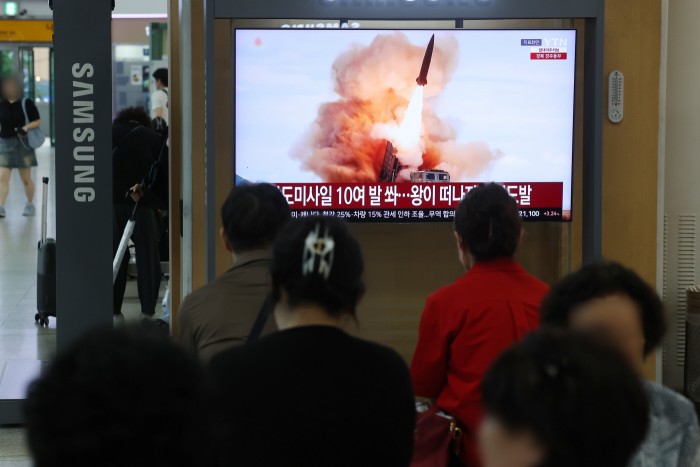 |
| News reports are broadcast at Seoul Station on the 20th as North Korea fired a barrage of around 10 short-range ballistic missiles. / Yonhap News |
North Korean state media have remained silent on the launch of two short-range ballistic missiles into the East Sea, releasing no related reports. Recently, North Korea has shown a tendency to withhold comment or delay reporting by several days, even when its missile launches are detected and reported by South Korean military authorities. Observers suggest North Korea is maintaining strategic ambiguity by keeping specific military activities under wraps.
On the 21st, North Korean state media outlets, including the external-facing Korean Central News Agency (KCNA) and the domestic-facing Rodong Sinmun, made no mention of the ballistic missiles fired the previous day. North Korea fired two short-range ballistic missiles from the Wonsan area into the East Sea at a three-hour interval the previous afternoon, but remained entirely silent on the matter.
Typically, North Korea has used state media reports the day after missile launches to demonstrate its military might externally and rally domestic solidarity, but observers note a recent shift in this pattern.
Last month, North Korea launched missiles on three separate occasions without any coverage by state media. In the case of the missile fired on the 12th, the day after the conclusion of the South Korea-U.S.-Japan regular joint exercise Freedom Edge, it was reported two days later via the external-facing KCNA. At the time, analysts suggested that North Korea disclosed the launch two days later with the intention of showcasing its integrated operational capabilities across nuclear, conventional, and advanced weapons systems to South Korea and the U.S. That move was interpreted as a countermeasure against Freedom Edge and a pressure tactic aimed at Washington and Seoul.
Accordingly, observers raise the possibility that North Korea might also belatedly reveal the missiles launched the previous day after some time has passed.
On the other hand, some analysts suggest North Korea may not have publicized the launch because it was of a routine training nature. Park Won-gon, a professor at Ewha Womans University, noted, "North Korea tends to disclose military demonstrations in state media when Chairman Kim conducts on-site guidance, when unveiling new weapons systems, or when external power projection is necessary."
Meanwhile, the Ministry of Foreign Affairs announced on the 21st that Baek Yong-jin, director general for Korean Peninsula policy, held phone consultations with David Wilezol, U.S. deputy assistant secretary of state for Korea and Japan, and Takashi Ariyoshi, deputy director general of the Asian and Oceanian Affairs Bureau at Japan's Foreign Ministry, to share intelligence and discuss future countermeasures regarding North Korea's ballistic missile launch the previous day.
The foreign ministry stated, "Diplomatic authorities of South Korea, the U.S., and Japan operate a channel to promptly share relevant information and situational assessments whenever North Korea launches ballistic missiles."
Mok Yong-jae
Most Read
-
1
Celltrion’s Omlyclo gains ground in major European..

-
2
Trump demands rates fall below 1% as Fed hikes for..

-
3
Trump makes $1 trillion bet ahead of midterm elect..

-
4
Iran resumes ballistic missile production, assembl..

-
5
Samsung Electronics, Mistral AI to jointly develop..

-
6
Trump warns countries not helping U.S. must pay re..

-
7
Apple launches first foldable, 1 million won prici..

PEOPLE






HEADLINE NEWS
- Trump to roll out ‘unprecedented welcome’ for Xi with B-2 bombers, F-22 fighters
- S. Korea, U.S., and Japan form united front on Taiwan and economic coercion..
- Trump administration moves to impose sweeping sanctions on International Cr..
- Xi to make state visit to U.S. Sept. 23-25, dispelling rumors over his heal..

-
Address : In-Young Bldg., 34, Uisadang-daero 1-gil, Yeongdeungpo-gu, Seoul
Copyright by ASIATODAY CO., LTD. All rights resereved