



Trump warns Iran he could ‘blow up the whole country’
Sep 21, 2026, 10:32 am


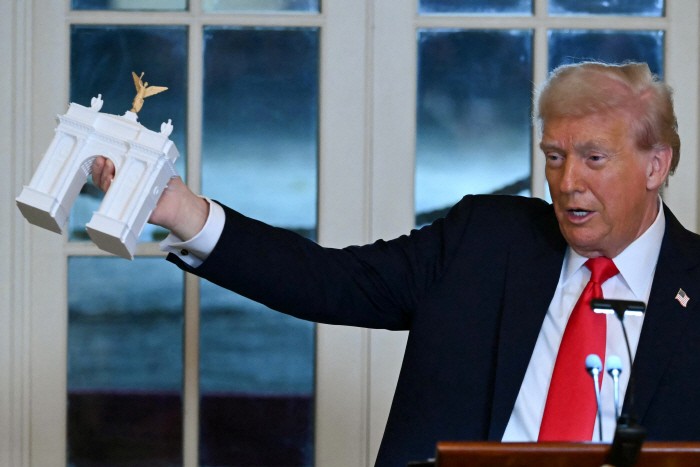 |
| U.S. President Donald Trump holds up a model of his proposed "Independence Arch" during a dinner with ballroom donors in the East Room of the White House in Washington, D.C., on October 15, 2025 (local time). President Trump stated on September 20, 2026 (local time) that the massive arch planned for construction at a historic site in Washington would also serve as a base for drones and snipers. / AFP, Yonhap |
U.S. President Donald Trump said on the 20th (local time) that he is in "deciding mode" regarding his response to Iran, weighing three options including military strikes, economic starvation, and reaching a deal, Fox News reported.
While President Trump warned that "the question is when to blow the entire nation away," Iranian military leadership pushed back, stating they would strike U.S. regional bases and assets if Washington resumes attacks. Meanwhile, Yemen's pro-Iranian Houthi rebels expanded their offensive across southwestern Yemen and around the Bab-el-Mandeb Strait on the 20th, following an attack on the Saudi Arabian capital of Riyadh the previous day.
President Trump also stated he would "probably be open" to meeting Iranian President Masoud Pezeshkian at this week's United Nations General Assembly in New York. Qatar noted that messages are being exchanged between the U.S. and Iran, adding that Gulf state leaders are pushing to arrange talks with President Trump on the sidelines of the UN General Assembly.
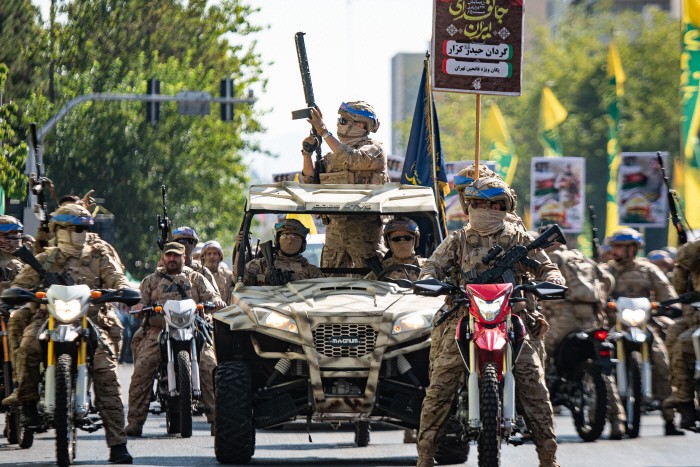 |
| Members of the Iranian Basij militia march during the "Janfada-ye Iran" exercise held in Tehran on the 18th (local time). High-ranking Iranian military officials, including Basij Commander Hossein Taeb and Hassan Hassanzadeh, commander of the Islamic Revolutionary Guard Corps (IRGC) Greater Tehran Corps, attended the exercise, which was conducted as a mobilization event involving 313,000 personnel. / UPI, Yonhap |
Trump weighs three options on Iran including destruction, economic starvation, and reaching a deal, opening door to possible UNGA talks with Iranian president
Fox News reporter Trey Yingst reported following a phone conversation with President Trump that the president is in "deciding mode" and stated that "very big things are going to happen in the very near future." President Trump laid out the available options as wiping out Iran, starving it economically, or reaching an agreement. He added, "The question is when to blow the entire nation away," warning that "they better behave."
When asked about his willingness to meet President Pezeshkian, President Trump replied that he would "probably be open to that." President Pezeshkian is scheduled to address the United Nations General Assembly on the 23rd, while President Trump is set to speak on the 22nd. Fox reported that direct talks between the U.S. and Iran are not currently taking place.
Amid escalating tensions, President Trump's weekend schedule was also cut short. Having arrived at the presidential retreat of Camp David near Washington, D.C., on the 18th with plans to stay until the 20th, President Trump returned to the White House a day early on the 19th. The U.S. State Department also issued a security alert on the 19th urging U.S. citizens across the Middle East to increase their vigilance due to Houthi military activity, advising them to stay alert to potential flight cancellations and airspace closures.
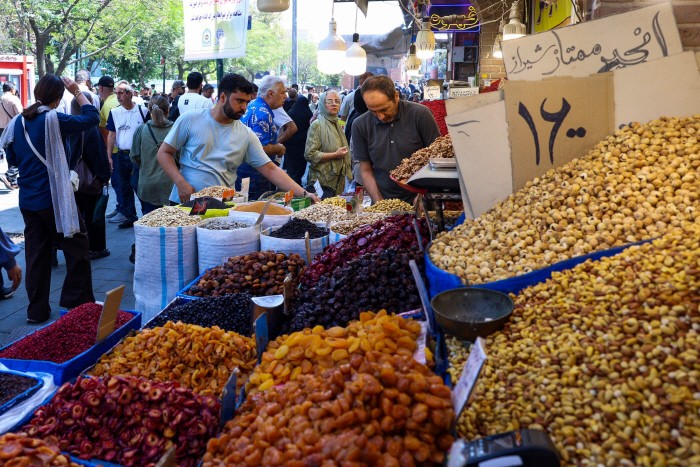 |
| Iranian merchants display dried fruits and nuts in front of a shop at a market in Tehran on August 24 (local time). Iran's economy contracted by more than 10% during the Middle East war that began with U.S. and Israeli strikes in late February. According to data released on September 20 by the Statistical Center of Iran, Iran's gross domestic product (GDP) fell 10.1% year-on-year from late March to late June, corresponding to the first quarter of the Persian calendar. / AFP, Yonhap |
Iran warns of strikes on U.S. bases in region citing resumption of U.S. attacks, considers NPT withdrawal
Iran swiftly adopted a hardline stance in response to President Donald Trump's military pressure. The Khatam al-Anbiya Central Headquarters, the unified command body of the Iranian Armed Forces, claimed on the 20th that it obtained intelligence indicating the U.S. decided to resume action against Iran through a joint meeting held in a European country with the approval of certain regional nations. It warned that if the U.S. attacks Iran again, it will launch continuous, effective, and painful strikes without limitations against all U.S. bases and assets in the region. It also stated that regional countries cooperating with U.S. attacks will be considered participants in the aggression.
Alongside the military warnings, Iran also laid out conditions for ending the war. Fox News reported that Iran presented seven key demands to conclude the conflict with the U.S. In an interview with Qatari broadcaster Al Jazeera, Mohsen Rezaee, secretary of Iran's Supreme National Security Council, called for unfreezing Iranian assets, ending the war on all fronts including Lebanon, non-interference in internal affairs, halting attacks, and lifting the naval blockade, according to Iran's state-run IRNA news agency.
Secretary Rezaee stated that Iran is prepared to deliver a more painful blow than before if the U.S. attacks again. He emphasized that Iran is also considering withdrawing from the Treaty on the Non-Proliferation of Nuclear Weapons (NPT), adding that the decision depends on U.S. actions. Iranian Parliament Speaker Mohammad Baqer Qalibaf also stated that Iran must "fight and negotiate" to defeat the enemy and cement its gains through diplomacy, Reuters reported.
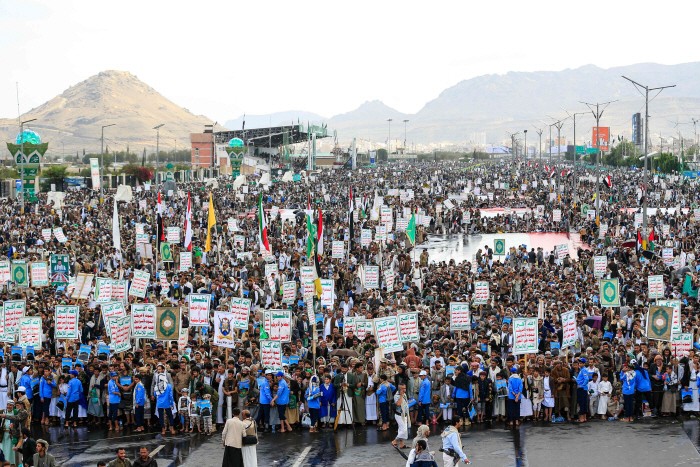 |
| Houthi rebel supporters hold placards and flags during a rally in Sanaa, Yemen, on the 18th (local time), condemning Saudi Arabia's intervention in Yemen and Saudi Arabia's recent claims that the Houthis launched an attack targeting the Islamic holy city of Mecca. / AFP, Yonhap |
Houthis expand fronts in southwestern Yemen and Bab el-Mandeb, pressing to encircle Saudi-backed forces
Amid escalating military tensions between the U.S. and Iran, ground combat in Yemen between Houthi rebels and Saudi-backed government forces is also expanding.
The New York Times (NYT) reported on the 20th that Houthi rebels and Saudi-backed Yemeni government forces are engaged in fierce fighting in southwestern Yemen and around the Bab el-Mandeb Strait. The two sides clashed in southwestern mountainous areas including Al-Wazi'iyah, Al-Madaribah, and Al-Arah. Intense battles have also continued recently around Kahbub, an area overlooking the Bab el-Mandeb Strait.
An official from the Saudi-backed government forces stated that if the Houthis seize control of this region, they could sever the route connecting Taiz to Aden in the south and encircle government forces in Taiz.
The Houthis have recently expanded their presence along Yemen's western coast by seizing the Port of Mokha and key islands in the Red Sea. As a result, their ability to monitor and control vessels transiting the Bab el-Mandeb Strait has also grown. Normally, about 12% of global trade passes through this critical maritime corridor, AP reported. While the Houthis declared a blockade against Saudi vessels, they stated that shutting down the entire strait is not the objective of their military operations.
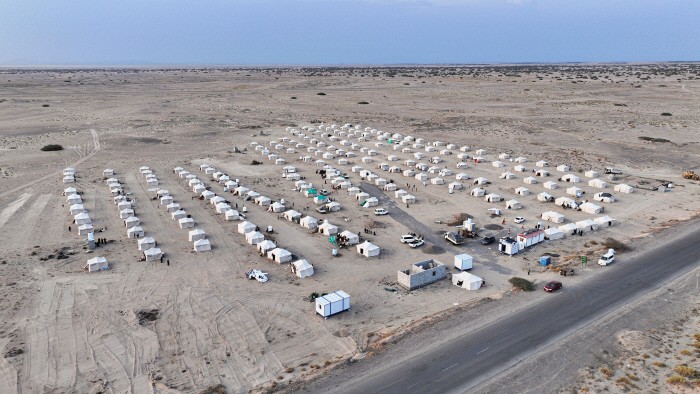 |
| A temporary camp set up for displaced Yemenis who fled Red Sea coastal areas to escape fighting between Houthi rebels and government forces is seen near Aden, Yemen, on the 19th (local time). / Reuters, Yonhap |
At the same time, the Houthis reaffirmed their position to avoid direct confrontation with the U.S. Mohammed al-Bukhaiti, a member of the Houthi political bureau, told AP that the U.S. reached out following the Houthi advance along the western coast, and that in indirect contacts via Oman, the group conveyed its stance that it is targeting only Saudi Arabia and will not attack vessels from the U.S. or other nations. "The objective of our military operations is not to close the Bab el-Mandeb Strait," he said. Mahdi al-Mashat, president of the Houthi Supreme Political Council, also stated, "We have not closed the door to peace."
The expanding ground war follows Houthi missile and drone attacks targeting the Saudi capital Riyadh and oil facilities on the 19th. Reuters reported that the Houthi offensive is putting Saudi Arabia under pressure to choose between continuing airstrikes to prevent further territorial losses or scaling back military action to shield critical infrastructure from drone strikes.
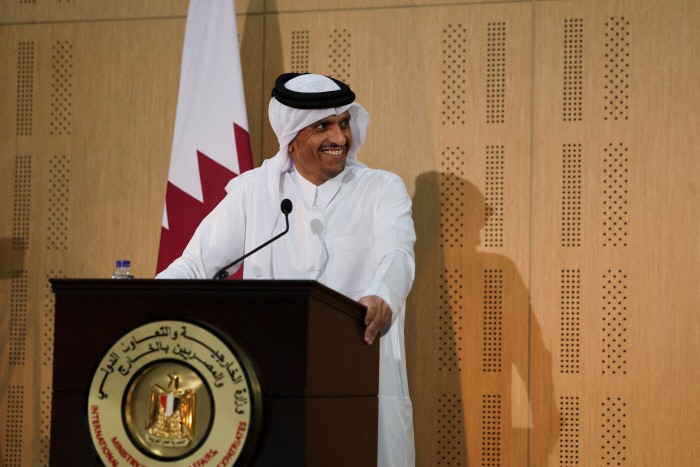 |
| Qatari Prime Minister and Minister of Foreign Affairs Sheikh Mohammed bin Abdulrahman Al Thani holds a press conference after concluding high-level talks in El Alamein, Egypt, August 20 (local time). / Reuters, Yonhap |
Qatari prime minister mediates U.S.-Iran messages, energy minister says Hormuz is irreplaceable
Amid widening military confrontations, Qatar continues its diplomatic push around the UN General Assembly. Bloomberg reported that Qatari Prime Minister Sheikh Mohammed bin Abdulrahman Al Thani said messages are being exchanged between the U.S. and Iran, speaking at the Qatar Economic Forum in New York. He emphasized that Gulf nations "must act together responsibly as a region" to restore regional stability and revealed that Gulf leaders are seeking to meet with President Donald Trump on the sidelines of this week's UN General Assembly. Prime Minister Al Thani called the Houthis' recent offensive "irresponsible" and said more mediators are needed to end the war between the U.S. and Iran.
On energy transport, Qatar reaffirmed the critical importance of the Strait of Hormuz. Saad Sherida Al-Kaabi, Qatar's Minister of State for Energy Affairs and CEO of QatarEnergy, pushed back against remarks made by U.S. Treasury Secretary Scott Bessent at the G20 meeting on the 1st—who claimed that "in two years, the Strait of Hormuz will be like a worthless piece of water"—calling the assertion "completely wrong." Minister Al-Kaabi stressed that the Strait of Hormuz remains an indispensable corridor not only for oil and gas but also for overall commerce, stating that Qatar decided against building new gas pipelines bypassing the strait based on commercial and technical considerations.
Ha Man-ju
Most Read
-
1
Celltrion’s Omlyclo gains ground in major European..

-
2
Trump demands rates fall below 1% as Fed hikes for..

-
3
Trump makes $1 trillion bet ahead of midterm elect..

-
4
Iran resumes ballistic missile production, assembl..

-
5
Samsung Electronics, Mistral AI to jointly develop..

-
6
Trump warns countries not helping U.S. must pay re..

-
7
Seoul faces triple squeeze over troop deployment t..

PEOPLE







-
Address : In-Young Bldg., 34, Uisadang-daero 1-gil, Yeongdeungpo-gu, Seoul
Copyright by ASIATODAY CO., LTD. All rights resereved