



China sets flight restriction zones around Beijing
Sep 21, 2026, 10:17 am


China has designated a vast flight restriction zone centered on Beijing, covering an area about 2.8 times the size of South Korea.
The move appears to reflect heightened security concerns following a June accident in which a light aircraft crashed into Beijing’s tallest building, killing the pilot and injuring 13 people.
In effect, the measure is aimed at significantly tightening airspace security around the Chinese capital.
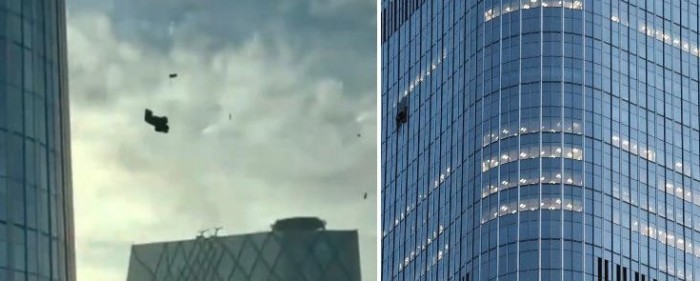 |
| A light aircraft is seen shortly after crashing into CITIC Tower in central Beijing in late June. / Social media post from an anonymous reader |
According to Beijing sources familiar with high-level developments in China on Sept. 18, Beijing’s air traffic control authorities announced that a special flight restriction zone with a diameter of about 600 kilometers will be established around the capital starting Sept. 20.
The restricted area will cover all of Beijing and Tianjin, most of Hebei Province, and parts of the Inner Mongolia Autonomous Region and the provinces of Shanxi, Shandong and Liaoning.
The total area is estimated to exceed 280,000 square kilometers, about 2.8 times the size of South Korea, which covers roughly 100,000 square kilometers. An estimated 100 million people live within the zone, which is also home to dozens of airports and smaller airfields.
According to the sources, all flight activity from ground level upward will, in principle, be prohibited within the restricted zone.
There will, however, be several exceptions. Scheduled commercial flights, preapproved business aviation, and flights for military, customs, police, firefighting and rescue purposes will be permitted to operate.
Even authorized aircraft will be required to strictly follow preapproved flight plans. If there is a possibility of deviating from a designated route, operators will be required to report it to the authorities and obtain separate approval. Failure to do so could, in the worst case, result in the aircraft being shot down.
The measure comes after a light aircraft crashed into CITIC Tower, Beijing’s tallest building, in late June. The skyscraper is also known as China Zun.
The aircraft reportedly strayed from its approved flight path before hitting the tower. The pilot was killed at the scene, while 13 people suffered injuries of varying severity.
Chinese public security authorities later said that entries in the pilot’s diary suggested suicidal intent. Authorities have since stepped up airspace security around the capital.
China has also sharply tightened controls on drones in Beijing.
Since May, the sale, transportation and operation of privately owned drones have been completely banned. More recently, authorities announced that possession and storage of drones will also be prohibited from Nov. 15.
Collection points are being set up across the city for residents who already own drones, who are being instructed either to remove them from Beijing or turn them in before the new rules take effect.
The policy appears to run counter to the broader direction of China’s industrial sector, which has identified the drone industry as a strategic growth sector for the future.
Hong Soon-do
Most Read
-
1
Celltrion’s Omlyclo gains ground in major European..

-
2
Trump demands rates fall below 1% as Fed hikes for..

-
3
Trump makes $1 trillion bet ahead of midterm elect..

-
4
Iran resumes ballistic missile production, assembl..

-
5
Samsung Electronics, Mistral AI to jointly develop..

-
6
Trump warns countries not helping U.S. must pay re..

-
7
Seoul faces triple squeeze over troop deployment t..

PEOPLE







-
Address : In-Young Bldg., 34, Uisadang-daero 1-gil, Yeongdeungpo-gu, Seoul
Copyright by ASIATODAY CO., LTD. All rights resereved