



KOTRA expands cooperation with Central Asia in exports, supply chains and infrastructure
Sep 17, 2026, 10:03 am


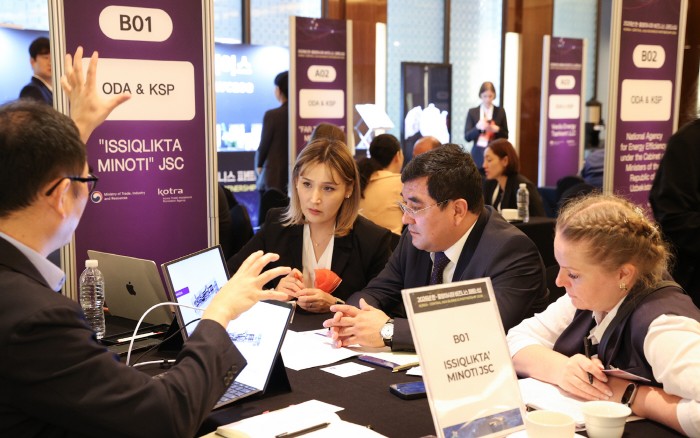 |
| Export consultations are underway at the Korea-Central Asia Business Partnership hosted by the Korea Trade-Investment Promotion Agency (KOTRA) on the 16th. / KOTRA |
The Korea Trade-Investment Promotion Agency (KOTRA) moved to expand economic cooperation across exports, supply chains, and infrastructure on the occasion of the Korea-Central Asia Summit.
KOTRA announced on the 17th that it hosted the Korea-Central Asia Business Partnership on the 16th, inviting 33 buyers, project owners, and raw material suppliers from Central Asia to South Korea. Around 90 domestic enterprises took part in the event, holding some 200 business consultations with Central Asian companies.
The five Central Asian nations are Kazakhstan, Uzbekistan, Turkmenistan, Kyrgyzstan, and Tajikistan. With a consumer base of roughly 80 million people, the region registered strong economic growth rates between 6% and 10% in 2025, driven by industrial diversification policies in manufacturing and information and communication technology (ICT), as well as increased foreign direct investment.
Central Asia has maintained close, long-standing ties with South Korea, anchored by geographic proximity and an ethnic Korean diaspora of roughly 300,000 Koryoin. In recent years, growing local popularity of Korean culture and consumer goods has fueled heightened demand for partnership among regional firms. Rich in critical raw materials such as urea, yellow phosphorus, and tungsten, the region is also regarded as having strong potential for supply chain cooperation.
The 33 Central Asian firms visiting South Korea included prospective buyers seeking to import Korean goods, as well as project owners from eight infrastructure initiatives and three suppliers of critical raw materials.
At the business consultation sessions held on the 16th, a total of 16 export contracts valued at roughly 14 million U.S. dollars were signed. Among them, domestic household goods company A concluded a 3 million U.S. dollar export contract with a Kazakh buyer.
Convenience store chain CU, which operates 70 locations across Kazakhstan, also set up a showcase at the venue, drawing significant interest from Central Asian companies. CU noted that roughly 80% of the products it ships from South Korea to Central Asia are manufactured by domestic small and medium-sized enterprises (SMEs) and mid-market firms.
A dedicated Supply Chain Lounge operated to stabilize critical raw material supply chains. Consultations focused on supply chain diversification were held between key Central Asian raw material suppliers and South Korean businesses, with related agencies including Korea Eximbank, the Korea Institute of Geoscience and Mineral Resources (KIGAM), and the Korea Mine Rehabilitation and Mineral Resources Corporation (KOMIR) providing advisory support.
The Development Cooperation Pavilion showcased a Knowledge Sharing Program (KSP) initiative titled "Policy and Technical Recommendations for Modernizing District Heating," a bilateral cooperation project between South Korea and Uzbekistan in district heating. Power generation equipment supply talks were also held between related partners, exploring avenues to connect development cooperation with export growth.
The event also featured dedicated exhibition booths for regional small enterprises and micro-business owners. Local companies that face hurdles meeting overseas buyers directly held consultations with major Central Asian firms, exploring opportunities to break into new markets.
KOTRA President and CEO Kang Kyung-sung said, "Central Asia is a region with immense cooperation potential, boasting strong growth prospects, rich raw material deposits, and geographic proximity, coupled with deep historical and emotional ties with South Korea," adding, "Leveraging the Korea-Central Asia Summit, we will proactively provide support so that tangible business cooperation among companies can expand across exports, supply chains, energy, and infrastructure."
Kim Deok-ho
Most Read
-
1
Celltrion’s Omlyclo gains ground in major European..

-
2
Hyundai Motor Group breaks ground on integrated st..

-
3
U.S. strikes 3 Iranian oil tankers, Iran vows reta..

-
4
S. Korea seeks redemption from World Cup setback w..

-
5
Trump makes $1 trillion bet ahead of midterm elect..

-
6
Iran resumes ballistic missile production, assembl..

-
7
Samsung Electronics, Mistral AI to jointly develop..

PEOPLE






-
Address : In-Young Bldg., 34, Uisadang-daero 1-gil, Yeongdeungpo-gu, Seoul
Copyright by ASIATODAY CO., LTD. All rights resereved