



S. Korea, 5 Central Asian nations map out next 30 years to institutionalize supply chain cooperation
Sep 17, 2026, 09:21 am


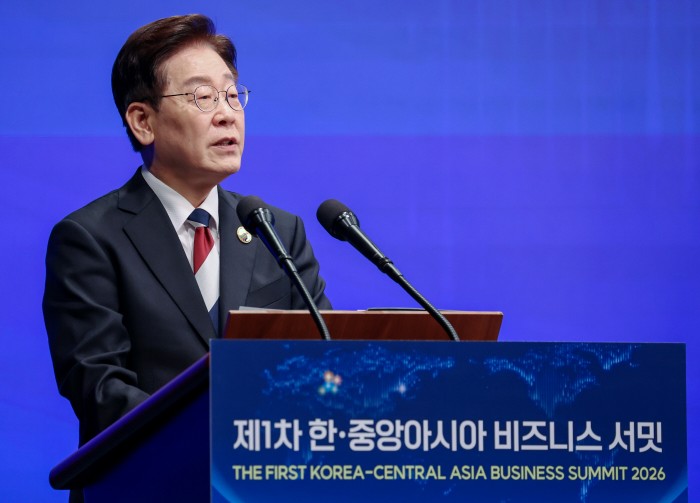 |
| President Lee Jae-myung delivers an address at the 1st Korea-Central Asia Business Summit held at a Seoul hotel on the 16th. / Yonhap News |
President Lee Jae-myung met with the leaders of five Central Asian nations in a single venue for the first time on the 16th to present a new cooperative vision for the next 30 years based on the "Silk Road spirit." Both sides adopted the Seoul Declaration outlining this vision and agreed to institutionalize cooperation across supply chains, energy, and security by elevating their bilateral cooperation framework—previously held at the ministerial level—to the summit level.
Delivering the opening address at the 1st Korea-Central Asia Summit held in Seoul on Wednesday afternoon, President Lee highlighted the international environment where supply chains, energy, markets, and technology intertwine, underscoring the necessity of expanding cooperation. "The Silk Road spirit of Central Asia, which connected the people, technologies, and cultures of the East and West into one, is needed now more than ever," President Lee stated. "Building upon the foundation of cooperation established over the past three decades, we must prepare for the next 30 years together."
President Lee also praised the Koryoin (ethnic Korean) diaspora as a historic bridge linking both sides, emphasizing an expanding foundation of collaboration across trade, investment, industry, infrastructure, education, and culture.
Under the Seoul Declaration, the leaders agreed to convene the Korea-Central Asia Summit every two years. In off-summit years, a ministerial cooperation forum will be held to review the implementation of milestones, alongside high-level vice-ministerial meetings. This institutionalizes the partnership by upgrading a ministerial framework that has been in place since the launch of the cooperation forum in 2007 to the summit level.
In the economic sphere, the parties decided to establish a Korea-Central Asia industry ministerial council and broaden cooperation guided by a memorandum of understanding (MOU) on industrial and supply chain collaboration. They agreed to pair Central Asia's critical minerals with South Korea's advanced technology, while pursuing joint ventures in oil, gas, clean energy, and transportation and logistics infrastructure. Dedicated Korean Desks will also be set up within the respective governments to support South Korean enterprises, alongside efforts to address and dismantle non-tariff trade barriers.
Artificial intelligence (AI), digital transformation, and science and technology were identified as key pillars for future cooperation. The blueprint envisions combining Central Asia's growth potential with South Korea's technological and industrial capabilities to build a joint value-added production network.
In security affairs, the leaders reaffirmed their commitment to the complete denuclearization of the Korean Peninsula and the establishment of lasting peace. The five Central Asian nations voiced support for the South Korean government's tension-reduction and confidence-building initiatives aimed at resuming inter-Korean dialogue, while all sides pledged concerted action against transnational threats, including terrorism, narcotics trafficking, and cybercrime. The 2nd Korea-Central Asia Summit is scheduled to take place in Astana, Kazakhstan, in 2028.
Park Young-hoon
Most Read
-
1
Celltrion’s Omlyclo gains ground in major European..

-
2
Trump demands rates fall below 1% as Fed hikes for..

-
3
Hyundai Motor Group breaks ground on integrated st..

-
4
U.S. strikes 3 Iranian oil tankers, Iran vows reta..

-
5
Trump makes $1 trillion bet ahead of midterm elect..

-
6
Iran resumes ballistic missile production, assembl..

-
7
Samsung Electronics, Mistral AI to jointly develop..

PEOPLE





-
Address : In-Young Bldg., 34, Uisadang-daero 1-gil, Yeongdeungpo-gu, Seoul
Copyright by ASIATODAY CO., LTD. All rights resereved