



[Exclusive] S. Korea to build AI-driven 3rd-generation weather model from next year
Sep 16, 2026, 09:10 am


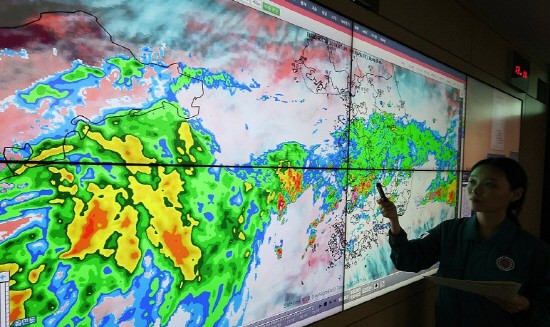 |
| Weather forecasting situation monitor at the Korea Meteorological Administration. / Yonhap |
The Korea Meteorological Administration (KMA) will embark next year on developing a 65.5 billion won, next-generation Korean Integrated Model (KIM). By incorporating artificial intelligence (AI), the agency plans to improve forecasting accuracy while strengthening responsive capabilities across various sectors of society. With a temporary research body set to be restructured into a permanent entity under the KMA starting this month, efforts to advance the proprietary model are expected to gain momentum.
According to the KMA on the 15th, the Korea Institute of Atmospheric Prediction Systems (KIAPS), scheduled to launch on the 18th, will begin developing the third-generation KIM starting in 2027. In connection with the project, the KMA has earmarked a total budget of 65.5 billion won over five years through 2031 for the research and development initiative titled "Advancement of the National Numerical Model and Technology Development for Multisectoral Expansion." A preliminary allocation of 11.3 billion won has been confirmed in the government's budget proposal for next year. A KMA official noted, "The total project cost is subject to change depending on the outcome of annual general budget reviews conducted by the National Assembly."
A numerical weather prediction model is a computational system that continuously integrates equations governing atmospheric phenomena using supercomputers to analyze current conditions and forecast future developments. South Korea developed and introduced its current first-generation KIM between 2011 and 2020 with an investment of 78.3 billion won. Through this effort, South Korea became the ninth country in the world to operate a proprietary numerical weather prediction model. The KMA subsequently began developing a higher-resolution second-generation model in 2020 and plans to complete it this year. A total of 80.5 billion won was invested in the second-generation project.
The defining feature of the third-generation KIM is the adoption of AI technologies. The agency envisions integrating AI into existing models to sharpen forecast accuracy, bolster national disaster response capabilities, and assist decision-making across diverse societal sectors beyond meteorology, including energy, agriculture, and water management. Notably, from the third generation onward, development will be overseen by KIAPS, a permanent numerical model research institution under the KMA, in accordance with the revised Weather Act taking effect on the 18th.
Previously, the temporary Korea Institute of Atmospheric Prediction Systems foundation oversaw development on an ad hoc basis. Under that framework, the foundation organized projects, passed preliminary feasibility studies, and dissolved once model development was completed. However, calls grew for institutional continuity and dedicated expertise to advance weather forecasting, prompting legal revisions that established the basis for a permanent organization.
As the new KIAPS launches alongside the implementation of the revised act, the existing foundation will be dissolved. Its existing budget, rights, obligations, and personnel—including employees and executives—will be fully transferred. Accordingly, Park Hoon, head of the former foundation, will take helm as head of the new institute. The institute will also continue to utilize the existing foundation's building in Dongjak District, Seoul. The second-generation model, slated for completion this year, will likewise be finalized by the newly established institute as it assumes the ongoing project.
A KMA official said, "Through the launch of the institute, South Korea's sole specialized research body for numerical models, we will reinforce the continuity and expertise of numerical modeling R&D," adding, "Starting next year, we aim to advance forecasting technologies by integrating cutting-edge tools like AI and operationalize research outcomes, thereby enhancing our national capacity to respond to meteorological and climate disasters."
Kim Hong-chan
Most Read
-
1
Celltrion’s Omlyclo gains ground in major European..

-
2
Trump demands rates fall below 1% as Fed hikes for..

-
3
Hyundai Motor Group breaks ground on integrated st..

-
4
U.S. strikes 3 Iranian oil tankers, Iran vows reta..

-
5
Trump makes $1 trillion bet ahead of midterm elect..

-
6
Iran resumes ballistic missile production, assembl..

-
7
Samsung Electronics, Mistral AI to jointly develop..

PEOPLE







-
Address : In-Young Bldg., 34, Uisadang-daero 1-gil, Yeongdeungpo-gu, Seoul
Copyright by ASIATODAY CO., LTD. All rights resereved