



Taiwan quietly gloats as it emerges as obstacle for U.S. and China
Sep 15, 2026, 10:31 am


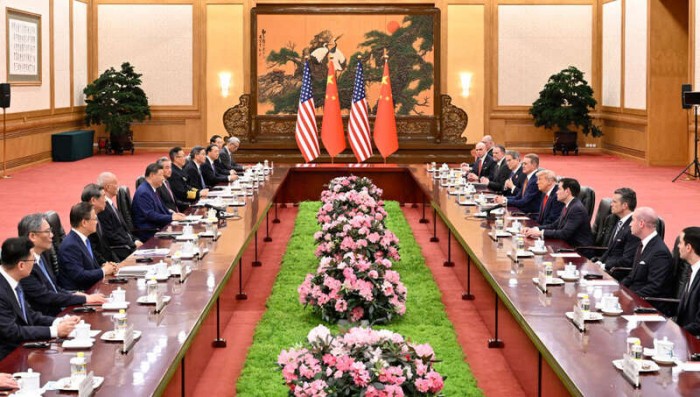 |
| An expanded session of the U.S.-China summit held at the Great Hall of the People in Beijing on May 14 last year. While the Taiwan issue poses an obstacle this year, the summit is expected to take place in Washington, U.S., on the 24th. / Xinhua News Agency |
The upcoming summit between U.S. President Donald Trump and Chinese President Xi Jinping, scheduled for the 24th local time in Washington, is showing sudden signs of faltering over Taiwan's massive plans to purchase U.S.-made weapons. Analysts warn that, in a worst-case scenario, pulling off the summit at the eleventh hour may no longer be a certainty.
This assessment carries considerable weight considering that China, ever since establishing diplomatic ties with the U.S. in 1979, has consistently displayed what could fairly be described as an allergic overreaction to Taiwan's acquisition of American arms. Indeed, citing a September 12 report by Japan's Nihon Keizai Shimbun, diplomatic sources in Beijing reported on the 14th that the Chinese Foreign Ministry conveyed its intention to cancel the summit if the U.S. does not show restraint regarding new arms sales to Taiwan before President Xi's visit.
Such an unyielding stance is par for the course for China, which views Taiwan as its sovereign territory under the "One China" principle. Coupled with Taiwan's recent decision to hike next year's defense budget by nearly 20% to a record 1.1225 trillion New Taiwan dollars (approximately 48.26 trillion won), anything less than pushback would be surprising. Beijing possesses ample leverage to throw a wrench into proceedings by putting the summit on the line.
To be sure, with the countdown already underway, the likelihood of the summit taking place remains high. President Trump, who began preparations for the meeting several days ago, addressed the potential cancellation while speaking to reporters in Ireland on the 13th local time, remarking, "China has treated the U.S. fairly in recent years. I am not worried at all."
Yet outcomes remain unpredictable. Although the odds may be slim, should the issue of U.S. arms exports to Taiwan flare up right before the meeting, the fallout could prove severe, and ruling out a last-minute disruption by China is difficult. An international relations commentator in Beijing surnamed Hu noted, "Selling new weapons to Taiwan crosses a red line. The U.S. must clarify its position this time; otherwise, an unfortunate outcome could follow." In this light, the view that cancellation cannot be entirely ruled out holds ground.
Naturally, Taiwan is closely tracking these developments. It is merely withholding official statements to avoid putting its steadfast backer, the U.S., in an awkward bind. Behind the scenes, however, Taipei is almost certainly rejoicing. The reasons are manifold. Chief among them is the unexpected windfall of reaffirming its strategic presence on the global stage.
Furthermore, the U.S. Taiwan Relations Act—which signals intervention in the event of external aggression against Taiwan—is being actively revisited by politicians and media outlets around the summit. Crucially, the surge in Taiwan's defense spending appears to have been driven by intense pressure from the U.S., which views Taiwan as a prospective ally against China. This strongly reinforces expectations that the U.S. will not look the other way should China launch an invasion. The view among Beijing diplomatic sources that Taiwan is quietly smiling hits the nail on the head.
Hong Soon-do
Most Read
-
1
U.S. Treasury Secretary Bessent publicly warns ove..

-
2
Celltrion’s Omlyclo gains ground in major European..

-
3
Hyundai Motor Group breaks ground on integrated st..

-
4
Russia faces warning signs over prolonged war econ..

-
5
Anti-Western solidarity strengthens amid Trump's e..

-
6
U.S. strikes 3 Iranian oil tankers, Iran vows reta..

-
7
S. Korea seeks redemption from World Cup setback w..

PEOPLE







-
Address : In-Young Bldg., 34, Uisadang-daero 1-gil, Yeongdeungpo-gu, Seoul
Copyright by ASIATODAY CO., LTD. All rights resereved