



KOSPI retreats to 6,600 level amid 3.3 trillion won foreign sell-off and overhang near 7,000
Sep 15, 2026, 10:24 am


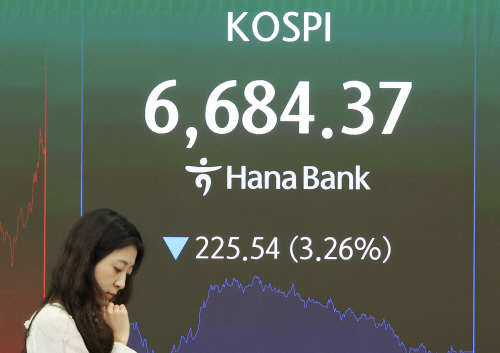 |
| A Hana Bank dealing room on the 14th. / Yonhap News |
The KOSPI retreated to the 6,600 level, weighed down by massive foreign selling. Investor sentiment dampened, centered on large-cap semiconductor stocks, as concerns mounted over high oil prices, elevated interest rates, and calls within the artificial intelligence (AI) industry to moderate the pace of development. Analysts in the securities industry noted that rather than a deterioration in market fundamentals, mounting supply-demand pressures—driven by external uncertainties and substantial stock overhang around the 7,000 mark—amplified the day's decline.
According to the Korea Exchange on the 14th, the benchmark KOSPI closed at 6,684.37, down 225.54 points (3.26%) from the previous trading session. The index dropped to as low as 6,654.82 intraday. Foreign investors were net sellers of 3.2995 trillion won on the main bourse, extending their selling streak to four consecutive sessions. Institutional investors also offloaded a net 1.1714 trillion won, while retail investors solely absorbed the supply by net purchasing 2.9721 trillion won. The won-dollar exchange rate closed at 1,347.3 won, up 1.4 won from the previous session.
Large-cap semiconductor shares also suffered steep losses. Samsung Electronics tumbled 4.05% to finish at 249,000 won, while SK Hynix fell 6.35% to close at 1,697,000 won. The tech-heavy KOSDAQ index likewise declined 1.69% to finish at 806.79.
With international crude oil prices hovering above $100 amid Middle East instability, caution over interest rate hikes heightened ahead of this week's U.S. Federal Open Market Committee (FOMC) meeting. On top of this, debates over pacing AI development emerging from the U.S. tech sector placed an additional burden on semiconductor equities, which had spearheaded the recent market rally.
Nevertheless, analysts argue it is premature to conclude that semiconductor earnings momentum has peaked. Kim Young-hwan, an analyst at NH Investment & Securities, stated, "There is currently no evidence that semiconductor earnings will turn downward; what worries the market is whether companies can maintain elevated profit levels a year from now," adding, "While big tech firms continue to issue guidance pledging higher investment, the market requires more time to become fully convinced."
In particular, the accumulation of overhang near the KOSPI's 7,000 mark is cited as a significant factor capping any near-term rebound. Because retail investors heavily absorbed foreign sell-offs during July's market pullback across the 7,200 to 8,500 range, that zone now functions as a breakeven point, intensifying selling pressure as the index approaches those levels.
"At the 6,500 level, an upside potential of roughly 10% toward the low-7,000s makes trading attractive for institutions and foreign investors, but the dynamics shift once the index crosses 7,000," Kim explained. "The more this box-range pattern repeats, the stronger retail investors' tendency becomes to break even and sell, making it even more challenging to pierce through the resistance wall above 7,000."
For the KOSPI to firmly establish a footing above 7,000, market observers project that favorable AI developments must be accompanied by broad improvements in external conditions such as interest rates and oil prices. Kim noted, "Positive AI catalysts alone are insufficient to generate enough momentum to absorb the overhang in one go," adding, "Market-friendly conditions must align, including confirmed signals that interest rates have peaked and a stabilization of oil prices through eased tensions in the Middle East."
Han Hye-seong
Most Read
-
1
U.S. Treasury Secretary Bessent publicly warns ove..

-
2
Celltrion’s Omlyclo gains ground in major European..

-
3
Hyundai Motor Group breaks ground on integrated st..

-
4
Russia faces warning signs over prolonged war econ..

-
5
Anti-Western solidarity strengthens amid Trump's e..

-
6
U.S. strikes 3 Iranian oil tankers, Iran vows reta..

-
7
S. Korea seeks redemption from World Cup setback w..

PEOPLE






-
Address : In-Young Bldg., 34, Uisadang-daero 1-gil, Yeongdeungpo-gu, Seoul
Copyright by ASIATODAY CO., LTD. All rights resereved