



S. Korea seeks redemption from World Cup setback with fourth consecutive Asian Games football title
Sep 04, 2026, 09:21 am


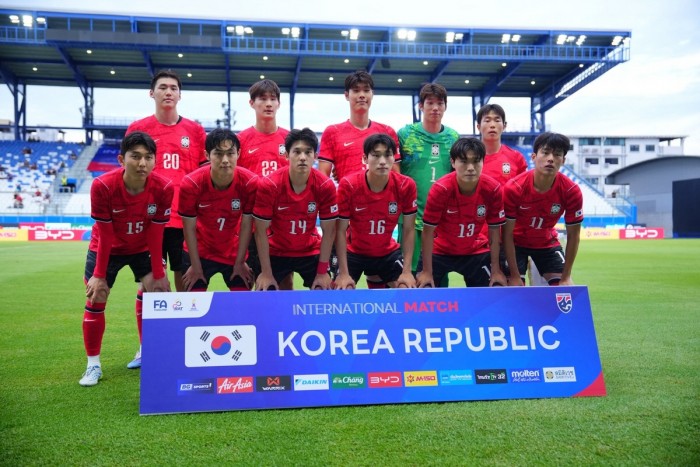 |
| South Korea's Asian Games national football team takes the pitch in an evaluation match against Thailand. / Provided by Korea Football Association |
South Korea's men's national football team competing in the 2026 Aichi-Nagoya Asian Games is set to challenge for its fourth consecutive gold medal. For South Korean football, which received a dismal report card following its group-stage exit at the North and Central America World Cup, the tournament serves as a golden opportunity to shift momentum. With young Europe-based players including Bae Jun-ho, Kim Ji-soo, and Yang Min-hyuk, alongside top prospects from the K League, turning out in full force, this tournament is projected to be a testing ground to gauge the competitiveness of the next-generation national squad.
As this Asian Games squad heavily features players who will progress toward the 2028 Los Angeles Olympics and the 2030 World Cup, it also represents a stage where the trajectory of South Korean football's generational shift can be verified.
Particular attention is focused on the performances of players gaining experience on European pitches, such as Bae Jun-ho, Kim Ji-soo, and Yang Min-hyuk. A key point to watch is how much of a difference these players, who have already demonstrated their potential on the senior stage, can make against top-tier Asian age-group competition. In addition, players who have steadily matured in the K League join the fold to balance the squad.
The deployment of wild-card selections is also vital. If experienced assets such as Lee Ki-hyuk hold the center among younger peers, the team can bolster game-management capabilities and defensive stability essential for short-format tournaments. Given that a single mistake becomes fatal as the Asian Games advances into knockout rounds, how effectively the vigor of youth is combined with the experience of the wild-card veterans remains crucial.
For head coach Lee Min-sung at the helm, the tournament marks a pivotal turning point. He must answer with results the doubts raised over his tactical setups, player selections, and in-game management. If he maximizes the strengths of young players while delivering consistent performances in the knockout rounds, assessments of his managerial leadership could turn favorable in an instant.
Conversely, falling short of expectations would not only bring regret over the roster construction aimed at gold, but could also intensify scrutiny over Lee's leadership. This is why the tournament is described as a high-stakes proving ground for Lee personally.
What draws even greater interest is the link to the upcoming Moreno era. The South Korean senior national team is preparing for a fresh start after handing its managerial reins to coach Moreno for international fixtures in the second half of the year. Should players shining at the Asian Games catch Moreno's eye, they could well emerge as viable options in the senior team's generational turnover.
For Moreno, who must elevate the national team's competitiveness within a limited timeframe, unearthing young and dynamic assets is a critical task. In that sense, this Asian Games can serve as a showcase to confirm the caliber of prospective next-generation national team members on an international stage.
South Korea achieved three consecutive Asian Games crowns, starting with the 2014 Incheon Games, followed by Jakarta-Palembang in 2018 and Hangzhou in 2022. Securing a gold medal at this tournament would establish a historic milestone of four consecutive titles.
Attention centers on whether South Korean football, weighed down by the North and Central America World Cup failure, can rebound at the Asian Games. The tournament carries immense stakes: the growth of young players, coach Lee Min-sung's leadership, and the direction of the generational transition leading into the Moreno era. If the team seals a fourth consecutive title, it could provide the most definitive catalyst to reverse the fortunes of South Korean football tainted by its World Cup setback.
Cheon Hyun-bin
Most Read
-
1
Celltrion nears additional contract with major U.S..

-
2
Putin proposes trilateral U.S.-China-Russia summit..

-
3
U.S. weighs dropping MOAB, world's most powerful n..

-
4
"Aren't those foreigners on welfare?": M..

-
5
Attention centers on APEC for possible Trump-Xi-Pu..

-
6
Saudi Arabia, Iran hold first diplomatic talks to..

-
7
Saudi airport in Riyadh struck again, leaving at l..

PEOPLE







-
Address : In-Young Bldg., 34, Uisadang-daero 1-gil, Yeongdeungpo-gu, Seoul
Copyright by ASIATODAY CO., LTD. All rights resereved