



S. Korean ministries split over N. Korea loudspeaker threat
Oct 23, 2026, 09:12 am


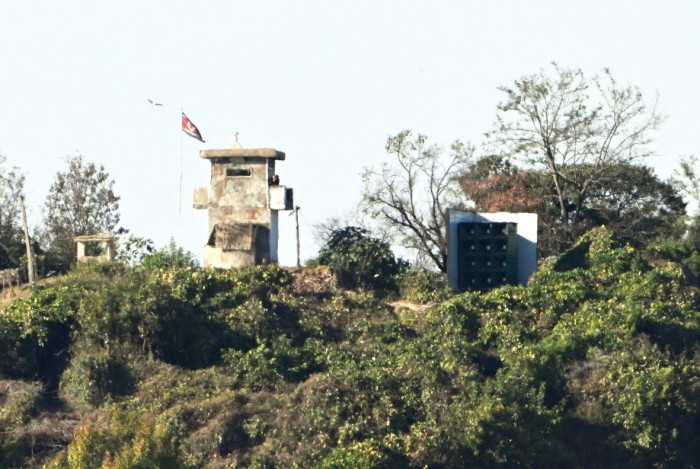 |
| A North Korean military guard post and loudspeaker directed toward South Korea are seen from the border area of Paju, Gyeonggi Province, on Oct. 22, as tensions between the two Koreas rise over the possible resumption of cross-border loudspeaker broadcasts used for psychological warfare. / Photo by Song Ui-ju |
As North Korea has announced plans to resume loudspeaker broadcasts toward South Korea, the Ministry of National Defense said it is considering "proportional measures," including installing loudspeakers directed toward the North. The Ministry of Unification, meanwhile, emphasized "dialogue" and called for the establishment of a communication system.
Asked during a briefing at the Ministry of National Defense in Yongsan, Seoul, on Oct. 22 whether the South Korean military would also install loudspeakers in response to North Korea's installation of loudspeakers targeting the South, ministry spokesperson Jeong Bit-na said, "Assuming North Korea installs them, I believe our military should naturally take proportional measures. However, no decision has been made."
The remarks left open the possibility of a response depending on North Korea's actions, despite the ministry's previous position that "the effectiveness of loudspeakers directed toward North Korea needs to be reconsidered." Asked about concerns that the resumption of loudspeaker broadcasts by both Koreas could lead to accidental clashes, Jeong said, "To prevent such a situation, North Korea must come to the negotiating table."
Jang Do-young, chief of the public affairs office at the Joint Chiefs of Staff (JCS), said, "We had detected signs of routine maintenance of North Korean loudspeakers even before the statement was issued." He explained, "If North Korea resumes loudspeaker broadcasts, we will take appropriate and effective measures through a joint investigation with the United Nations Command."
The Ministry of Unification expressed concern over moves to resume loudspeaker broadcasts, emphasizing, "Just over a year ago, residents of both Koreas experienced unbearable suffering as the two sides directed loudspeaker broadcasts at each other. We must not repeat the mistakes of the past."
As a fundamental solution, the ministry proposed that the two Koreas align their positions on the Military Demarcation Line (MDL) and establish a communication system for its peaceful management. It urged North Korea to "stop threatening us and make efforts to resolve the issues effectively."
Earlier, on Oct. 21, Kim Yo-jong, director of the General Affairs Department of North Korea's ruling Workers' Party of Korea, said loudspeakers directed toward South Korea along the entire border would be put into "operation" "within this month." However, just a day later, she changed her wording, saying they would be placed on "standby" "within days." She also mentioned new countermeasures and announced preparations to place them on operational standby.
Hong Min, a senior research fellow at the Korea Institute for National Unification, said, "What had already been decided and was to be implemented turned into a means of conditional pressure in just one day." However, he added, "It is also possible to interpret standby and operation as separate stages, meaning the two statements are not necessarily contradictory." Hong interpreted North Korea's intentions as an attempt to reduce the frequency of warning shots by South Korean troops so that it could complete its border fortification work before winter.
Lim Eul-chul, a professor at the Institute for Far Eastern Studies at Kyungnam University, assessed that the statements reflected North Korea's dilemma of having to carry out Kim Jong-un's orders to complete the fortifications while avoiding armed clashes. "North Korea chose loudspeakers directed toward the South to establish a justification for claiming it had responded firmly to South Korea while minimizing the risk of clashes," he said.
However, Lim pointed out that deploying equipment and personnel to the front lines to operate loudspeakers could increase fatigue among North Korean troops. "If North Korean troops respond accidentally to our military's legitimate warning shots, there is a possibility that the situation could escalate into an unintended, high-intensity military clash," he warned.
Meanwhile, the Ministry of Foreign Affairs said that day that it planned to send a letter to the president of the United Nations Security Council regarding the North Korean landmine explosion in the Demilitarized Zone (DMZ).
Lee Han-sol
Most Read
-
1
Celltrion nears additional contract with major U.S..

-
2
Putin proposes trilateral U.S.-China-Russia summit..

-
3
U.S. weighs dropping MOAB, world's most powerful n..

-
4
"Aren't those foreigners on welfare?": M..

-
5
Attention centers on APEC for possible Trump-Xi-Pu..

-
6
Saudi Arabia, Iran hold first diplomatic talks to..

-
7
China tightens grip on boosting domestic demand an..

PEOPLE







-
Address : In-Young Bldg., 34, Uisadang-daero 1-gil, Yeongdeungpo-gu, Seoul
Copyright by ASIATODAY CO., LTD. All rights resereved