



Anti-Western solidarity strengthens amid Trump's economic sanctions threats
Sep 02, 2026, 09:56 am


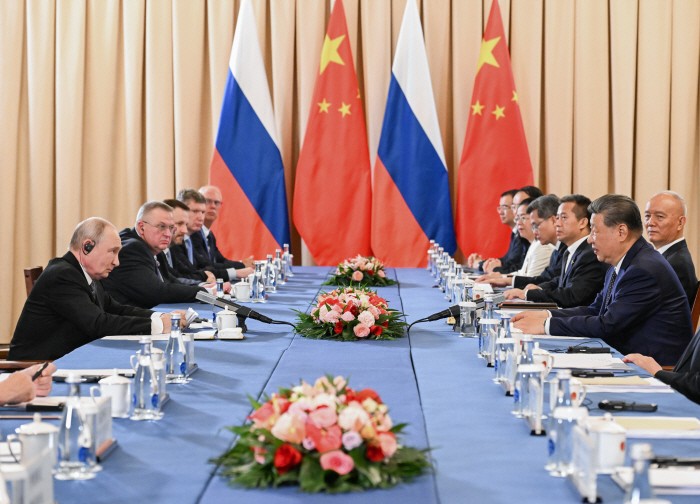 |
| Russian President Vladimir Putin (left) and Chinese President Xi Jinping attend a bilateral meeting on the sidelines of the Shanghai Cooperation Organisation (SCO) summit held in Bishkek, Kyrgyzstan, on August 31 (local time). / AP, Yonhap |
Non-Western leaders, including Russian President Vladimir Putin and Iranian President Masoud Pezeshkian, gathered in Bishkek, the capital of Kyrgyzstan, where the Shanghai Cooperation Organisation (SCO) summit is being held, displaying diplomatic and economic solidarity centered around Chinese President Xi Jinping.
According to reports from foreign media, including the Associated Press, on the 1st (local time), the two-day SCO summit that began the previous day drew leaders of member states, including President Xi, President Putin, Indian Prime Minister Narendra Modi, and President Pezeshkian.
The summit draws keen attention because these leaders convened with China at a time when the U.S. is stepping up economic pressure on Russia and Iran. The Trump administration has consistently warned of potential sanctions not only against Russia and Iran, but also against countries that trade with or economically support them.
However, the scene of the leaders gathered in Bishkek revealed a reality divergent from U.S. isolation pressure. The New York Times (NYT) analyzed that while President Trump is attempting to pull the world into Washington's orbit of influence, President Xi is also building formidable diplomatic leverage centered around himself. The NYT assessed the dynamic by noting that while President Trump wants to make the world revolve around Washington, Xi Jinping has a powerful orbit of his own. The summit, where the leaders of Russia and Iran gathered alongside President Xi despite U.S. efforts to internationally isolate both nations, serves as a clear illustration of that "orbit of Xi Jinping."
Underpinning this Chinese influence is its close economic relationship with Russia and Iran. The AP analyzed that amid the ongoing war in Ukraine and prolonged conflict in the Middle East, Russia and Iran are absorbing Western economic pressure through trade and cooperation with China. As the world's largest crude oil importer, China continues to purchase Russian and Iranian crude, securing its own energy security while providing critical export outlets for both countries.
While the U.S. is cognizant of China's role, it has not yet launched full-scale sanctions targeting major Chinese corporations or banks. Although the U.S. recently imposed sanctions on certain entities and oil tankers based in mainland China and Hong Kong in connection with Iran, it has refrained from sweeping sanctions against large-scale Chinese enterprises or financial institutions.
Lee Jeong-eun
Most Read
-
1
Celltrion nears additional contract with major U.S..

-
2
Putin proposes trilateral U.S.-China-Russia summit..

-
3
U.S. weighs dropping MOAB, world's most powerful n..

-
4
"Aren't those foreigners on welfare?": M..

-
5
Attention centers on APEC for possible Trump-Xi-Pu..

-
6
Saudi Arabia, Iran hold first diplomatic talks to..

-
7
Saudi airport in Riyadh struck again, leaving at l..

PEOPLE






-
Address : In-Young Bldg., 34, Uisadang-daero 1-gil, Yeongdeungpo-gu, Seoul
Copyright by ASIATODAY CO., LTD. All rights resereved