



U.S. Treasury Secretary Bessent publicly warns over Takaichi's economic policy
Sep 03, 2026, 01:27 pm


 |
| U.S. Treasury Secretary Scott Bessent speaks to reporters to the effect that Japan "can take a step back policy-wise" following the Group of 20 (G20) Finance Ministers and Central Bank Governors Meeting held in Asheville, North Carolina, on the 1st. / Yonhap News |
The U.S. has stepped in to publicly hit the brakes on Japanese Prime Minister Sanae Takaichi's expansionary fiscal spending and the Bank of Japan's low-interest-rate policy, assessing that a weakening yen and spiking Japanese government bond yields could disrupt U.S. financial markets. A faster pivot in Japan's monetary and fiscal policy is expected to carry a considerable impact not only on the value of the yen, but also on South Korea's export competitiveness and financial markets.
According to the Yomiuri Shimbun and other media outlets on the 3rd, U.S. Treasury Secretary Scott Bessent spoke to reporters to the effect that Japan "can take a step back policy-wise" following the Group of 20 (G20) Finance Ministers and Central Bank Governors Meeting held in Asheville, North Carolina, on the 1st.
Secretary Bessent specifically referenced Abenomics, which sought to stimulate the economy through massive monetary easing and fiscal spending. While crediting Abenomics with helping Japan escape deflation, he pointed out that it is now time to end reflationary policies.
It is unusual for the U.S. to issue such overt demands regarding Japan's domestic economic policies. Behind the move lie the weakening yen and a steep climb in Japanese government bond yields. Japan's 10-year government bond yield recently surged past 3%, reaching its highest level since 1996. This reflects a convergence of international interest rate increases alongside mounting concerns that large-scale fiscal expenditures under the Takaichi administration could further expand the national debt.
Weakness in the yen has also shown little sign of abating. In July, Japan went so far as to conduct an unusual joint yen-buying intervention alongside the U.S., but market observers continued to point out that currency intervention alone cannot reverse the weakening trend as long as fiscal expansion and low interest rates persist. Secretary Bessent's remarks are interpreted as pressure on the Bank of Japan to raise interest rates further and on the Takaichi administration to pace its fiscal expansion. Reuters reported that market expectations are growing for the Bank of Japan to pursue an additional rate hike at its meeting on the 18th.
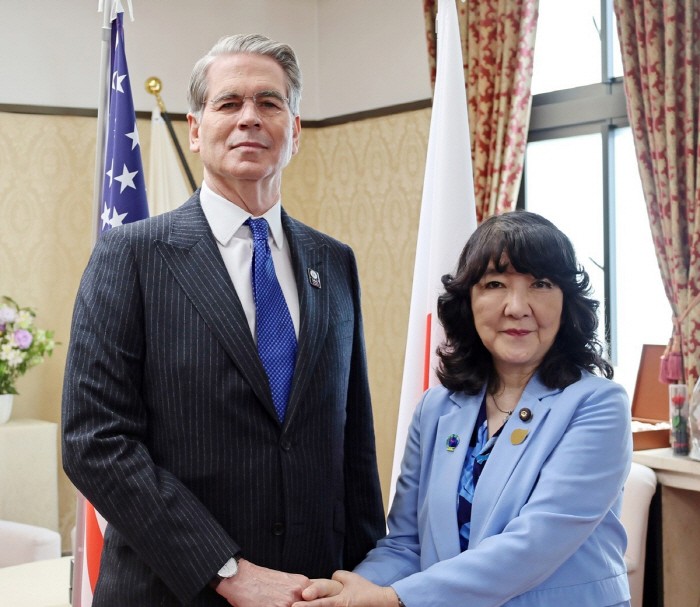 |
| U.S. Treasury Secretary Scott Bessent (left) and Japanese Finance Minister Satsuki Katayama / Yonhap News |
The Bank of Japan's own assessment is not far removed from U.S. demands. In its economic and price outlook released in July, the central bank projected consumer inflation to hit 2.5% for fiscal 2026, outlining a policy direction to continue raising its policy rate and adjusting the degree of monetary easing in accordance with economic and price developments.
During his visit to Japan in May, Secretary Bessent reportedly expressed dissatisfaction to Finance Minister Satsuki Katayama over the Takaichi administration's push for fiscal expansion while simultaneously pressing the Bank of Japan to keep interest rates low, questioning why independence was not being afforded to the BOJ. By raising the issue directly at a G20 press conference rather than behind closed doors, Bessent noticeably dialed up the pressure.
The Japanese government is avoiding a head-on confrontation. Finance Minister Katayama stated that during the U.S.-Japan finance ministers' meeting, she explained the Takaichi administration's policy of reconciling a "strong economy" with fiscal sustainability. Japan's Ministry of Finance also announced that both nations affirmed that an orderly yen market is essential for the stability of global financial markets, including the U.S., and confirmed the need for continued joint action.
South Korea cannot afford to view this merely as Japan's domestic interest rate issue. First, if a BOJ rate hike eases the yen's weakness, it will bolster the price competitiveness of South Korean exporters competing with Japanese firms in global markets across sectors such as automobiles and machinery. Indeed, as Bessent's remarks coincided with expectations of a BOJ rate hike, the yen surged roughly 1% against the U.S. dollar on the 2nd.
Conversely, financial markets warrant caution. Higher Japanese interest rates incentivize Japanese investors to pull funds from overseas bonds in the U.S. and Europe to repatriate capital back home. Japanese investors reportedly registered net sales of approximately 3 trillion yen in foreign bonds from the beginning of the year through August. Capital repatriation from Japan, one of the world's largest holders of foreign assets, could push up global sovereign bond yields—including in the U.S.—and heighten volatility across South Korean bond and equity markets.
Ultimately, what the U.S. is demanding is not a one-off market intervention to defend the yen, but a fundamental pivot in Japan's economic policy. Should the Takaichi administration rein in fiscal expansion and the BOJ accelerate the pace of interest rate normalization, the era of ultra-low interest rates in Japan that dominated global financial markets for over a decade could come to a decisive close. For South Korea, this represents both an opportunity through a relief from yen weakness and a risk factor stemming from a reversal in global capital flows.
Choi Young-jae
Most Read
-
1
Celltrion nears additional contract with major U.S..

-
2
Putin proposes trilateral U.S.-China-Russia summit..

-
3
U.S. weighs dropping MOAB, world's most powerful n..

-
4
"Aren't those foreigners on welfare?": M..

-
5
Attention centers on APEC for possible Trump-Xi-Pu..

-
6
Saudi Arabia, Iran hold first diplomatic talks to..

-
7
Saudi airport in Riyadh struck again, leaving at l..

PEOPLE







-
Address : In-Young Bldg., 34, Uisadang-daero 1-gil, Yeongdeungpo-gu, Seoul
Copyright by ASIATODAY CO., LTD. All rights resereved