



China overhauls National Defense Mobilization Law on massive scale after 16 years
Aug 28, 2026, 05:18 pm


China has launched a sweeping effort to strengthen its defense readiness system, including realigning the roles of the military and local governments, to rapidly convert peacetime industrial, technological, and human resources into defense capabilities in times of crisis.
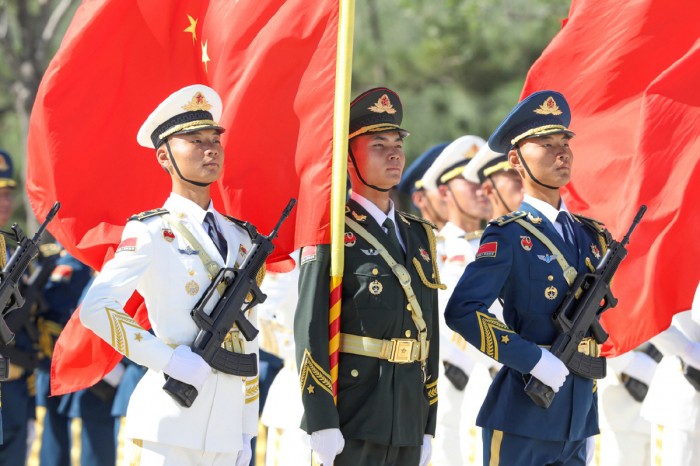 |
| China's People's Liberation Army is expected to see parts of its role adjusted under the National Defense Mobilization Law, which is undergoing a major overhaul after 16 years. / Xinhua |
According to a report on the 18th by state-run Xinhua News Agency, the Standing Committee of China's National People's Congress (NPC) held a meeting the previous day at the Great Hall of the People in Beijing, presided over by Standing Committee Chairman Zhao Leji, to deliberate on draft revisions to the National Defense Mobilization Law.
The draft revision first defines the concept of national defense mobilization in law for the first time. It is defined as "the state taking necessary measures in accordance with the law to respond to situations where the state's sovereignty, unity, territorial integrity, security, and development interests are threatened, ensuring a rapid transition between peacetime and wartime, and converting economic and social capabilities into national defense capabilities."
This clearly establishes that industrial production capacity, transportation assets, technology, and manpower maintained during peacetime can be utilized militarily in times of crisis.
In addition, the revision includes the provision that "national defense mobilization adheres to the leadership of the Communist Party of China and implements the holistic national security concept and military strategies for a new era based on General Secretary and President Xi Jinping's thought on strengthening the military."
The draft revision also introduces a new clause to "promote the application of advanced technologies in the field of national defense mobilization and develop mobilization capabilities in emerging domains." While specific sectors were not outlined, given recent developments, it is highly likely that artificial intelligence (AI), unmanned aerial vehicles, robotics, and satellite communication technologies will be fully integrated into the national defense mobilization system going forward.
The authorities also streamlined the powers and responsibilities between the military and local governments. For instance, local governments at or above the county level and military organs will handle mobilization duties according to their respective responsibilities, while national and local defense mobilization commissions will oversee organization, leadership, and coordination functions.
According to sources, China has pushed for reforms to its defense mobilization system since 2019. Beginning in 2022, it sequentially established national defense mobilization offices across provinces, cities, and counties. It is natural that analysts view this legislative revision as formalizing in law the organizational restructuring and role adjustments between the military and local governments that have taken place over several years following broader military reforms.
Hong Soon-do
Most Read
-
1
Celltrion nears additional contract with major U.S..

-
2
Putin proposes trilateral U.S.-China-Russia summit..

-
3
U.S. weighs dropping MOAB, world's most powerful n..

-
4
"Aren't those foreigners on welfare?": M..

-
5
Attention centers on APEC for possible Trump-Xi-Pu..

-
6
Saudi Arabia, Iran hold first diplomatic talks to..

-
7
China tightens grip on boosting domestic demand an..

PEOPLE







-
Address : In-Young Bldg., 34, Uisadang-daero 1-gil, Yeongdeungpo-gu, Seoul
Copyright by ASIATODAY CO., LTD. All rights resereved