



Questions linger over effectiveness of youth social media curbs despite talks with tech giants
Sep 15, 2026, 09:33 am


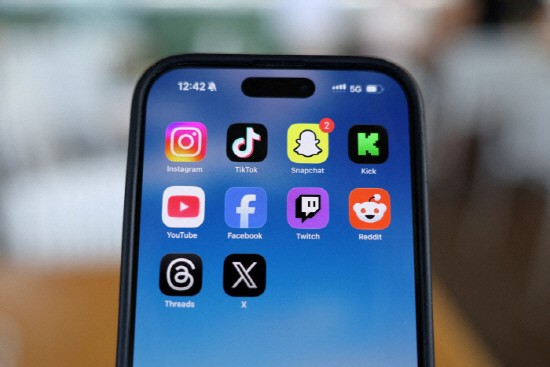 |
| Social media applications including Instagram, TikTok, Snapchat, YouTube, and Facebook are seen on a smartphone screen. / Reuters, Yonhap |
While the government is pushing forward with measures to restrict youth sign-ups and usage of social networking services (SNS), doubts continue to be raised regarding the regulatory effectiveness. This is because relying solely on restrictions such as age thresholds and screen time limits can leave loopholes, including circumvented registrations. Observers stress the need to either hold platforms more strictly accountable for identity verification or fundamentally cultivate youth digital literacy.
According to the Broadcasting, Media and Communications Commission on the 14th, the commission has been reviewing phased regulations based on age brackets since July to prevent SNS overdependence among youth. Specifically, the plan under review seeks to ban SNS use for children under 14 and restrict algorithm exposure for youths under 19.
This aligns with an international regulatory shift. Australia enacted an Online Safety Act on December 10 last year that blocks users under 16 from 10 platforms, including Facebook and Instagram. In France, legislation banning SNS use for minors under 15 passed early this year. In the U.S., regulatory discussions gained fresh momentum after Meta, the operator of Facebook and Instagram, agreed on the 26th of last month to pay 25 trillion won across 48 state governments and cap usage time for users under 18.
In particular, the agreement between Meta and U.S. state governments is expected to influence South Korea's legislative process. Meta demonstrated its willingness to consult with the South Korean government by unveiling its youth protection policies at Meta Korea's headquarters in Gangnam-gu, Seoul, on the 10th. Announcing a protection mode automatically applied to users between the ages of 14 and 18, Meta stated that its goal is to expand the rollout to countries including South Korea by the 18th of this month.
However, questions are being raised about practical age-verification methods under the age-based restrictions currently being discussed. In Australia, where regulations have already been implemented, cases have been reported where systems misjudged user ages or individuals bypassed restrictions using third-party identification. This stems from the fact that mandates compelling platforms to adopt specific age-verification technologies have not yet taken effect.
Verifying actual ages is expected to serve as a critical challenge in South Korea as well. If the system relies entirely on individual companies' self-authentication mechanisms, regulatory loopholes emerge where users can register as adults simply by entering someone else's mobile phone number or date of birth on certain platforms.
Experts argue that the government must demand technical safeguards directly from the platforms. Others maintain that for fundamental youth protection, the broader social environment must shift toward preventing SNS addiction.
Park Il-jun, president of the Digital Literacy Association, stated at a Meta Korea roundtable on the 10th that youth protection should not be left entirely to corporations or limited strictly to screen time curbs, adding that equipping teachers and parents with the literacy to protect youth online must take priority.
Kim Hong-chan
Most Read
-
1
Alteogen secures European patent for Keytruda SC,..

-
2
Trump shares map on social media labeling Strait o..

-
3
Celltrion seeks rheumatoid arthritis indication ex..

-
4
Kia Sportage outperforms Mazda CX-5 in German auto..

-
5
Chinese e-commerce giants AliExpress, Temu and She..

-
6
U.S. deploys carrier, 10,000 more troops to Middle..

-
7
Trump rejects Iran's offer to open Strait of Hormu..

PEOPLE







-
Address : In-Young Bldg., 34, Uisadang-daero 1-gil, Yeongdeungpo-gu, Seoul
Copyright by ASIATODAY CO., LTD. All rights resereved