



Prolonged Saudi pipeline shutdown could cut global oil supply by 4%, Reuters reports
Sep 14, 2026, 04:38 pm


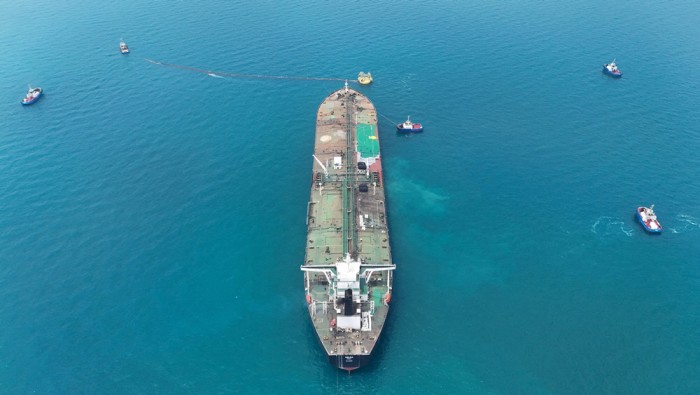 |
| The oil tanker Helga, the second tanker to dock since the Strait of Hormuz was blocked on April 24 local time, is anchored at an offshore oil terminal near Basra in southern Iraq as it prepares to load crude. / Reuters-Yonhap |
Saudi Arabia could run out of crude available for export and global oil supply could fall by as much as about 4% unless it restarts a key pipeline to the Red Sea within days, Reuters reported on Sept. 13 local time, citing Saudi crude buyers and traders.
Any further decline in Saudi crude supply is expected to worsen an already severe global shortage.
Insufficient oil supplies have recently pushed international fuel prices to record highs, accelerated inflation worldwide and driven U.S. Treasury yields to their highest levels since the 2008 financial crisis.
Saudi Arabia shut down its East-West Pipeline after a drone attack on Sept. 11 but has not disclosed details including the extent of the damage or when operations will resume.
Estimates for repairs vary. One source told Reuters that repairs could take five to six weeks, while another said the pipeline could be restored sooner and that some sections might resume operations while repairs are underway.
Saudi Arabia has relied on the pipeline crossing the Arabian Peninsula over the past six months to offset the economic impact of the closure of the Strait of Hormuz.
The world’s largest crude exporter has been transporting around 4 million barrels a day through the pipeline to the Red Sea port of Yanbu, equivalent to about 4% of global supply.
Three sources said that with the pipeline now shut, crude inventories at Yanbu amount to only about five to seven days of normal exports.
Industry estimates put crude storage capacity at Yanbu at around 35 million barrels. Sources said the storage facilities and related infrastructure were not full, meaning inventories could be exhausted unless the East-West Pipeline resumes operations.
Exports have become even more difficult as Yemen’s Houthi rebels, who have threatened Saudi oil shipments, expanded their control around the Bab el-Mandeb Strait at the entrance to the Red Sea.
The International Energy Agency said on Sept. 11 that Saudi crude supply had already fallen last month to its lowest level in more than 30 years, reflecting reduced shipments through both the Strait of Hormuz and the Red Sea.
The IEA expects global oil supply this year to fall by 5.7 million barrels a day from a year earlier, or about 6%.
Kim Hyun-min
Most Read
-
1
U.S. Treasury Secretary Bessent publicly warns ove..

-
2
Celltrion’s Omlyclo gains ground in major European..

-
3
Hyundai Motor Group breaks ground on integrated st..

-
4
Russia faces warning signs over prolonged war econ..

-
5
Anti-Western solidarity strengthens amid Trump's e..

-
6
U.S. strikes 3 Iranian oil tankers, Iran vows reta..

-
7
S. Korea seeks redemption from World Cup setback w..

PEOPLE







-
Address : In-Young Bldg., 34, Uisadang-daero 1-gil, Yeongdeungpo-gu, Seoul
Copyright by ASIATODAY CO., LTD. All rights resereved