



Xi Jinping proposes expanding AI cooperation to BRICS
Sep 14, 2026, 10:09 am


Chinese President Xi Jinping, general secretary of the Chinese Communist Party, proposed establishing an open-source artificial intelligence (AI) community and expanding cooperation in developing and applying large language models (LLMs) across BRICS member states (Brazil, Russia, India, China, and South Africa).
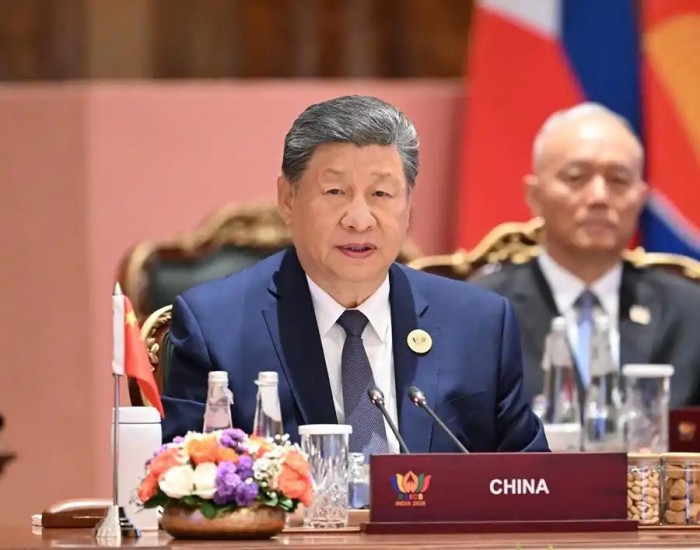 |
| Chinese President Xi Jinping, general secretary of the Chinese Communist Party, delivers a speech at the first session of the 18th BRICS Summit held in New Delhi, India, on the 12th local time, proposing expanded cooperation in artificial intelligence (AI). / Xinhua News Agency |
According to a report on the 13th by China's state-run Xinhua News Agency, President Xi voiced this stance during his speech at the second session of the 18th BRICS Summit held in New Delhi, India, that morning. Xi put AI at the top of his list as he proposed five initiatives to bolster cooperation within BRICS.
He also proposed an "AI Open-Source Universal Benefit Initiative" to open up AI technology and share its benefits broadly, stating, "China will take the lead in building a BRICS open-source AI community." He added, "We will support cooperation in LLM development and applications, and conduct specialized AI training and education to foster an open AI ecosystem."
Xi also highlighted the establishment of international norms for AI, emphasizing, "We must put people at the center and ensure that AI develops in a direction that benefits society and humanity. We need to promptly shape a global AI governance framework based on broad consensus." In addition, he maintained that "emerging technologies should contribute to common prosperity."
He proposed expanding cooperation in digital industries and smart manufacturing as well. Specifically, he outlined plans for China to drive the creation of a BRICS digital industry cloud platform while supporting member nations in building smart factories and establishing related standards. Furthermore, Xi stressed that nations of the Global South—largely emerging and developing countries across Asia, Africa, and Latin America—must uphold multilateralism and steer World Trade Organization (WTO) reform in the right direction.
Xi wrapped up his two-day itinerary for the BRICS summit following the second session and departed New Delhi to return home. Upon his return, he is expected to fully focus on preparations for his bilateral summit with President Donald Trump scheduled for the 24th local time in Washington, D.C.
Xi's visit to India was his first in seven years since 2019. On the previous day, he held a bilateral summit with Indian Prime Minister Narendra Modi to discuss ways to improve bilateral ties, including border stability and the expansion of economic and trade cooperation. However, more concrete details have not been made public, suggesting that relations between the two nations may still remain uneasy.
Hong Soon-do
Most Read
-
1
U.S. Treasury Secretary Bessent publicly warns ove..

-
2
Celltrion’s Omlyclo gains ground in major European..

-
3
U.S. strikes Iran after a month, hits IRGC rocket..

-
4
Hyundai Motor Group breaks ground on integrated st..

-
5
Russia faces warning signs over prolonged war econ..

-
6
Anti-Western solidarity strengthens amid Trump's e..

-
7
U.S. strikes 3 Iranian oil tankers, Iran vows reta..

PEOPLE







-
Address : In-Young Bldg., 34, Uisadang-daero 1-gil, Yeongdeungpo-gu, Seoul
Copyright by ASIATODAY CO., LTD. All rights resereved