



Canada seeks EU associate membership as it distances itself from U.S.
Sep 14, 2026, 10:11 am


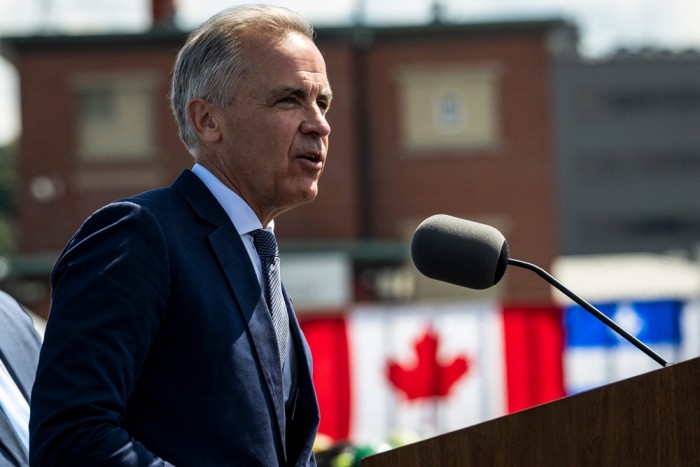 |
| Canadian Prime Minister Mark Carney speaks regarding trade disputes with the U.S. at the Davie shipyard in Lévis, Quebec, Canada, on the 24th of last month local time. / AFP, Yonhap |
Canada, amid ongoing trade friction with the U.S., is reportedly moving to forge quasi-full-member ties with the European Union to diversify away from its dependence.
Canadian Prime Minister Mark Carney has spent months quietly discussing ways to integrate more closely with the 27-member EU bloc, reaching out not only to leaders of France, Italy, Germany, and Nordic nations, but also to lesser-known European royal figures, The Wall Street Journal reported on the 12th local time.
Prime Minister Carney is pursuing a new alignment with Europe to offset the economic fallout that could stem from a severing of trade ties with the U.S.
According to people familiar with the matter, Carney dispatched special envoys to Europe with instructions to explore the most ambitious cooperation arrangements possible, short of formally joining the EU as a full member or entering its single market.
He told aides that he intended to reshape the trajectory of an economy and society that had been dominated by the U.S. for half a century, and has reportedly set up working-level task forces to flesh out the details.
Carney also floated to European leaders the idea of granting Canada the status of an EU associate member.
Officials on both sides noted that the EU, which has historically maintained strict membership requirements, reacted receptively to the concept.
Following months of talks, Canada is exploring ways to informally plug into Europe's 21 trillion dollar single market across strategic supply chains, including energy, artificial intelligence, critical minerals needed for batteries and semiconductors, and most pressingly, defense.
Two officials said discussions with France also touched on arrangements that would allow Canadians to live and work in Europe without visas. Carney is known to confer frequently with French President Emmanuel Macron.
A deeper tilt toward Europe faces several potential hurdles. While Carney's approval ratings remain relatively high, his political standing could erode once ordinary Canadians start feeling the practical impact of pivoting toward the EU.
The Canadian government, already grappling with separatist sentiment in Alberta and Quebec, could encounter domestic backlash if it appears to be ceding aspects of national sovereignty to align with the EU.
Countries trading freely with the EU typically bear burdens such as contributing to the EU budget, accepting EU workers, and adhering to EU regulations.
Moreover, Europe, whose economic growth runs at roughly half the pace of the U.S., is unlikely to easily replace the trade volumes that flourished between the U.S. and Canada under the North American Free Trade Agreement.
A U.S. government official remarked that with the U.S. scaling back its role as the ultimate destination for global demand, it remains unclear whether Canada or the EU is equipped to step into that role by absorbing each other's output.
Kim Hyun-min
Most Read
-
1
U.S. Treasury Secretary Bessent publicly warns ove..

-
2
Celltrion’s Omlyclo gains ground in major European..

-
3
U.S. strikes Iran after a month, hits IRGC rocket..

-
4
Hyundai Motor Group breaks ground on integrated st..

-
5
Russia faces warning signs over prolonged war econ..

-
6
Anti-Western solidarity strengthens amid Trump's e..

-
7
U.S. strikes 3 Iranian oil tankers, Iran vows reta..

PEOPLE







-
Address : In-Young Bldg., 34, Uisadang-daero 1-gil, Yeongdeungpo-gu, Seoul
Copyright by ASIATODAY CO., LTD. All rights resereved