



S. Korea wins final victory in 260 billion won ISDS case against Chinese investor
Sep 14, 2026, 09:26 am


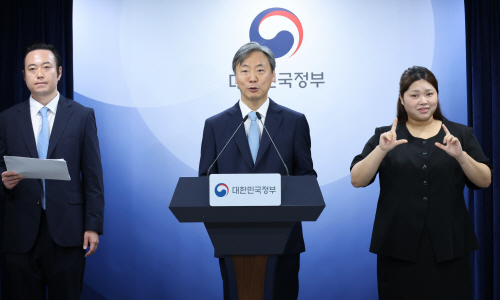 |
| Kang Jun-ha, Director General for International Legal Affairs at the Ministry of Justice, explains that the South Korean government won the investor-state dispute settlement (ISDS) suit filed by a Chinese investor against the Seoul government, at the Government Complex Seoul in Jongno-gu, Seoul, on the 13th. / Yonhap News |
A ruling confirming that the South Korean government bears no compensation liability has been finalized in an investor-state dispute settlement (ISDS) suit of around 260 billion won filed by a Chinese investor against the Seoul government.
The Ministry of Justice announced on the 13th that an annulment committee at the International Centre for Settlement of Investment Disputes (ICSID) dismissed all applications for annulment of the arbitral award filed by Ping-Chuan Min at around 5:25 a.m. on the 12th. The annulment committee also ordered Min to pay the South Korean government approximately 1.51283 billion won in legal costs for the annulment proceedings, along with interest.
While pursuing a project to acquire and develop the Huapu Building in Beijing, China, Min established Pi Korea domestically in 2007 and raised 380 billion won in acquisition funds through a project financing (PF) loan from Woori Bank.
When Min failed to repay the loan, the bank sold the company shares it held as collateral. Min filed a civil lawsuit but ultimately lost before the Supreme Court in July 2017. Min was also indicted on charges of promising or providing money, valuables, and personal gains to bank officials during the loan process, and a guilty verdict was finalized in March of the same year.
Taking issue with the bank's stock sale as well as the civil and criminal trials, Min filed an ISDS claim in 2020. In May 2024, the original arbitral tribunal accepted the government's argument that Min's establishment of the company and acquisition of shares constituted an illegal investment not protected under the treaty, dismissed all claims, and ordered Min to pay the South Korean government approximately 4.9 billion won in legal costs plus interest.
Min filed an application for annulment in September of that year, but the annulment committee once again ruled in favor of the South Korean government. ICSID annulment proceedings do not constitute an appeal to rehear findings of fact or legal judgments; an award can be annulled only on limited grounds, such as a manifest excess of powers by the tribunal or a serious departure from a fundamental rule of procedure.
The Ministry of Justice stated, "This decision reaffirms the principle that investments illegal under domestic law are not protected under ISDS." The ministry added, "We will do our utmost to recover legal costs and disclose the annulment decision and related documents to the maximum extent possible through consultations with the claimant."
Meanwhile, aside from this case, the government also prevailed in annulment proceedings in international investment disputes with Lone Star and Elliott. In November last year, the portion of the arbitral award recognizing the government's compensation liability in the Lone Star case was annulled, extinguishing a compensation obligation of around 400 billion won. In February, a compensation obligation of around 160 billion won was extinguished in the Elliott case concerning the merger of Samsung C&T and Cheil Industries.
Son Seung-hyun
Most Read
-
1
U.S. Treasury Secretary Bessent publicly warns ove..

-
2
Celltrion’s Omlyclo gains ground in major European..

-
3
Hyundai Motor Group breaks ground on integrated st..

-
4
Russia faces warning signs over prolonged war econ..

-
5
Anti-Western solidarity strengthens amid Trump's e..

-
6
U.S. strikes 3 Iranian oil tankers, Iran vows reta..

-
7
S. Korea seeks redemption from World Cup setback w..

PEOPLE







-
Address : In-Young Bldg., 34, Uisadang-daero 1-gil, Yeongdeungpo-gu, Seoul
Copyright by ASIATODAY CO., LTD. All rights resereved