



Lee weighs public address before Chuseok amid personnel and troop dispatch dilemmas
Sep 14, 2026, 09:12 am


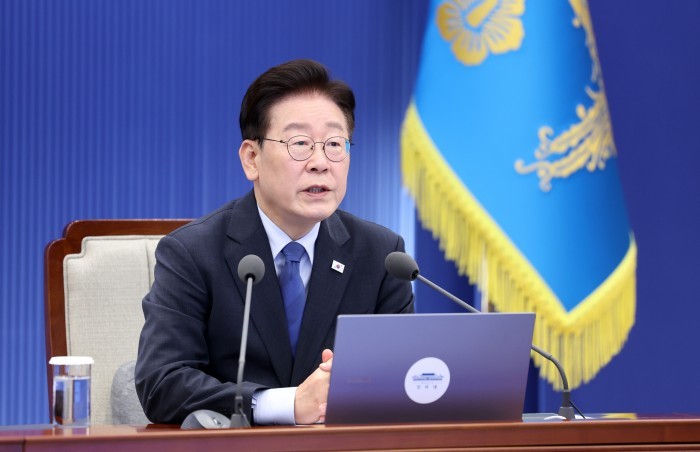 |
| President Lee Jae-myung / Yonhap |
Although President Lee Jae-myung moved past a critical juncture in the personnel controversy following the voluntary withdrawal of Yong Hye-in, the nominee for Minister of Gender Equality and Family, state affairs burdens persist. The confirmation hearing for Justice Minister nominee Kim Seung-won and the issue of contributing to the Strait of Hormuz remain unresolved, while his approval rating has dipped to the lowest level since taking office. Cheong Wa Dae plans to regain momentum in state affairs through President Lee's characteristic direct communication.
According to political circles on the 13th, while the immediate fire was extinguished with Yong's withdrawal, embers of controversy surrounding appointments remain. Various allegations continue to swirl around nominees such as Kim Seung-won, whose confirmation hearing is scheduled for the 15th.
The appointment controversies in particular are weighing on President Lee's approval ratings. In a poll conducted by Gallup Korea from the 8th to the 10th of 1,000 adults nationwide, the positive evaluation of President Lee's job performance dropped 2 percentage points from the previous survey to 38 percent, marking the lowest figure since his inauguration.
On top of this, contributing to the Strait of Hormuz stands as a major foreign policy and security issue President Lee must resolve. While appointment controversies concern the fate of individual nominees, deciding whether to dispatch troops is a high-level equation intricately entangling domestic public opinion with diplomatic and security interests.
As key issues such as U.S. investment and semiconductor tariff negotiations are intertwined with the U.S., it is difficult to dismiss calls for contributions from the international community. Still, the government must weigh the justification and practical gains of military involvement alongside relations with Iran. The fact that opposition to troop deployment to Hormuz stood at 55 percent—substantially higher than support at 32 percent in the same poll—also adds to the burden. Amid these circumstances, Cheong Wa Dae is considering arranging a platform where President Lee can directly address key pending issues ahead of Chuseok. The timing is widely seen as likely following his summit diplomacy schedule, including the Korea-Central Asia Summit on the 14th to 16th.
President Lee is expected to state his stance on major pending issues, including cabinet appointments, contributions to the Strait of Hormuz, and constitutional amendments, through an open forum or press conference. Cheong Wa Dae is known to have been evaluating direct communication formats for the president since early last week.
With his approval rating falling to post-inauguration lows, President Lee is expected to seek a turnaround by personally explaining the context behind policy decisions and appealing for public understanding.
Park Young-hoon
Most Read
-
1
Celltrion’s Omlyclo gains ground in major European..

-
2
Trump demands rates fall below 1% as Fed hikes for..

-
3
Hyundai Motor Group breaks ground on integrated st..

-
4
U.S. strikes 3 Iranian oil tankers, Iran vows reta..

-
5
Trump makes $1 trillion bet ahead of midterm elect..

-
6
Iran resumes ballistic missile production, assembl..

-
7
Samsung Electronics, Mistral AI to jointly develop..

PEOPLE






-
Address : In-Young Bldg., 34, Uisadang-daero 1-gil, Yeongdeungpo-gu, Seoul
Copyright by ASIATODAY CO., LTD. All rights resereved