



[Exclusive] 690 cases under investigation for over a year, but police make no effort to track delays
Sep 11, 2026, 09:26 am


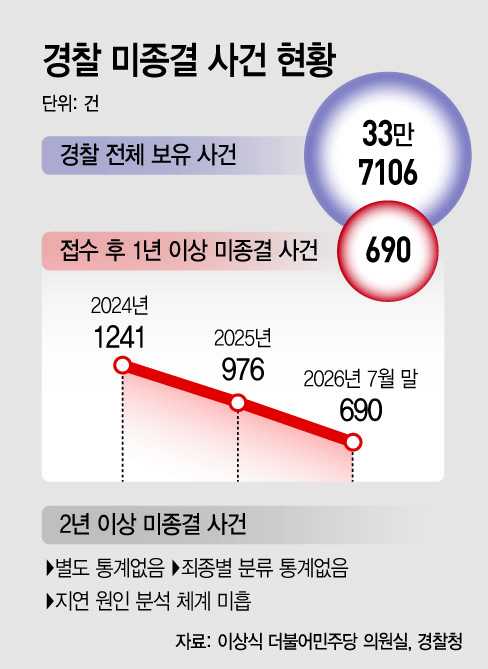 |
More than 1,000 police investigations remain unresolved for over a year each year, but detailed statistics needed to manage long-running cases remain insufficient. Police track only the number of cases that have been open for at least one year and do not separately compile data on investigations lasting more than two years. As a result, it is difficult to determine which types of crimes take the longest to investigate or why certain investigations become prolonged.
According to National Police Agency data obtained through the office of Democratic Party lawmaker Lee Sang-sik, a member of the National Assembly’s Public Administration and Security Committee, police nationwide were handling 337,106 investigative cases as of the end of July this year. Of those, 6,842 had been open for at least six months but less than one year, while 690 had remained unresolved for more than a year. The figures were calculated based on month-end case holdings recorded in the Korea Information System of Criminal Justice Services (KICS).
The number of unresolved cases lasting more than a year fell from 1,241 at the end of 2024 to 976 at the end of 2025 and to 690 at the end of July this year, a 44.4% decline from the end of 2024. Cases lasting between six months and one year also fell from 12,903 to 6,842 over the same period. The average number of cases held per investigator declined from 16.3 in 2024 and 16.5 in 2025 to 14.4 as of the end of July this year. However, direct year-on-year comparisons should be made with caution because the 2024 and 2025 figures are year-end data, while this year’s figure is from the end of July.
Regional disparities were significant. Of the 690 unresolved cases lasting more than a year, 583, or 84.5%, were under the jurisdiction of the Seoul Metropolitan Police Agency. Seoul police were handling 77,730 cases in total, or about 23.1% of all cases nationwide, meaning long-running investigations were disproportionately concentrated in the capital. The Gyeonggi Nambu Provincial Police Agency had 38 such cases, followed by Busan with 12, Gangwon with eight and South Gyeongsang with seven. Ulsan had none.
There were also wide differences among police stations in Seoul. Mapo Police Station had the largest number, at 74, followed by Gangnam with 71, Jungnang with 61, Yeongdeungpo with 47 and Songpa with 39. Notably, the number at Jungnang rose by 57 from four at the end of 2025 to 61 at the end of July this year. By contrast, Gwanak Police Station saw the number fall by 100, from 118 to 18 over the same period.
The longer an investigation drags on, the greater the burden on those involved. Victims may have to wait for investigative results before pursuing follow-up measures such as damages claims and recovery, while suspects remain in prolonged uncertainty over their legal status. As time passes, witnesses’ memories may fade and relevant evidence may become harder to secure, making the investigation itself more difficult.
Police, however, do not maintain sufficiently detailed statistics to examine long-running investigations closely. Cases lasting more than two years are not separately counted, nor are figures managed by offense type, such as fraud, or by how the case was initiated, such as complaints or accusations. This makes it difficult to identify which kinds of cases are most affected by investigative delays.
Experts say police need to move beyond simply counting total cases and break down statistics by investigation length, offense type and case intake category. In particular, as police assume greater investigative responsibility, they should separately track cases lasting more than two years and establish a system for analyzing the causes of delays.
“Long-unresolved cases should not simply be counted. Police need to examine in detail why cases become prolonged,” said Lee Kun-soo, a professor in the Department of Police Administration at Baekseok University. “They should classify and manage the reasons for delays, such as cases in which a suspect is overseas, multiple cases are intertwined or an investigation is still underway.”
“As the investigative role and responsibility of the police have expanded, there is also a need for clearer statistics and a more systematic management framework for long-unresolved cases,” he added.
Seol So-young
Most Read
-
1
Celltrion’s Omlyclo gains ground in major European..

-
2
Trump demands rates fall below 1% as Fed hikes for..

-
3
Hyundai Motor Group breaks ground on integrated st..

-
4
U.S. strikes 3 Iranian oil tankers, Iran vows reta..

-
5
Trump makes $1 trillion bet ahead of midterm elect..

-
6
Iran resumes ballistic missile production, assembl..

-
7
Samsung Electronics, Mistral AI to jointly develop..

PEOPLE







-
Address : In-Young Bldg., 34, Uisadang-daero 1-gil, Yeongdeungpo-gu, Seoul
Copyright by ASIATODAY CO., LTD. All rights resereved