



Presidential office downplays Hormuz deployment, but weighs P-8, technical support options
Sep 11, 2026, 09:20 am


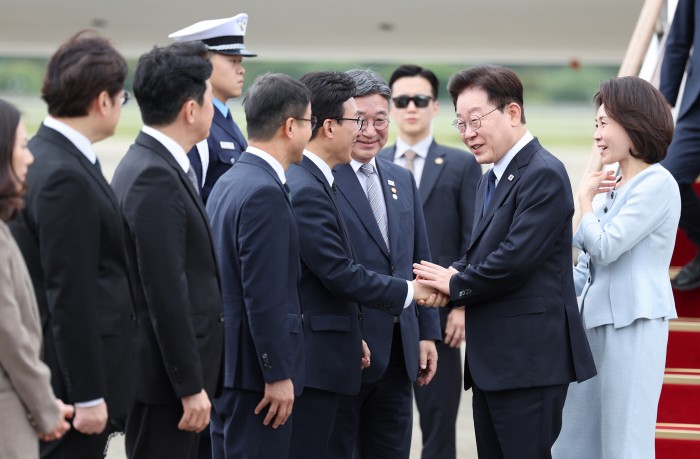 |
| President Lee Jae-myung greets Democratic Party leader Kim Min-seok at Seoul Air Base in Seongnam, Gyeonggi Province, on Sept. 10 after returning from a state visit to France. / Yonhap |
President Lee Jae-myung’s return on Sept. 10 from a state visit to France is expected to accelerate deliberations over how South Korea should contribute to security in the Strait of Hormuz.
The presidential office has drawn a line under speculation about a troop deployment, saying that “nothing has been decided.” However, signs of working-level reviews have emerged, including the return of a Defense Ministry assessment team, possible participation linked to the Maritime Freedom Coalition (MFC), and options involving P-8 maritime patrol aircraft and explosive ordnance disposal (EOD) personnel. Attention is now focused on Lee’s final decision, which the government says will be based on the national interest and public consensus.
There is also speculation that a decision may be approaching, with the presidential office reportedly considering convening a standing committee meeting of the National Security Council (NSC) as early as Sept. 17 to begin full-scale discussions on whether to deploy forces.
According to the presidential office, the government is reviewing whether and how to respond to international requests for contributions to stabilizing the Strait of Hormuz. It says various options remain open, including not only a troop deployment but also technical support, although no specific plan has yet been finalized.
A Defense Ministry assessment team returned home on Sept. 10 after being dispatched to the United Arab Emirates to examine conditions for a possible South Korean contribution in the Strait of Hormuz. Its findings are expected to be reviewed during future NSC discussions.
The government is considering both participation linked to the US-led MFC and joining a multinational cooperation framework led by France and Britain.
As it reviews the form and scale of any contribution, the government is also weighing relations with the United States, Iran and other relevant countries. Washington has called on allies, including South Korea, to expand their role in ensuring safe navigation through the Strait of Hormuz.
Iran, meanwhile, has publicly warned South Korea against possible military involvement. Depending on the level of participation Seoul chooses, the decision could affect both Korea-US coordination and relations with Tehran.
The domestic procedures required would also vary depending on the type of contribution. If the government opts to deploy military personnel, National Assembly approval would be required, potentially triggering political debate over the size, mission and duration of the deployment.
The presidential office has also said it will take public opinion into account. Its repeated emphasis on the “national interest and public consensus” as key criteria for any decision reflects that position.
During the final leg of his France trip, Lee met Mathias Cormann, secretary-general of the Organisation for Economic Co-operation and Development, and said, “I am concerned that intensifying confrontation between countries is increasingly likely to escalate into war.”
With both freedom of navigation and energy security at stake in the Strait of Hormuz, while military tensions remain high, such concerns are expected to factor into the government’s decision on the form and scale of South Korea’s contribution.
Meanwhile, the presidential office is reportedly considering holding a press conference for Lee as early as next week. If held, Lee is expected to address the Hormuz issue directly along with domestic matters such as constitutional revision.
Park Young-hoon
Most Read
-
1
Celltrion’s Omlyclo gains ground in major European..

-
2
Trump demands rates fall below 1% as Fed hikes for..

-
3
Hyundai Motor Group breaks ground on integrated st..

-
4
U.S. strikes 3 Iranian oil tankers, Iran vows reta..

-
5
Trump makes $1 trillion bet ahead of midterm elect..

-
6
Iran resumes ballistic missile production, assembl..

-
7
Samsung Electronics, Mistral AI to jointly develop..

PEOPLE







-
Address : In-Young Bldg., 34, Uisadang-daero 1-gil, Yeongdeungpo-gu, Seoul
Copyright by ASIATODAY CO., LTD. All rights resereved