



[Exclusive] Economic crime investigators up 56%, but caseload per officer jumps from 18 to 29
Sep 10, 2026, 09:40 am


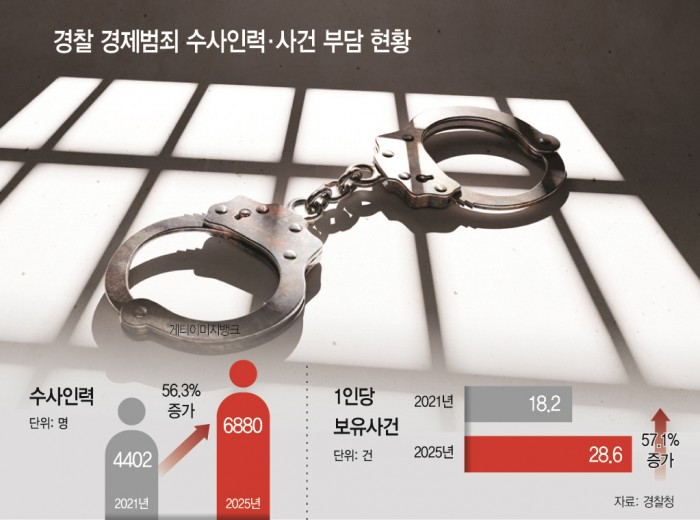 |
Although police expanded economic crime investigative personnel by 56 percent over the past five years, the caseload handled simultaneously by frontline investigators actually increased by 57 percent. Despite a substantial increase in investigative personnel to counter economic crimes that require expertise, the caseload burden in the field has grown heavier than five years ago due to rising investigative demand and an expanded scope of assigned cases.
According to the National Police Agency on the 9th, investigative personnel on integrated economic investigation teams numbered 4,402 in 2021. Following pilot operations in 2022, the police reorganized the units into integrated investigation teams combining economic, intelligence, and cyber functions in 2024 for full-scale implementation. As of 2025, personnel on integrated investigation teams stood at 6,880, up by 2,478 (56.3 percent) from the economic team investigative personnel in 2021.
Although investigative personnel expanded significantly alongside the organizational reorganization, the caseload borne by investigators actually increased. In 2021, the caseload per investigator on integrated economic investigation teams stood at 18.2 cases, but jumped to 28.6 cases in 2025 integrated investigation teams, up by 10.4 cases (57.1 percent).
Police assess that while personnel numbers grew, concurrent growth in investigative demand for economic crimes and various types of fraud contributed to the rise in caseloads per investigator. They also analyzed that the widening scope of cases assigned to investigators—spurred by restructuring from economic-centered teams to integrated investigation teams—served as another contributing factor. The police explained that a combination of personnel increases, expanding investigative demand, and organizational restructuring prevented workforce expansion from directly translating into a reduction in caseload per investigator.
This is why observers point out that a purely quantitative expansion of investigative personnel has limits in reducing case burdens. In particular, integrated investigation teams handle cyber cases such as online fraud in addition to conventional economic crimes. The police introduced integrated investigation teams precisely to respond to blurred boundaries across conventional functional case divisions as crime traverses online and offline realms. At the time of the full-scale rollout of integrated investigation teams in 2024, the police stated they would boost the efficiency of case assignment and investigation by consolidating overlapping crime types between economic and cyber teams.
Along with the volume of cases, the complexity of individual cases also drives investigators' workload. Economic crime investigations require analyzing contracts, bank account transaction records, and registry documents, while cases involving investments and loans necessitate legal determinations to distinguish between civil default and criminal fraud. In cases combined with online fraud or virtual assets, investigators often must track digital evidence alongside fund flows simultaneously.
Consequently, calls are mounting from the field to secure specialized and experienced personnel who can continuously handle economic crimes, beyond simple head-count increases. This entails not only increasing personnel based on case counts, but also assigning investigators tailored to case types and difficulty levels, while fostering conditions that enable experienced investigators to remain in investigative departments over the long term.
A police official working in an investigative department noted, "There is a strong perception that economic teams handle difficult cases with heavy responsibility while facing disadvantages in promotion or compensation," adding, "It is crucial to secure specialized investigators and create conditions for seasoned personnel to serve long term, taking into account not only case volume but also complexity."
The National Police Agency stated, "We recognize the shortage of specialized personnel in economic crime investigations," adding, "We will pursue securing specialized talent, reinforcing training, increasing head counts, securing budgets, and building forensic science infrastructure utilizing advanced technologies."
Seol So-young
Most Read
-
1
U.S. Treasury Secretary Bessent publicly warns ove..

-
2
China overhauls National Defense Mobilization Law..

-
3
U.S. strikes Iran after a month, hits IRGC rocket..

-
4
Hyundai Motor Group breaks ground on integrated st..

-
5
Russia faces warning signs over prolonged war econ..

-
6
CIA director visits Russia, warns Moscow not to at..

-
7
Anti-Western solidarity strengthens amid Trump's e..

PEOPLE






HEADLINE NEWS
- U.S. strikes Iranian tanker again, retaliating for attack on American warships
- Canada enacts retaliatory tariffs up to 50% on U.S., deepening trade confli..
- 'Super El Niño' looms over Latin America, threatening food security and put..
- S. Korea and France sign 16 agreements and MOUs on defense, advanced tech

-
Address : In-Young Bldg., 34, Uisadang-daero 1-gil, Yeongdeungpo-gu, Seoul
Copyright by ASIATODAY CO., LTD. All rights resereved