



Why were so many old apartments 15 stories? How sprinklers shaped building heights
Sep 10, 2026, 09:38 am


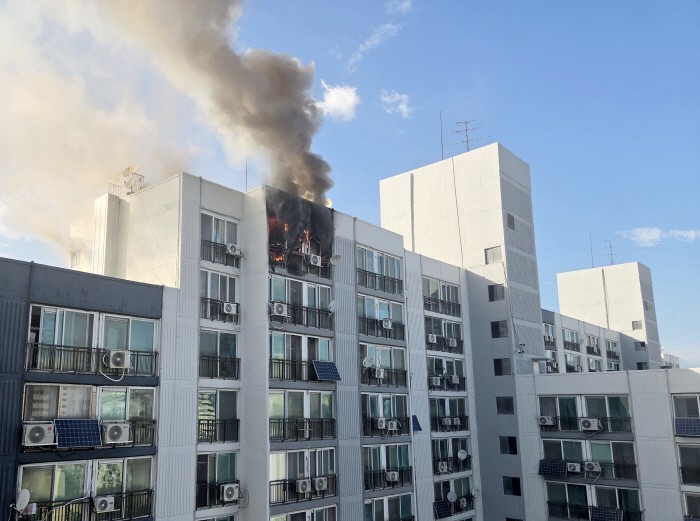 |
| A fire breaks out on the 15th floor of an apartment building in Gayang-dong, Gangseo-gu, Seoul, on Aug. 11. The building, completed in 1992, was not equipped with sprinklers. / Yonhap |
Nearly one out of every two apartments in South Korea has no fire sprinklers installed. In the past, the mandatory sprinkler installation requirement applied only to buildings above a certain number of stories, leaving a significant portion of older apartments built under those earlier standards as fire safety blind spots to this day.
According to the National Fire Agency on the 9th, out of approximately 12 million apartment households in Korea, 6.68 million households lack fire sprinklers. A substantial majority are older apartments constructed when installation criteria were far more lenient than today.
The primary reason behind the stark shortage of sprinklers in older apartments lies in the evolution of regulatory standards. In July 1990, when sprinkler installation requirements were first introduced, the mandate applied only to floors on and above the 16th story in multi-family housing complexes of 16 stories or taller. Apartments of 15 stories or fewer were exempt. Because an apartment needed only to be built one story higher—to 16 stories—to trigger the mandate under that standard, the 15th floor stood as a clear regulatory dividing line.
The standards were gradually tightened over time. From January 2005, sprinklers were mandated for every floor of buildings with 11 stories or more. In January 2015, a fire at an urban lifestyle housing complex in Uijeongbu, Gyeonggi Province, resulted in heavy casualties, leaving five dead and 125 injured. This blaze served as a catalyst for further regulatory tightening. From January 28, 2018, installing sprinklers across all floors of buildings with six or more stories became mandatory, a requirement that remains in effect today.
The core issue is that tightened standards are not applied retroactively to already constructed apartments. Retrofitting fire sprinklers across all existing apartments would require an estimated 57 trillion won.
An official from the National Fire Agency noted: "To install sprinklers in existing apartments, water storage tanks must be newly constructed and plumbing completely relaid. In some cases, residents would also need to vacate their homes during the construction period, making full retroactive retrofitting practically challenging."
To narrow these blind spots, the National Fire Agency is promoting the distribution of automatic diffusion fire extinguishers, which automatically discharge extinguishing agents when reaching a certain temperature. Tests conducted roughly 11 times at the National Fire Academy confirmed their fire suppression effectiveness within spaces roughly the size of a single room. The Seoul Metropolitan Government is currently running a pilot project covering around 38,000 households this year.
An official from the National Fire Agency said: "There are practical constraints to installing new equipment across every existing residence that lacks sprinklers. Since automatic diffusion fire extinguishers can serve as a minimal alternative, we are reviewing ways to expand distribution centered on aging apartments and vulnerable populations after examining the results of the pilot project."
Kim Nam-hyung
Most Read
-
1
U.S. Treasury Secretary Bessent publicly warns ove..

-
2
China overhauls National Defense Mobilization Law..

-
3
U.S. strikes Iran after a month, hits IRGC rocket..

-
4
Hyundai Motor Group breaks ground on integrated st..

-
5
Russia faces warning signs over prolonged war econ..

-
6
Anti-Western solidarity strengthens amid Trump's e..

-
7
U.S. strikes 3 Iranian oil tankers, Iran vows reta..

PEOPLE






HEADLINE NEWS

-
Address : In-Young Bldg., 34, Uisadang-daero 1-gil, Yeongdeungpo-gu, Seoul
Copyright by ASIATODAY CO., LTD. All rights resereved